
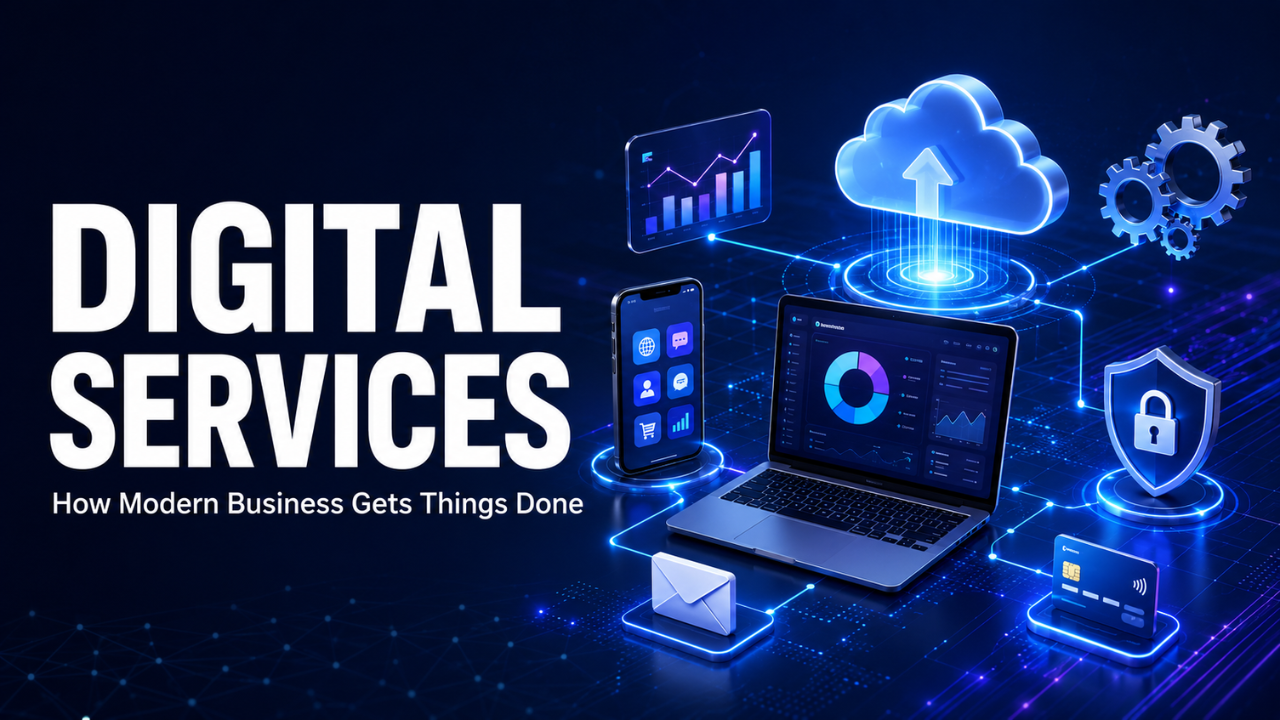
Digital Services: How Modern Business Gets Things Done
A customer books a haircut through an app. A small shop accepts an online payment. A company stores its files in the cloud instead of keeping them on an office computer. These everyday actions have one thing in common: digital services.
Most people use dozens of them without giving the term much thought. They check bank balances, order food, attend video meetings, stream music, and contact customer support online. Behind each simple click, though, there’s a system designed to complete a task, solve a problem, or deliver information.
For businesses, digital services aren’t just convenient extras anymore. They shape how customers find a company, how employees work, and how quickly the business can respond when something changes.
Table of Contents
- What Digital Services Really Mean
- Why Digital Services Have Become Essential
- The Digital Services People Use Every Day
- How Businesses Benefit from Going Digital
- What Makes a Digital Service Feel Good
- Choosing the Right Digital Services
- Cost, Value, and the Hidden Trade-Offs
- Security and Trust Still Matter
- Where Digital Services Are Heading
- Digital Services Should Make Life Simpler
What Digital Services Really Mean
Digital services are services delivered through technology, usually over the internet or through a connected device. Unlike a physical product, they may not be something you can hold. Their value comes from what they allow you to do.
Online banking is a clear example. The bank still exists as a business, but many of its services can now be used without visiting a branch. You can transfer money, pay a bill, download a statement, or freeze a card from your phone.
The same idea applies to cloud storage, streaming platforms, online learning, website hosting, email marketing, digital design, and virtual consultations. Each service provides a practical solution through a digital platform.
Some digital services work almost entirely on their own. A customer selects a plan, pays online, and receives access immediately. Others include human support behind the screen. A graphic designer may communicate through email and deliver the finished work online, but personal skill remains central to the service.
That mix of technology and human effort is important. “Digital” doesn’t always mean automated. It simply means that technology plays a major role in how the service is accessed, managed, or delivered.
Why Digital Services Have Become Essential
Convenience is the obvious reason. People don’t want to wait until Monday morning to perform a task that could take two minutes on Sunday evening.
Imagine a business owner who notices that a website domain is about to expire. With an online dashboard, the renewal can be completed immediately. Without that service, the owner might need to call an office, wait on hold, fill out a form, or risk losing the domain.
Speed matters, but access matters even more. A digital service can often be used from different locations and on multiple devices. That gives people more control over when and how they get things done.
Businesses also face higher customer expectations. Someone who can track a food delivery in real time may wonder why another company can’t even confirm whether an order has shipped. Good digital experiences in one industry quietly raise expectations everywhere else.
Let’s be honest, nobody enjoys chasing basic information. Customers prefer services that give clear answers without making them send three emails or repeat the same details to several people.
The Digital Services People Use Every Day
The range is wider than it first appears. Communication services include email, video calling, instant messaging, and team collaboration platforms. Financial services cover mobile banking, digital wallets, payment gateways, invoicing tools, and accounting software.
Entertainment has also moved heavily into the digital space. Music, films, games, podcasts, and books can all be delivered instantly. People no longer need to own a shelf full of discs or wait for a television schedule.
Then there are business-focused services such as website hosting, search tools, cybersecurity monitoring, customer management systems, cloud backups, and project management platforms. These may be less visible to the public, but they keep modern companies running.
Healthcare offers another familiar example. A patient might book an appointment online, speak with a doctor through a video call, receive a digital prescription, and view test results through a secure portal. The medical care is still personal, yet several parts of the experience are digital.
Education follows a similar path. Recorded lessons, live online classes, learning portals, digital quizzes, and downloadable resources let students study beyond a traditional classroom.
What connects all these services isn’t the industry. It’s the ability to deliver access, support, information, or a completed task through digital technology.
How Businesses Benefit from Going Digital
For a small business, the first benefit is often saved time. Consider a local repair company that handles bookings through phone calls and handwritten notes. One missed message can lead to an empty appointment slot or an unhappy customer.
An online booking service changes that. Customers can see available times, choose a slot, and receive an automatic reminder. The owner spends less time managing calls and more time doing paid work.
Digital services can also reduce repetitive tasks. Invoices can be generated automatically. Stock levels can update after every sale. Customer questions can be collected in one support system instead of being scattered across calls, emails, and social media messages.
Better information is another advantage. A shop owner can see which products sell fastest. A website manager can learn which pages visitors use most. A service company can identify the days when demand is highest.
That doesn’t mean every decision should be controlled by a dashboard. Numbers need context. Still, having reliable information is usually better than relying entirely on memory or guesswork.
Digital systems also make it easier for small companies to serve customers outside their local area. A consultant in one city can work with clients across the country. A teacher can sell a course internationally. A niche store can take orders while its owner sleeps.
What Makes a Digital Service Feel Good
The best digital services often feel almost invisible. You open the app or website, understand what to do, finish the task, and move on.
Clarity plays a big role. Buttons should make sense. Prices should be easy to find. Instructions should sound like normal language, not technical notes written for developers.
Reliability matters just as much. A beautiful payment page is useless if transactions regularly fail. A cloud storage service loses its value when files disappear or syncing becomes unpredictable.
Good services also respect the user’s time. They remember sensible preferences, reduce unnecessary steps, and explain errors clearly. “Payment failed” isn’t very helpful. “Your bank declined the payment; try another card or contact your bank” gives the customer a next step.
Support becomes especially important when something goes wrong. People are usually patient with an occasional problem. They become frustrated when they can’t reach anyone, find an answer, or understand what happened.
A useful digital service doesn’t just work well under perfect conditions. It helps users recover when conditions aren’t perfect.
Choosing the Right Digital Services
More features don’t always mean a better choice. A two-person business may not need the same software used by a company with 500 employees.
Start with the actual problem. If appointments are being missed, look for a dependable booking and reminder service. If files are difficult to share, focus on secure cloud storage. Buying an oversized system before defining the need often creates more work rather than less.
Ease of use deserves serious attention. A tool may look impressive during a demonstration but feel awkward during daily use. If employees avoid it or continue using old methods, the business won’t receive much value from the investment.
Compatibility matters too. A new service should ideally connect with tools the business already uses. For example, an online store may need its payment system, stock records, email platform, and accounting software to exchange information.
It’s also worth checking what happens if you decide to leave. Can you export your customer records, documents, or reports? A service is much less attractive when your own data becomes difficult to retrieve.
Trying a limited plan or short trial can reveal more than a long feature list. Real use quickly exposes confusing menus, missing functions, and unnecessary complications.
Cost, Value, and the Hidden Trade-Offs
Digital services are often sold through monthly or annual subscriptions. The individual price may seem small, but several subscriptions can quietly become a serious expense.
A company might pay for email, storage, design tools, video meetings, website services, bookkeeping, security, and customer support software. Each service appears affordable on its own. Together, they need regular review.
Price alone, however, can be misleading. A booking tool that costs $30 per month may save ten hours of administrative work. In that case, the value could be far greater than the fee.
Free services also come with trade-offs. They may include advertisements, limited storage, fewer security controls, weaker support, or restrictions on exporting data. Sometimes the user effectively pays through personal information or reduced control.
Here’s the thing: the cheapest option is only cheap when it continues to meet the need. Switching systems later can involve moving data, training staff, rebuilding processes, and dealing with interrupted work.
The sensible question isn’t simply, “How much does it cost?” It’s, “What does it save, improve, or make possible?”
Security and Trust Still Matter
Every digital service asks for some level of trust. Users may share names, email addresses, payment details, business documents, health information, or private conversations.
Companies should understand what information a service collects, where it stores that information, and who can access it. Clear privacy settings and strong account controls aren’t optional when sensitive data is involved.
Simple habits make a meaningful difference. Strong, unique passwords reduce risk. Two-step verification adds another layer of protection. Regular backups help when a device fails, an account is compromised, or a file is deleted accidentally.
Providers also need to communicate honestly. If a service suffers an outage or security incident, vague statements can damage trust more than the original problem. People want to know what happened, how they’re affected, and what they should do next.
Trust takes time to build, but a confusing charge, hidden condition, or careless response can weaken it quickly.
Where Digital Services Are Heading
Digital services will continue becoming more connected and more personal. Customers already expect platforms to remember preferences, suggest useful options, and keep information consistent across devices.
More routine tasks will happen automatically. A business system might notice that stock is running low, prepare a new order, and ask the manager for approval. A banking service could identify an unusual payment and request confirmation before processing it.
Still, automation needs limits. People want convenience, but they also want control. A system that makes assumptions without explaining them can feel intrusive rather than helpful.
Human support won’t disappear either. When a problem is unusual, expensive, emotional, or urgent, most people still want to speak with someone who understands the situation.
The strongest services will probably combine both sides: fast digital tools for routine tasks and capable people for moments that require judgment.
Digital Services Should Make Life Simpler
Digital services work best when they remove effort without removing control. They can save time, improve access, support better decisions, and help even a small business reach customers far beyond its physical location.
But technology isn’t valuable simply because it’s new or impressive. A service earns its place when it solves a real problem reliably, protects the user’s information, and feels straightforward to use.
That’s the practical takeaway. Choose digital services based on usefulness, not hype. Keep the ones that genuinely make work or everyday life easier, and don’t be afraid to replace those that create more friction than they remove.

One Comment