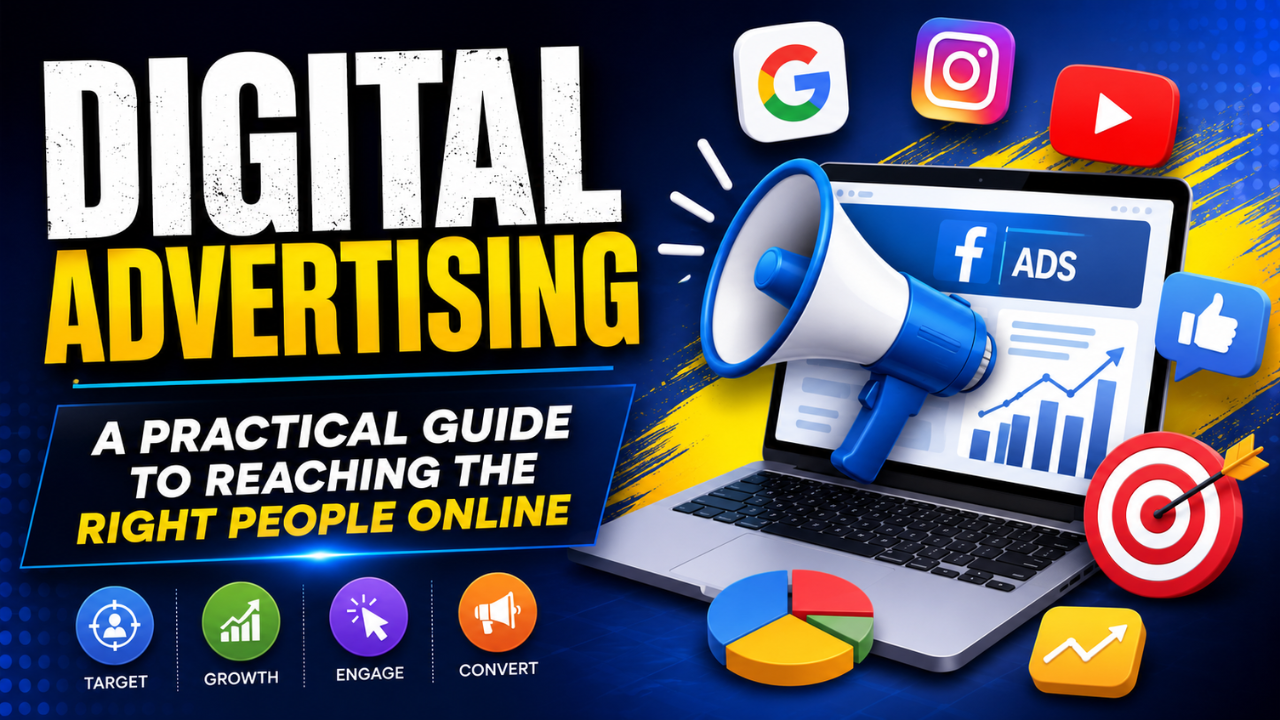
Digital Advertising: A Practical Guide to Reaching the Right People Online
Digital advertising is everywhere. You see it while scrolling through social media, watching videos, reading the news, or searching for answers on Google. Some ads catch your attention instantly. Others disappear from your memory within seconds.
That difference isn’t luck.
Good digital advertising is about showing the right message to the right person at the right time. When done well, it feels helpful instead of annoying. It solves problems, introduces useful products, and helps businesses grow without wasting money.
Whether you’re a business owner, marketer, freelancer, or simply curious about online marketing, understanding how digital advertising works can save time, improve results, and help you make smarter decisions.
Table of Contents
- What Is Digital Advertising?
- Why Digital Advertising Matters Today
- The Most Common Types of Digital Advertising
- How Targeting Makes Ads More Effective
- Creating Ads That People Actually Notice
- Budgeting Without Wasting Money
- Measuring Success Beyond Clicks
- Common Digital Advertising Mistakes
- Trends Shaping Digital Advertising
- Final Thoughts
What Is Digital Advertising?
Digital advertising is the process of promoting products, services, or brands through online platforms. Instead of placing an ad in a newspaper or on a billboard, businesses pay to reach people through websites, search engines, mobile apps, social media platforms, streaming services, and email.
The biggest advantage is control.
You can choose who sees your ads based on factors like location, interests, age, online behavior, or even recent searches. Traditional advertising often reaches thousands of people who may never become customers. Digital advertising focuses on finding the audience that’s most likely to care.
Imagine opening a new coffee shop. Instead of paying for a citywide newspaper ad, you can show your promotion only to people within a few miles who regularly search for coffee shops or cafés. That’s a much smarter use of your budget.
Why Digital Advertising Matters Today
People spend hours online every day. They search for answers, compare products, watch videos, and connect with friends. Businesses naturally want to be part of those moments.
Here’s the thing. Even the best product won’t sell if nobody knows it exists.
Digital advertising gives businesses of every size the chance to compete. A local bakery, a startup, and a global brand can all advertise on the same platforms. The difference comes down to strategy, creativity, and understanding the audience.
Another reason digital advertising has become so popular is speed.
A campaign can go live within minutes. If something isn’t working, you can adjust it immediately instead of waiting weeks to see results. That flexibility makes online advertising much more practical than many traditional methods.
The Most Common Types of Digital Advertising
Digital advertising isn’t limited to one format. Different goals call for different approaches.
Search advertising appears when people actively search for something online. These ads often appear above regular search results and work well because users already have intent. Someone searching for “best running shoes” is probably interested in buying.
Display advertising places visual banners across websites and apps. While these ads may not always generate immediate sales, they’re useful for building brand awareness.
Social media advertising reaches users while they browse platforms like Facebook, Instagram, LinkedIn, TikTok, or X. These platforms offer detailed targeting options, making it easier to reach specific audiences.
Video advertising has exploded over the past few years. Short videos often grab attention faster than plain text or images. A well-made thirty-second video can explain a product more effectively than several paragraphs.
Shopping ads are also a highly effective advertising option for online stores. Instead of showing only text, they display product images, prices, and store information directly in search results.
Each format serves a different purpose. The best advertisers usually combine several instead of relying on only one.
How Targeting Makes Ads More Effective
Not everyone is your customer.
That simple idea sits at the heart of digital advertising.
Modern advertising platforms allow businesses to narrow their audience in impressive ways. You can target people based on demographics, interests, devices, previous website visits, purchase behavior, and even life events.
Let’s be honest. Showing baby product ads to college students rarely makes sense. Showing them to new parents is a completely different story.
Good targeting also improves the experience for users. Instead of seeing random advertisements, people are more likely to encounter products that actually match their needs.
Still, targeting should never become too narrow. Sometimes advertisers create such tiny audiences that campaigns struggle to gain enough reach. Finding the balance takes testing and patience.
Creating Ads That People Actually Notice
Most people ignore online ads without thinking twice.
That’s why creative quality matters so much.
Strong digital ads usually start with a clear headline. It should immediately explain why someone should care.
Visuals also play a huge role. Clean images, readable text, and consistent branding help build trust. Cluttered designs often get skipped.
The message itself should focus on benefits rather than features.
Instead of saying a laptop has sixteen gigabytes of memory, explain that it helps users run demanding software smoothly without slowing down.
Small details matter too.
A simple call to action, such as “Learn More,” “Shop Now,” or “Get Your Free Quote,” tells people exactly what to do next. Without that direction, even interested users may leave without doing anything.
Budgeting Without Wasting Money
A common myth is that digital advertising only works if you spend a lot of money.
You don’t.
Many successful campaigns begin with modest daily spending while businesses learn what works. The key is testing before scaling.
Suppose you have two different ad designs.
Instead of spending your full budget on one version, split the budget evenly between both. After several days, compare the results. Move more of your budget to the version that delivers the best results.
This simple approach reduces risk and improves long-term performance.
It’s also important to think beyond the cost of a click.
A cheaper advertisement isn’t automatically better if visitors never become customers. Paying slightly more for higher-quality traffic often produces better overall results.
Measuring Success Beyond Clicks
Clicks tell part of the story.
They don’t tell the whole story.
A campaign with thousands of clicks but very few sales isn’t necessarily successful. On the other hand, an ad with fewer clicks may generate excellent revenue if the visitors are highly interested.
Businesses often track several performance indicators, including impressions, click-through rate, conversion rate, cost per acquisition, and return on ad spend.
Now imagine two online stores.
Store A receives 5,000 visitors but only sells ten products.
Store B attracts 800 visitors and sells sixty products.
Store B clearly has the stronger campaign, even though it generated much less traffic.
The goal isn’t simply attracting attention. The goal is attracting the right attention.
Common Digital Advertising Mistakes
Many advertising campaigns fail for surprisingly simple reasons.
Some businesses try to reach everyone instead of focusing on a specific audience. Others create beautiful ads but send users to confusing landing pages that make buying difficult.
Another common mistake is giving up too quickly.
Advertising platforms often need time to collect data before delivering their best performance. Constantly changing campaigns every day can prevent that learning process from happening.
Ignoring mobile users is another costly error.
A large share of internet traffic now comes from smartphones. If your website loads slowly or looks difficult to navigate on a small screen, potential customers may leave before taking action.
Finally, never assume one successful campaign will work forever.
Consumer behavior changes. Trends evolve. Competitors improve. Regular testing keeps advertising fresh and effective.
Trends Shaping Digital Advertising
Digital advertising continues to evolve at a rapid pace.
Privacy changes have encouraged businesses to rely more on first-party customer data instead of third-party tracking. Building direct relationships with customers is becoming increasingly valuable.
Short-form video continues to dominate many platforms. Quick, engaging content often earns more attention than long promotional messages.
Personalization is also growing. Consumers expect advertisements to feel relevant rather than generic. Businesses that understand customer needs usually create stronger campaigns.
Voice search, connected TV advertising, interactive content, and improved automation tools are also changing how advertisers reach audiences.
While technology keeps advancing, one principle remains surprisingly consistent.
People respond to useful messages delivered at the right moment.
That hasn’t changed, and it probably won’t anytime soon.
Final Thoughts
Digital advertising isn’t about chasing every new trend or spending the biggest budget. It’s about understanding people.
When businesses focus on solving real problems, reaching the right audience, and continuously improving their campaigns, advertising becomes much more effective.
Some campaigns will exceed expectations. Others won’t perform as planned. That’s perfectly normal.
The businesses that succeed over time are the ones willing to learn from the data, test new ideas, and keep their audience at the center of every decision.
In the end, digital advertising isn’t simply about getting more clicks. It’s about building meaningful connections that lead to lasting growth.