
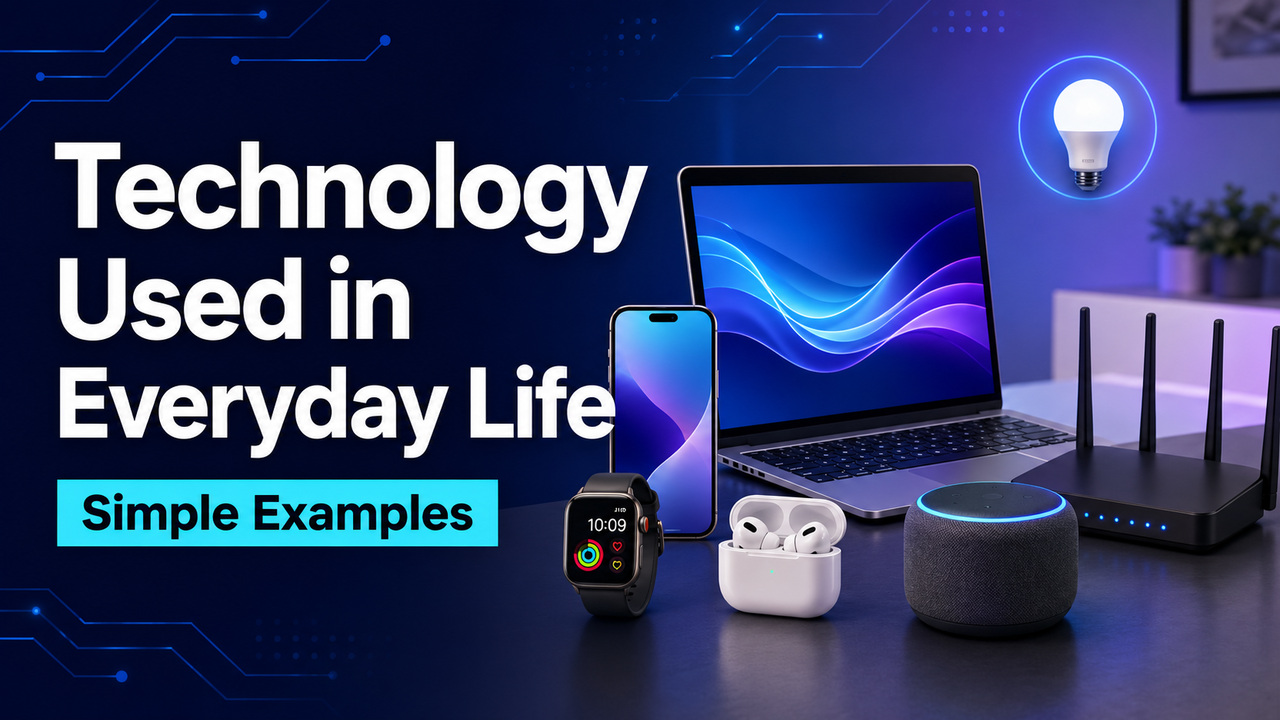
Technology Used in Everyday Life: Simple Examples
Technology is so deeply woven into daily life that we often stop noticing it. You wake up to a phone alarm, check the weather, send a message, make coffee, and perhaps open a map before leaving home. All of that can happen within the first hour of the day.
Not every useful technology looks advanced. A microwave, traffic light, debit card, barcode scanner, and digital thermometer are all examples of technology used in everyday life. Some devices save time, while others improve safety, communication, comfort, or access to information.
Here’s the thing: technology doesn’t simply add more gadgets to our homes. It quietly changes how we make decisions, solve small problems, and organize our routines.
Table of Contents
- Technology Starts Working Before We Leave Bed
- Communication Has Become Almost Instant
- Work and Education Now Follow Us Anywhere
- Shopping and Banking Take Less Time
- Smart Technology Is Changing the Home
- Health Technology Helps Us Pay Attention
- Travel Has Become Easier to Manage
- Invisible Technology Keeps Daily Life Moving
- The Convenience Comes With Responsibilities
- Finding a Healthy Balance With Technology
- Technology Will Keep Becoming Less Noticeable
- Final Thoughts
Technology Starts Working Before We Leave Bed
For many people, the smartphone is the first piece of technology they use each morning. It works as an alarm clock, calendar, weather station, news source, camera, calculator, and communication device.
Imagine waking up late for work. Your phone shows a traffic delay, suggests another route, and reminds you about a morning meeting. Within seconds, you can message a coworker and order a ride. Twenty years ago, handling the same situation would have required several separate tools—and probably much more stress.
Kitchen technology also shapes the morning routine. Electric kettles, coffee makers, refrigerators, toasters, and microwaves make food preparation faster. A refrigerator doesn’t feel exciting, but it preserves food safely for days or weeks. That has a bigger effect on everyday life than many flashy devices.
Even basic household systems count. Electric lighting lets us start the day before sunrise. Water heaters provide a warm shower. Washing machines clean clothes with little physical effort. We rarely think about these inventions until the power goes out.
Communication Has Become Almost Instant
Communication is one of the clearest examples of technology used in everyday life. Mobile phones, email, messaging apps, and video calls allow people to stay connected across cities and countries.
A parent in Pakistan can video-call a child studying abroad. A small business owner can answer a customer while travelling. Friends can share photos from a wedding before the event has even finished.
This speed can be genuinely helpful. Emergency information travels quickly, remote families remain close, and work problems can be solved without waiting for a face-to-face meeting.
Still, instant communication creates new pressure. People may expect an immediate reply simply because a message shows as “seen.” That little notification can make a normal conversation feel urgent when it isn’t. Technology gives us faster communication, but we still have to decide when to respond and when to put the phone down.
Work and Education Now Follow Us Anywhere
Laptops, cloud storage, video meetings, and online collaboration tools have changed the meaning of a workplace. Many tasks no longer require everyone to sit in the same building.
Someone can write a report at home, save it online, and let a colleague review it from another city. A shop owner can check sales from a mobile phone. A freelancer can work with clients on the other side of the world without ever meeting them in person.
Education has changed in a similar way. Students can attend online classes, watch demonstrations, use digital dictionaries, and access entire libraries from a single device. If a student doesn’t understand a maths problem at school, they can often find another explanation later that evening.
Of course, access isn’t equal. A reliable internet connection and a good device still cost money. Technology can open educational doors, but only when people have the tools and skills needed to use it.
Shopping and Banking Take Less Time
Shopping used to mean visiting several stores, comparing products by memory, and carrying cash. Now, people can compare prices, read customer reviews, place an order, and track delivery from a phone.
Physical shops also depend heavily on technology. Barcode scanners identify products, digital inventory systems track stock, and card machines process payments. When you tap a bank card at a checkout, several systems communicate within seconds to confirm the transaction.
Mobile banking offers similar convenience. People can pay bills, transfer money, check balances, and receive payment alerts without visiting a branch. That’s especially useful when a bill is due late at night or the nearest bank is far away.
But convenience can encourage careless spending. Clicking “buy now” doesn’t feel the same as handing over physical cash. It’s easy to make three small purchases and only later realize how much they cost together.
Smart Technology Is Changing the Home
Home technology has moved far beyond televisions and kitchen appliances. Smart bulbs, security cameras, doorbells, speakers, thermostats, and robotic vacuum cleaners can now perform tasks automatically.
Picture someone returning home after dark. A motion sensor turns on the outside light, a smart lock opens through their phone, and the heating has already adjusted the room temperature. None of these actions is essential, but together they can make the home safer and more comfortable.
Security systems are particularly useful. A video doorbell lets residents see who’s outside before opening the door. Smoke detectors and carbon monoxide alarms provide early warnings. Some systems can even send alerts to a phone when nobody is home.
Smart devices aren’t always necessary, though. A regular light switch still works perfectly well. The best home technology solves a real problem instead of creating another app that needs passwords, updates, and troubleshooting.
Health Technology Helps Us Pay Attention
Technology has made health information easier to measure and record. Digital thermometers, blood pressure monitors, glucose meters, hearing aids, and fitness watches support millions of people every day.
A fitness tracker might remind an office worker that they’ve been sitting for two hours. A medication app can alert an older adult when it’s time to take a tablet. A digital blood pressure monitor allows someone to record readings at home and share them with a doctor.
Hospitals rely on much more advanced systems, but everyday health technology often works best when it stays simple. A reminder to walk, sleep earlier, or drink water can be useful if it leads to a better habit.
Still, a watch reading shouldn’t replace professional medical advice. Consumer devices can provide helpful clues, but measurements may be incomplete or inaccurate. They’re tools, not doctors.
Travel Has Become Easier to Manage
Getting lost used to involve unfolding a paper map, asking a stranger, or driving around until something looked familiar. Navigation apps now provide live directions, traffic updates, estimated arrival times, and nearby fuel stations.
Public transport uses technology too. Electronic ticketing, arrival screens, ride-booking apps, and live bus tracking reduce uncertainty. Instead of standing at a stop and wondering when the bus will come, passengers can often check its location.
Cars contain even more everyday technology. Parking sensors, reversing cameras, anti-lock brakes, airbags, and tyre-pressure warnings improve comfort and safety. Drivers may barely notice these systems until one prevents an accident.
Even walking has changed. A traveller can translate a sign, convert currency, find a restaurant, and book accommodation using one small device. That kind of independence would have seemed remarkable not long ago.
Invisible Technology Keeps Daily Life Moving
Some of the most important technology used in everyday life remains hidden. Internet servers process requests in the background. Satellites support navigation and weather forecasting. Computer systems manage electricity, water supplies, deliveries, and public transport.
Consider a simple online food order. The restaurant receives the request, a payment system confirms the charge, mapping software finds the address, and a delivery platform matches the order with a rider. Several technologies work together before the meal reaches the door.
Traffic lights are another ordinary example. They control movement at busy intersections and help pedestrians cross safely. Modern systems may adjust timing based on traffic levels, helping reduce long queues.
Technology often feels most successful when we don’t have to think about it. It completes its job quietly, reliably, and at the right moment.
The Convenience Comes With Responsibilities
Let’s be honest: technology creates problems as well as solutions. Scams, data theft, weak passwords, false information, and excessive screen time are now part of modern life.
Basic digital safety matters. Strong, unique passwords make accounts harder to steal. Two-step verification adds another layer of protection. Software updates may feel annoying, but they often repair security weaknesses.
People should also pause before sharing personal information. A harmless-looking online quiz might ask for a pet’s name, childhood street, or birthday—the same details sometimes used in account security questions.
Privacy settings deserve attention too. Apps don’t always need access to contacts, microphones, cameras, and exact locations. Checking permissions takes only a few minutes and can prevent unnecessary data collection.
Finding a Healthy Balance With Technology
The goal doesn’t have to be using less technology in every situation. It’s better to use it with purpose.
A navigation app is useful while driving, but constant notifications are distracting. A video call can strengthen a long-distance relationship, while checking messages during dinner can weaken the conversation happening at the table.
Small boundaries help. Turning off nonessential notifications, keeping phones away from the bed, and choosing screen-free moments can make technology feel less demanding. Families might leave devices off the dining table. Workers can mute job-related apps after finishing for the day.
Good technology should support life, not control every quiet moment in it.
Technology Will Keep Becoming Less Noticeable
Future everyday technology will probably feel more natural and less like a separate activity. Homes, cars, medical devices, and public services will become better at responding automatically to people’s needs.
We’re likely to see longer-lasting batteries, safer transport systems, more accurate health monitoring, and appliances that use less electricity. Accessibility should improve as well. Better voice controls, captions, hearing devices, and navigation tools can help people live more independently.
The most valuable developments won’t necessarily be the most impressive-looking ones. Often, the best invention is simply the tool that saves ten minutes, prevents a mistake, or makes an ordinary task easier for someone.
Final Thoughts
Technology used in everyday life covers far more than phones and computers. It includes the refrigerator keeping food fresh, the card machine processing a payment, the map guiding a driver, and the alarm reminding someone to take medicine.
These tools make life faster, safer, and more connected, but they also ask us to think carefully about privacy, security, spending, and screen time. The sensible approach is simple: use technology where it adds real value, question it when it creates pressure, and remember that convenience should serve people—not the other way around.
One Comment