
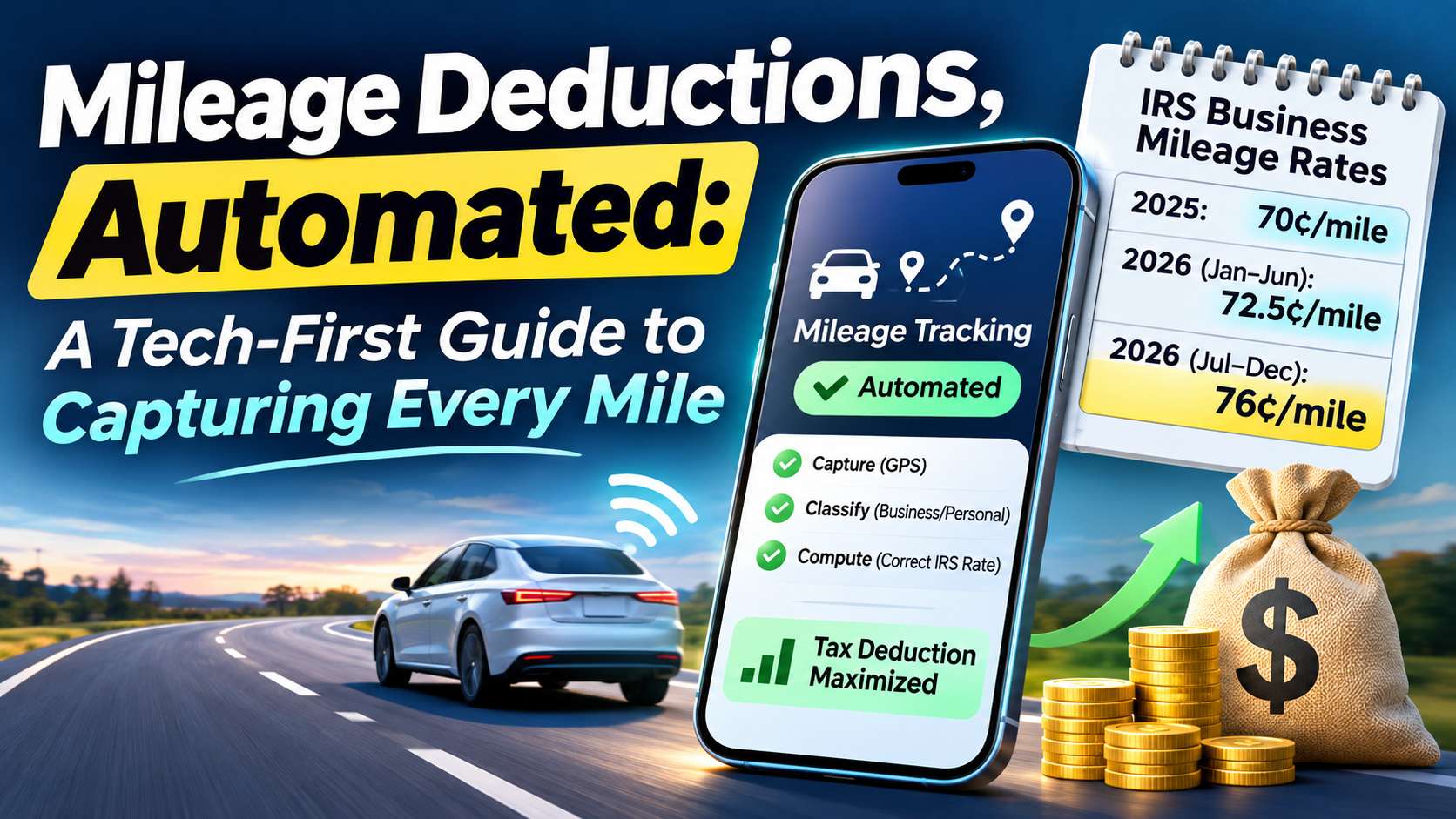
Mileage Deductions, Automated: A Tech-First Guide to Capturing Every Mile
For anyone who likes letting software handle the tedious parts of life, mileage deductions are low-hanging fruit. If you use your vehicle for work, each business mile can help reduce your tax bill through deductions. However, many people miss out on these savings because manually tracking every trip requires consistent effort. on a discipline nobody keeps. This is exactly the kind of repetitive, rule-based task that machines handle better than humans. Understanding the easiest financial wins available to anyone who drives to earn.
Understanding mileage deductions and using automated tools to track business trips can help anyone who drives for work save money and make tax reporting easier. This guide takes a tech-first view.
Why This Is a Perfect Automation Problem
Some tasks are ideal candidates for automation, and mileage tracking checks every box. It is repetitive, rule-based, easy to forget, and costly to get wrong.
- Repetitive: the same log-this-trip action happens on every drive.
- Rule-based: each trip is either business or personal, a clean binary software can assist.
- Easy to forget: on a busy day, manual logging is the first thing to slip.
- Costly when missed: every unlogged mile is a lost deduction worth real money.
When a task has all four traits, handing it to software is almost always the right call. A sensor that never gets tired beats human memory every time.
The Rate You Are Capturing
ThThe IRS allows you to claim a standard deduction for each eligible business mile you drive, with the current mileage rate offering meaningful tax savings. 2026 is unusual because it changed mid-year.
| Period | Business rate |
|---|---|
| 2025 | 70¢/mile |
| 2026 (Jan–Jun) | 72.5¢/mile |
| 2026 (Jul–Dec) | 76¢/mile |
The IRS increased the 2026 business mileage rate from 72.5 cents to 76 cents per mile on July 1 in response to higher fuel costs. That mid-year split means a correct deduction depends on knowing when each trip happened, which turns your mileage record into time-sensitive data.
What Your Miles Are Worth
The payoff is real, which is what makes automating it worthwhile.
| Business miles per year | Deduction at 76¢/mile |
|---|---|
| 3,000 | $2,280 |
| 6,000 | $4,560 |
| 10,000 | $7,600 |
| 15,000 | $11,400 |
These deductions come off your taxable income directly. For a regular driver, automated tracking routinely captures thousands of dollars that manual methods leave behind.
Clean Data In, Clean Deduction Out
Any developer knows the principle: garbage in, garbage out. Mileage deductions follow the same rule. Your deduction is a product of your rate and your logged miles, so any error in the record flows straight into the result.
- Missing trips bias your deduction downward.
- Misdated trips can be valued at the wrong rate, a real risk with the 2026 mid-year change.
- Misclassified trips overstate or understate your business use.
- Reconstructed logs are both inaccurate and legally weak.
Automated capture solves all of these by recording clean, dated, complete data as it happens, and it applies the correct rate to each period automatically.
How the Automation Works
A good mileage app is more sophisticated under the hood than it looks. It combines several signals to detect, record, and organize your driving without input from you.
| Component | What it does |
|---|---|
| Motion detection | Senses when you have started driving |
| GPS logging | Records route, distance, and endpoints |
| Automatic trip capture | Starts and stops without a manual timer |
| Classification assist | Speeds up sorting business vs. personal |
| Cloud sync | Backs up every trip so nothing is lost |
The result is a complete, timestamped record captured as it happens. All you need to do manually is identify which trips were business-related, a task you can easily handle in a short weekly review.
Standard Mileage vs. Actual Expenses
The app feeds the standard mileage method, but it helps to know the two options for deducting car costs.
- The standard mileage method calculates your deduction by multiplying your eligible business miles by the IRS rate. It’s straightforward and often works well for fuel-efficient vehicles that cover a lot of business miles.
- Actual expenses deducts the business-use share of real costs, but requires keeping every receipt.
- Both need the miles, since even the actual method relies on your business-use percentage from the log.
For most people the standard method is simpler and often the larger deduction. The official rules, including the first-year lock-in that limits switching later, are on the IRS standard mileage rates pageThe actual expenses method allows you to deduct the business-related portion of your vehicle costs, but it requires detailed records and receipts. Both methods depend on accurate mileage tracking because your business-use percentage determines how much you can claim under the actual expenses method.
For many drivers, the standard mileage method is easier to manage and may provide a larger deduction, depending on their vehicle costs and driving habits. You can find the official guidelines, including first-year eligibility requirements and restrictions on switching methods, on the IRS standard mileage rates page.
Treating the Log as a Pipeline
To remove human error, think of your mileage record as a small pipeline: capture, classify, compute.
| Stage | What it does | Failure mode | Fix |
|---|---|---|---|
| Capture | Records every drive with a timestamp | Forgotten trips | Automatic GPS detection |
| Classify | Tags trips business or personal | Misclassification | Weekly review |
| Compute | Applies the correct rate per period | Wrong-rate errors | Date-aware calculation |
Automated tracking ensures every trip is recorded, reducing the risk of missing important mileage details. When classification is a weekly habit, labels stay accurate. When computation is date-aware, the July 1 change is handled correctly. A pipeline built this way produces trustworthy output every year.
What Counts as a Business Mile
Automation only helps if you know what qualifies, since the app captures all driving and you classify it. Only business-related trips are deductible.
| Trip | Deductible? |
|---|---|
| Driving to meet a client or customer | Yes |
| Travelling between work locations | Yes |
| Picking up business supplies | Yes |
| Driving to a temporary work site | Yes |
| Your regular commute to a fixed base | No |
| Personal errands | No |
The test is purpose. Generally, a trip may qualify as business mileage if it is directly related to your work, provided it meets IRS requirements. Your regular commute does not, which is the exception people most often get wrong. The app’s swipe-to-classify flow makes keeping these separate effortless, so your business total stays accurate.
A Quick Real-World Example
Consider a freelancer who drives 8,000 business miles a year and has never tracked them.
| Approach | Deduction at 76¢/mile | Tax saved (24% bracket) |
|---|---|---|
| No tracking | $0 | $0 |
| Full tracking | $6,080 | ~$1,459 |
By installing one app and letting it run, that freelancer captures a $6,080 deduction worth nearly $1,500 in real savings, money that would otherwise have vanished. The trips were already happening; the only change was automating the record. That is about as good a return on setup effort as any tool offers.
The Bottom Line
Mileage deductions are not really a tax problem. They are a data-collection problem wearing a tax costume. Solve the collection problem with automation and consistency, and the tax side reduces to a multiplication you can trust.
For anyone comfortable letting software own a repetitive, rule-based task, this is one of the clearest wins available. Set up an app once, let it capture every trip with an accurate date, and let it apply the correct rate automatically. The result is a deduction that is both maximized and defensible, captured from clean data with almost no ongoing effort on your part.