Droven Unscramble: The Answer and Other Words You Can Make
Six letters can look surprisingly unfamiliar when they’re sitting in the wrong order. You spot “drove,” notice there’s still an N left over, and start wondering whether you’ve missed an obvious word. That’s usually the frustrating part of a scramble: the answer feels close, but your first guess keeps getting in the way.
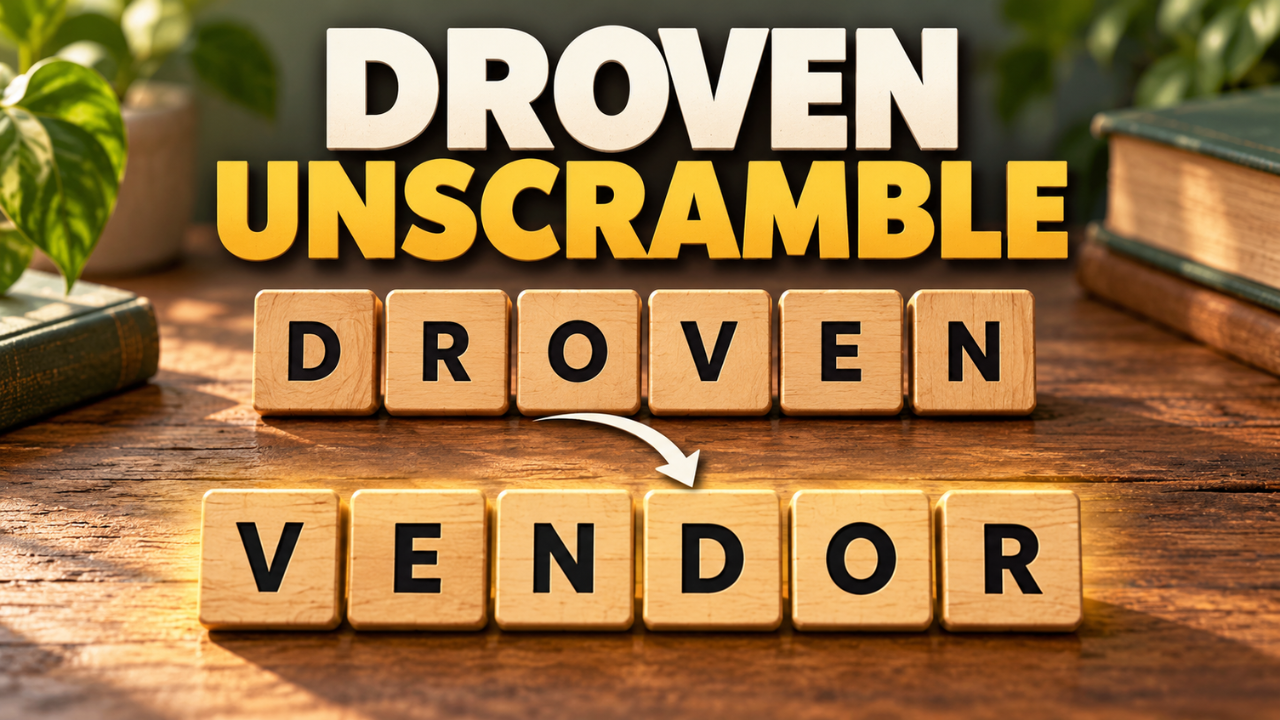
If you’re looking for the full answer to droven unscramble, it’s VENDOR. Rearranging D, R, O, V, E, and N gives you a familiar six-letter word. There are also shorter words worth finding, especially when your puzzle accepts several answers.
Table of Contents
- The Six-Letter Answer Is Vendor
- Shorter Words Hiding in the Same Letters
- How to Find the Answer Without Random Guessing
- Let the Puzzle Rules Narrow Your Options
- Why Word Solvers Don’t Always Agree
- Easy Mistakes to Catch Before Submitting
- Making the Most of a Word Solver
- A Small Practice Routine That Helps
The Six-Letter Answer Is Vendor
VENDOR uses every letter in DROVEN exactly once. Nothing needs adding, and nothing gets left behind. Merriam-Webster’s Scrabble word finder lists it as the six-letter result for these letters.
A vendor is a seller. It might be someone selling fruit at a market or a company supplying software to businesses. The word works in everyday conversation as well as business settings.
For example: “The seller placed the mangoes inside a paper bag.”
If you want to check the arrangement, write the original letters in alphabetical order: D, E, N, O, R, V. Then sort the letters in VENDOR. You’ll get the same sequence.
That little check is useful whenever an answer looks convincing but you’re unsure about a repeated or missing letter. Familiarity alone can fool you; matching the letters gives you something concrete.
Shorter Words Hiding in the Same Letters
Not every puzzle asks you to use all six letters. Some want several words, while others give you a specific number of empty boxes.
These familiar options provide a useful starting point:
| Word length | Words you can form |
|---|---|
| Five letters | DRONE, DROVE, ROVED |
| Four letters | DOER, DONE, DOVE, NERD, NODE, OVEN, OVER, REDO, REND, RODE, ROVE, VEND |
| Three letters | DEN, DOE, DON, END, EON, NOD, NOR, ODE, ONE, ORE, RED, REV, ROD, ROE |
| Two letters | DO, NO, ON, OR, RE |
These examples appear in Merriam-Webster’s Scrabble finder, although another game may use a different selection of accepted words.
Notice how a small rearrangement opens another option. RODE becomes REDO. DONE becomes NODE. ROVE can grow into ROVED when you add D.
Looking for these relationships is often more productive than hunting for unrelated words. Once you have one useful combination, move its letters around before abandoning it.
Also, shorter words use a selection of the available letters. A full anagram, such as VENDOR, uses the entire set. Knowing which kind of answer you need saves wasted effort.
How to Find the Answer Without Random Guessing
Start by separating the vowels from the consonants. Here, your vowels are E and O. The remaining letters are D, R, V, and N.
You don’t need to write out every possible arrangement. Instead, test small, familiar groups.
VEND is a useful example. Once you spot it, the only letters left are O and R. Put those at the end and you have VENDOR. That’s a much easier route than trying to read DROVEN aloud until something sounds right.
Another approach is to move away from the original starting letter. The scramble begins with D, so it’s tempting to keep building words that begin with D. Try V first, then R or N. Changing the starting point can break that habit.
If you’re using physical tiles, spread them out and rebuild from scratch. On paper, rewrite the letters in a different order. You’re giving yourself a fresh arrangement to inspect.
Here’s the thing: spotting a shorter word doesn’t mean you’re nearly finished. DROVE looks promising, but adding N to its end doesn’t produce the required answer. Sometimes you have to dismantle a good partial word to find the complete one.
Let the Puzzle Rules Narrow Your Options
Before submitting anything, check what the puzzle actually wants.
Six empty boxes suggest a six-letter answer. Five boxes mean VENDOR won’t fit, even though it uses the available letters perfectly. A clue can narrow things further.
For a clue meaning “seller,” VENDOR fits. If the clue asks for the past tense of “drive,” DROVE is the relevant choice. A clue meaning “wandered” could point toward ROVED.
These examples show why a word list alone doesn’t always solve a puzzle. You still have to match the word to the space and meaning.
Some games also require a particular letter in every answer. If V must appear, words such as NODE and REND won’t qualify. They use the available letters correctly, but they miss that extra condition.
Read the instructions before you start collecting answers. A few seconds spent there can prevent several frustrating rejections.
Why Word Solvers Don’t Always Agree
Two unscrambling tools can show different totals for the same letters because they use different dictionaries and filters.
One may include unfamiliar words, regional forms, or specialist vocabulary. Another may focus on common words. Minimum word length also changes the total immediately: a tool that includes two-letter words will display more results than one starting at four letters.
That’s why a large total may look impressive but doesn’t tell you much by itself.
Merriam-Webster’s Scrabble finder marks DROVEN itself as unplayable, while accepting VENDOR. That tells you how its particular word list treats those entries; your game’s own checker remains the place to confirm an answer for that game.
If you find an unfamiliar suggestion, look up its meaning before relying on it. Learning a real word can be worthwhile. Copying something you don’t understand just because it appeared in a solver is less helpful, especially when your puzzle rejects it anyway.
Easy Mistakes to Catch Before Submitting
The easiest mistake is borrowing a letter you don’t have.
“Driven” looks close to DROVEN, and it’s a familiar word. But it needs I instead of O. It cannot be formed from this exact set.
“Vendor” and “vender” can cause another mix-up. VENDER requires two Es and has no O, so it doesn’t match your letters.
Repeated letters deserve the same attention. “Never” might come to mind when you’re experimenting with N, E, V, and R, but you only have one E available.
A simple habit catches these problems: cross out each original letter as you use it. If you need a letter that’s already crossed out, the candidate fails.
Also check whether you’ve accidentally dropped a letter. DRONE is a valid five-letter formation, but it leaves V unused. That’s fine for a shorter-word challenge and insufficient for a puzzle requiring all six letters.
Making the Most of a Word Solver
A solver is most useful when you give it the right information.
Enter DROVEN exactly as shown. Then set the word length if your puzzle provides one. Add a starting letter, ending letter, or known position when the tool supports those filters.
For instance, six boxes with V already placed at the beginning give you a much narrower search than a completely open letter bank. There’s little value in scrolling through three-letter results when you already know the answer needs six.
After checking the result, compare it with the original letters yourself. That brief review helps you catch a mistyped input or an extra wildcard.
If your aim is to improve, spend a moment noticing how the answer was built. With this scramble, VEND plus OR is the useful pattern. Remembering that connection gives you more than simply remembering which button produced the answer.
A Small Practice Routine That Helps
You can get a little more value from these letters by changing the challenge.
First, find a five-letter word containing V. Next, make a four-letter word beginning with N. Finish with a three-letter word beginning with O.
DROVE, NODE, and ORE are possible answers. There are other choices, depending on the condition you set.
Keep the practice brief. The goal is to notice arrangements, check letters accurately, and become more comfortable moving away from your first guess.
For this particular scramble, VENDOR is the full answer to remember. The more useful habit is how you reach it: inspect the letters, try a fresh starting point, and check the puzzle’s requirements before submitting. Six jumbled letters become much easier to handle when you give yourself a clear place to start.