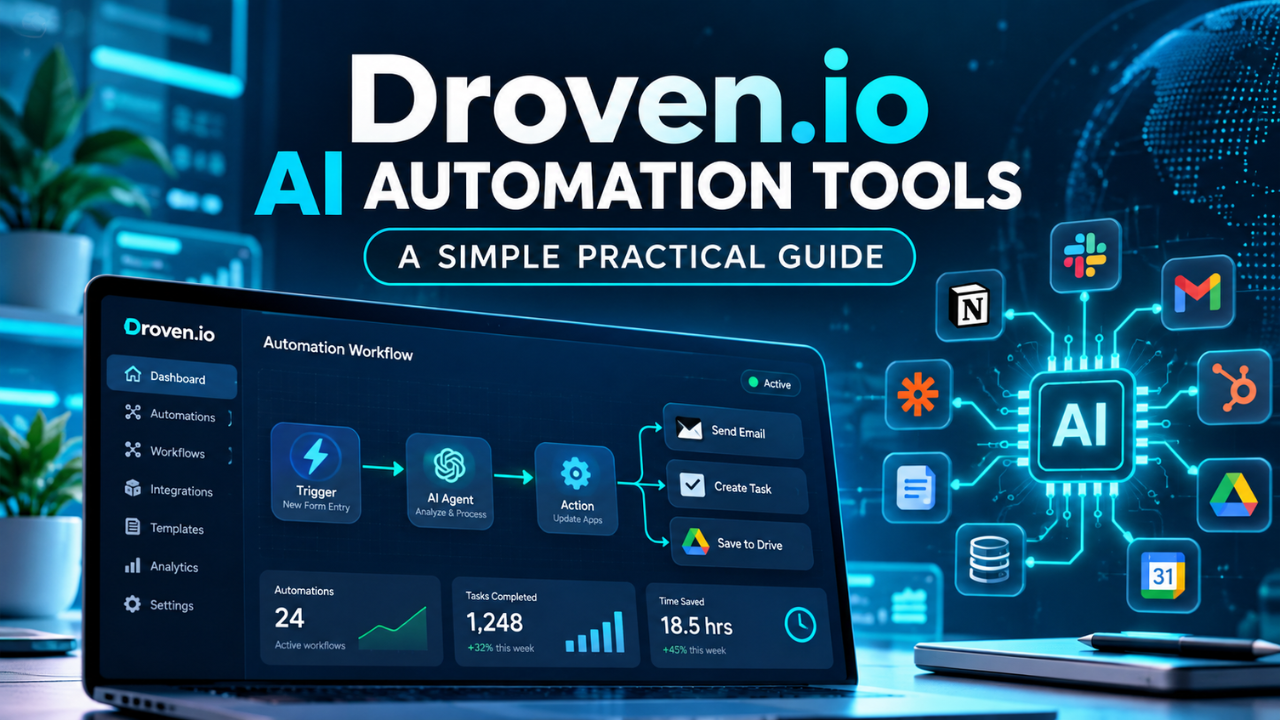
Droven.io AI Automation Tools: A Simple Practical Guide
A customer sends an inquiry. Someone copies the details into a spreadsheet, creates a task, forwards the message, then remembers to follow up two days later. None of those steps feels difficult. Together, they can eat up an afternoon.
That’s the appeal behind searches for droven io ai automation tools: finding practical ways to reduce repetitive work without turning a familiar business process into a complicated technical project.
The useful starting point is your everyday workload. Where does information get stuck? Which tasks keep slipping through? Once you can answer those questions, automation becomes much easier to evaluate.
Table of Contents
- What Droven.io Offers Readers
- Identify the Task That’s Slowing You Down
- Understand What the Automation Actually Does
- Three Workflow Tools to Understand
- Where Automation Fits into Everyday Work
- Build One Small Workflow First
- Check Costs, Connections, and Data Access
- Keep Someone Responsible for the Outcome
- Turn Your Research into a Useful Routine
What Droven.io Offers Readers
Droven.io presents itself as an editorial resource covering technology, artificial intelligence, and digital transformation. The site’s navigation covers AI Tools & Applications, AI Automation Work, AI Business Processes, and Productivity Tools. That makes these sections sensible places to begin researching automation topics.
Use the site to build your understanding, then check any software you’re considering directly with its provider. A helpful explanation can introduce an idea; the provider’s documentation should confirm whether the product supports your particular workflow.
The AI Automation Work section currently covers a broad mix of subjects, including business systems, customer engagement, and industry-specific automation. Browse by relevance rather than assuming every entry will help with the same problem.
For example, a freelancer organizing client inquiries needs a different starting point from a company connecting inventory records across several departments.
Read with one question in mind: could this help with a task I actually perform?
Identify the Task That’s Slowing You Down
Before comparing tools, pay attention to what happens during an ordinary working day.
Perhaps you keep checking whether a client has submitted a document. Maybe new orders arrive through several channels, leaving someone to assemble a single daily summary. Or your team repeatedly asks who owns the next step.
Those are useful starting points because you can describe the problem clearly.
Saying “I want to automate my business” is too broad and leaves too many details undefined. “I want every approved inquiry to create a task with the customer’s name and deadline” gives you something concrete to build.
Frequency matters, too. A task that takes four minutes but happens twenty times a day deserves attention. Something you do twice a year might be easier to handle manually.
I’d start with repetitive work that follows a reasonably stable pattern. Complicated exceptions can wait until the basic process works.
Understand What the Automation Actually Does
A workflow needs a starting event and a result. A submitted form could start the process; a new record in your customer system could be the result.
Some tasks only need fixed rules. Copying a date from one field into another doesn’t require interpreting language.
Other tasks involve messier information. A customer might describe a delivery problem in several sentences without choosing a category. An AI step could attempt to identify the issue, summarize the message, or suggest which team should review it.
Here’s the thing: interpreting a message and taking action on it are separate decisions.
A suggested category may be useful even when you still want a person to approve the response. You can automate part of the work while keeping judgment where it matters.
That distinction helps you avoid adding complexity to tasks that already have clear, predictable answers.
Three Workflow Tools to Understand
As you explore automation, it helps to recognize the difference between educational resources and the software used to build workflows. These three products provide concrete examples.
Zapier connects applications through workflows called Zaps. Its documentation describes a trigger followed by one or more actions. A submitted inquiry could start a workflow that adds a record and alerts the relevant person. Check the specific trigger and action available for each application before choosing it. Zapier
Make uses scenarios made from modules. Each module performs a task, such as retrieving information, updating a record, or sending data elsewhere. When evaluating it, sketch the steps you need and see whether you can understand how information moves between them.
n8n combines workflow automation with AI capabilities and offers different deployment options, including cloud and self-hosting. Its documentation covers setup, integrations, and development. If you’re considering managing it yourself, include maintenance and technical support in your decision.
These are starting points for comparison. The deciding factor should be whether a tool supports your actual process at a cost and maintenance level you can manage.
Where Automation Fits into Everyday Work
Client intake is a straightforward example. Imagine a small service business receiving inquiries through a website form. A workflow could collect the details, prepare an internal summary, and assign a follow-up task.
The owner would still decide whether the project is suitable and what to charge. The repetitive preparation would take less attention.
An online shop might use a similar approach to organize customer messages. Routine questions could enter one queue, while refund requests go to someone authorized to review them.
For a team that holds regular meetings, an automation could turn approved action items into tasks. The important word is “approved.” A vague comment during a discussion shouldn’t quietly become a firm commitment.
These examples work best when everyone agrees on the desired outcome. A faster process isn’t much help if it creates records nobody uses or notifications nobody reads.
Build One Small Workflow First
Keep your first attempt narrow enough to explain in a sentence.
Suppose every new inquiry should create a draft task for review. Define the fields you need: customer name, contact details, request summary, and proposed deadline.
Then try several examples. Include a complete submission, one with missing information, and another with an unusually long message. Test a duplicate as well.
Watch what happens at each step. Does the task contain the right details? Can someone tell where the information came from? Does missing data produce an alert or an empty record?
Start by reviewing every result. Once you understand the common mistakes, you can decide which steps need less supervision.
A small workflow gives you room to learn. If it saves time consistently, extend it carefully. Adding five more steps before understanding the first two usually makes troubleshooting harder.
Check Costs, Connections, and Data Access
A product supporting your favorite application doesn’t guarantee that it supports the exact action you need. Confirm whether it can read the relevant fields, update the right records, and handle the event that starts your process.
Costs deserve the same attention. Ask how the provider measures usage and whether any connected services charge separately. Compare the likely monthly bill with the time you expect to save.
Also consider what information the workflow needs. An automation that sorts inquiry topics may have no reason to access an entire customer history.
Use sample information while testing, and review permissions before connecting live accounts. Check the provider’s current terms for data storage and access.
Finally, think about leaving. Can you export your records? Will your team still understand the process if you change tools? Those questions are much easier to answer before everything depends on one setup.
Keep Someone Responsible for the Outcome
Automation still needs an owner.
Choose someone who will notice failed runs, review unusual results, and update the workflow when the business changes. Without that responsibility, a process can appear healthy while quietly sending information to the wrong place.
Decide what should happen when the system isn’t sure. An unclear message could go into a review queue. A missing deadline could prompt a request for clarification.
For commitments to customers, approvals should be deliberate. It’s reasonable to automate preparation while requiring a person to confirm prices, delivery dates, or refunds.
Measure the result after you start using the workflow. Compare time spent, corrections needed, and tasks completed with your earlier routine.
If checking the automation takes longer than doing the original task, simplify it. You’re allowed to remove steps that looked promising but don’t help.
Turn Your Research into a Useful Routine
Searching for droven io ai automation tools can introduce you to useful ideas, but the value comes from applying one of them to a clear problem.
Choose a relevant topic on Droven.io, check the software provider’s current documentation, and build a small version of the process you want to improve. Give it ordinary examples and awkward ones. See how it behaves.
You don’t need to automate everything at once. Getting one recurring task under control can make the working day easier and show you what to tackle next. Keep the process understandable, keep someone responsible, and expand when the results justify it.