

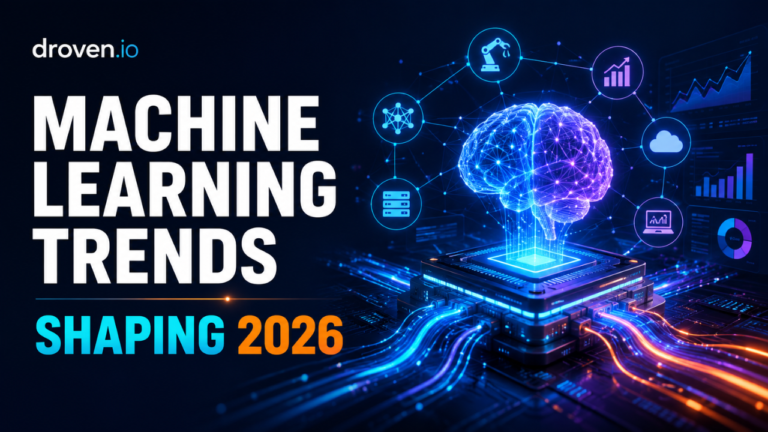
Droven.io Machine Learning Trend: What to Watch
A café owner orders extra pastries because last Saturday was busy. This Saturday, rain keeps customers at home, and half the tray remains untouched. The sales figures weren’t wrong. They simply left out something that mattered.
Machine learning tries to find useful patterns across those scattered pieces of information. Done well, it can help people prepare earlier, waste less, and make decisions with a clearer view of what might happen next.
The term “droven.io machine learning trend” highlights this broader topic and helps explain why it matters. The developments worth following include more flexible forecasting, compact models, and simpler ways to run experiments. Understanding them starts with everyday problems.
Table of Contents
- Putting the Droven.io Topic in Context
- Better Predictions Begin With a Better Question
- Data Quality Deserves Your Attention
- Compact Models Bring Processing Closer to the Task
- Different Types of Information Can Work Together
- Automated Training Changes Where the Effort Goes
- The Work Continues After a Model Goes Live
- What a Sensible First Trial Looks Like
Putting the Droven.io Topic in Context
Droven.io’s homepage features a range of technology-related articles, covering topics such as data analytics, software development, and digital transformation. Readers encounter published coverage and explainers, which gives the website a clear editorial role.
When exploring machine learning through a technology publication, look past the name of a development and examine what it actually enables.
An overview might introduce local processing or automated training. Your next step is to check the relevant research or documentation and consider whether the idea fits your situation.
A new capability becomes interesting when you can connect it to a specific difficulty. Perhaps your forecasts miss sudden demand changes. Perhaps a useful application struggles whenever the internet connection drops. Those details give broad technology coverage a practical purpose.
Better Predictions Begin With a Better Question
“Can we predict sales?” sounds reasonable, but it’s too broad to guide much useful work.
A better question might be: “How many units of this product should each branch order for next week?” Now there’s a time period, a location, and a decision attached to the answer.
Forecasting models are developing ways to combine several related streams of information. In August 2026, Google Research introduced TimesFM-3, a model capable of analyzing multiple time series while considering contextual information, including certain upcoming events known in advance.
For a chain of bicycle shops, that could mean considering product sales alongside planned promotions and repair bookings. Each source might reveal something the others miss.
More information only helps when it’s relevant and available at the right moment, though. A planned promotion is useful before an order is placed. A final sales total recorded afterwards isn’t.
Choose the question first. Then decide which records could reasonably help answer it. That order keeps a forecasting project connected to the person who needs to act on the result.
Data Quality Deserves Your Attention
Before comparing models, spend some time looking at the records they would learn from.
You may find that one branch records returns as negative sales while another stores them separately. Perhaps product names changed halfway through the year. A surprising dip might even reflect a missing file.
These problems can quietly distort a project.
Another trap is data leakage: information enters model development even though it wouldn’t be available during actual use. Scikit-learn’s documentation explains that this can make evaluation results appear stronger than real performance.
For example, a company may want to identify customers who are likely to cancel their subscriptions. Including a cancellation confirmation in the inputs would give the model an answer it couldn’t have beforehand.
Keep records used for evaluation separate from those used to develop the model. Check that each input genuinely exists when a prediction is needed.
Here’s the thing: a tidy spreadsheet can still contain the wrong evidence. Knowing where the data came from and how it was gathered is just as important as cleaning up missing values.
Compact Models Bring Processing Closer to the Task
Running a model on a local device can make sense when connection quality, response time, or hardware limits affect the job.
Google’s Gemma 3n is one example of development aimed at this setting. Its design emphasizes efficient operation on devices, including mobile hardware, through architectural changes that reduce memory requirements.
Picture a warehouse employee checking a label in a corner of the building with weak connectivity. A suitable local system might complete the task without waiting for a remote service.
This could be a helpful solution, but its effectiveness must be tested on the equipment being used. Battery drain, storage, heat, and processing speed all affect the experience.
Local operation can also change how much information travels elsewhere. Privacy depends on the complete application, including its permissions and logging.
Compact models make another deployment option available. The best option depends on what needs to be done, the device being used, and how well it performs in everyday situations.
Different Types of Information Can Work Together
People describe problems in whatever format is easiest. Someone reporting a damaged package might send a photograph, type a sentence, and record a voice message.
Multimodal machine learning helps systems analyze and combine information from various sources, including written content, pictures, sound recordings, and videos. The Qwen2.5-Omni research report describes a model capable of processing text, images, audio, and video within one system.
For a claims team, such a capability could help bring scattered information together before a staff member reviews the case.
There’s a difference, however, between accepting an image and interpreting it accurately. Shadows may resemble damage. Background noise can obscure a spoken detail. A video may omit the moment that explains what happened.
Try representative examples before relying on the output. Include awkward angles, short messages, and incomplete submissions.
Adding another input format should help resolve uncertainty. If it mainly produces a longer answer without clearer evidence, it may add little value to the process.
Automated Training Changes Where the Effort Goes
AutoML tools automate parts of the work involved in finding a suitable model. Google’s tabular training documentation describes searching different architectures, tuning settings, and evaluating candidate approaches.
That can make it easier to explore possibilities. It also shifts attention towards defining success properly.
Suppose you’re building a system to flag damaged products on a production line. Missing a serious defect may be more expensive than asking someone to inspect an undamaged item. A single overall accuracy figure won’t explain that tradeoff.
Look at the mistakes individually. Which ones cause disruption? Which can a reviewer resolve quickly? How many extra checks would the system create?
Compare the result with a basic alternative, such as an existing inspection rule. A more complicated approach should deliver enough improvement to justify its upkeep.
Automated training helps with experimentation. The team still has to decide whether the result is useful.
The Work Continues After a Model Goes Live
Launch day tells you whether a system can run. The following months reveal whether it can remain helpful.
Customers change their habits. Suppliers alter schedules. A business adds a product that barely resembles anything in its historical records.
Google’s guidance on machine learning operations, or MLOps, describes monitoring and ongoing maintenance as essential parts of production systems. It explains that changes in incoming data can weaken predictions over time.
Give someone responsibility for reviewing performance. They should know what to inspect, how to investigate a decline, and when to involve the people who use the system.
Watch for everyday friction too. If staff regularly correct one type of recommendation, that pattern deserves attention even when the average score looks acceptable.
People also need a way to challenge an output. A customer service employee may know about an unusual situation that the records don’t capture. Useful oversight gives that employee access to supporting information and authority to request a review.
Plan how work will continue during a failure. A familiar backup process can prevent a temporary technical problem from becoming a business-wide interruption.
What a Sensible First Trial Looks Like
A manageable trial begins with one decision that happens often enough to evaluate.
For example, an equipment rental company might test whether it can anticipate which items will be needed next weekend. Before building anything, it should record how its current planning method performs.
The trial needs representative conditions and a clear way to judge improvement. Include busy periods, quieter days, and cases with incomplete information. Keep the scope small enough that errors can be understood and corrected.
Costs deserve the same attention as prediction quality. Count the work involved in preparing records, maintaining connections, reviewing outputs, and dealing with mistakes.
Then talk to the people handling the task. Did the system help them prepare? Did it save effort? Were its suggestions easy to check?
Following machine learning developments becomes much more rewarding when you can answer those questions. Flexible forecasts, compact models, and automated training each solve different problems. Pick a capability that addresses a real need, examine the evidence, and judge it by what happens in practice. The strongest reason to keep a system is that it consistently helps someone do their job better.



One Comment