AI Customer Segmentation: A Practical Guide to Understanding Your Customers
Two people can buy the same product for completely different reasons. One may be trying it for the first time; the other may rely on it every week. Treat them as identical customers, and your message can miss both.
AI customer segmentation helps businesses spot these differences by finding patterns in customer behavior, preferences, and needs. Used well, it can make marketing more relevant and help teams choose what to improve. Used carelessly, it can produce confusing groups, intrusive messages, or decisions based on bad data. The value comes from pairing useful analysis with a clear understanding of the people behind it.
Table of Contents
- What AI Customer Segmentation Actually Means
- Why Traditional Segments Miss the Details
- How AI Finds Useful Customer Groups
- The Data That Makes Segmentation Work
- Turning Segments into Better Experiences
- A Practical Way to Get Started
- Common Mistakes to Avoid
- Privacy, Fairness, and Customer Trust
- How to Tell Whether It Is Working
- The Best Segments Lead to Better Conversations
What AI Customer Segmentation Actually Means
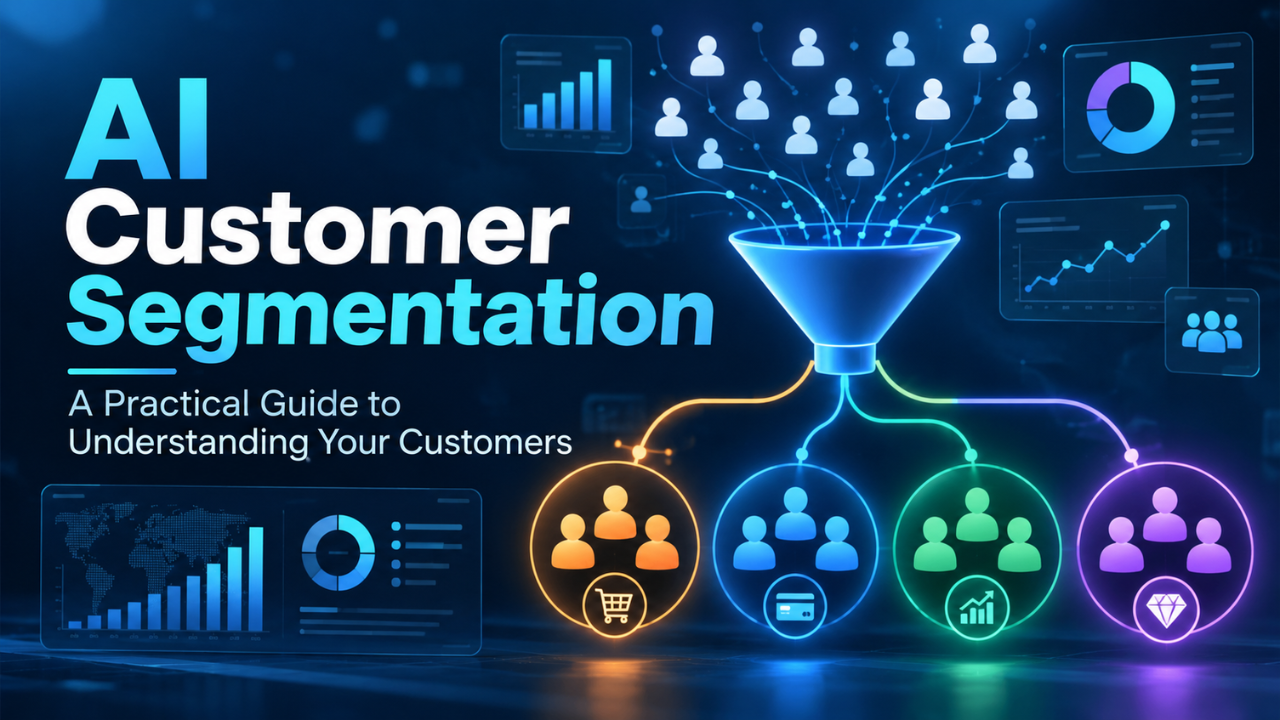
Customer segmentation means grouping people who share something that matters to a business. That might be a need, a buying habit, a stage in the customer journey, or a response to a particular offer. AI can help analyze large amounts of customer information and identify patterns that are difficult to spot by hand.
Imagine an online shop with thousands of customers. A basic report might show who bought running shoes last month. A more detailed analysis could reveal several kinds of buyers: people replacing worn-out shoes, beginners starting to run, and shoppers who compare several models before deciding. Those groups may need different product advice or follow-up messages.
The goal isn’t to give every customer a complicated label. It’s to learn enough to make useful decisions. A segment is only valuable if a team can understand what it represents and act on it in a way that benefits the customer as well as the business.
Why Traditional Segments Miss the Details
Traditional segments often rely on broad categories such as age, location, or income. Those details can be useful, but they don’t always explain what someone wants today. Two people of the same age and in the same city might have completely different reasons for visiting a website.
Behavior-based segments can add more context. A business might notice that some customers repeatedly read buying guides but haven’t made a purchase, while others buy as soon as a new product becomes available. Their actions suggest different questions and levels of readiness.
Customers also change. Someone who used to buy monthly may have stopped visiting. Another person may have gone from browsing to placing frequent orders. Static groups can miss those shifts, especially when teams update them only once or twice a year. AI-assisted segmentation can help teams refresh their picture more often, though the results still need human interpretation.
How AI Finds Useful Customer Groups
Different methods can support segmentation. Some look for natural clusters in behavior, such as customers who tend to buy similar products or use a service in similar ways. Others estimate the likelihood of an event, such as a customer making another purchase or canceling a subscription.
These approaches answer different questions. Clustering might help a retailer discover that many customers buy related items together, even if no one planned that category in advance. A predictive model might help a subscription business identify accounts that have become less active. Neither result explains the full story by itself; a team still has to decide what the pattern means and what action, if any, makes sense.
The clearest results often come from a focused question. Instead of asking, “What can we learn from all this data?” a team might ask, “Which first-time buyers are likely to need setup help?” That gives the analysis a practical purpose and makes it easier to judge whether the resulting groups are genuinely useful.
The Data That Makes Segmentation Work
Useful segmentation depends on useful information. Purchase history can show what customers bought and when. Website or app activity may reveal what they explored. Support conversations can point to recurring frustrations. Survey responses can provide context that clicks alone cannot.
Not every business has all of these sources, and not every source needs to be combined. A small store with accurate order records may learn more from its own data than from a large, messy collection of loosely connected signals. It’s usually better to start with a few reliable sources than to feed in every available field.
Data quality matters, too. Duplicate customer records, outdated contact details, and inconsistent product names can distort the patterns. A model might treat one person as three separate customers or mistake a tracking error for a change in behavior. Before investing heavily in analysis, check whether the data is accurate enough to support the decision you want to make.
Turning Segments into Better Experiences
A segment should lead to a relevant experience, not simply a more targeted sales pitch. If new customers often need help setting up a product, a simple welcome guide may be more useful than an immediate offer to buy something else. If regular buyers keep asking when a product will be back in stock, clearer availability updates could solve a real problem.
Consider a meal-kit company that notices some customers pause their plans after a few deliveries. The pattern might reflect cost, repetitive menus, busy schedules, or something else entirely. The company could test flexible delivery options or ask customers why they paused. Sending the same discount to everyone may produce a short-term purchase while leaving the reason for leaving untouched.
Good personalization feels helpful because it responds to a likely need. It becomes uncomfortable when a business seems to know more than the customer expects it to know. Teams should use segments to improve timing and relevance, while keeping messages clear and easy to control.
A Practical Way to Get Started
Start with a business question that has a clear outcome. You might want to improve first-month retention, reduce abandoned carts, or help customers find the right product. Pick one goal and define what progress would look like before building segments.
Next, choose a small number of data sources connected to that goal. If you’re studying first-month retention, customer start dates, usage activity, support requests, and cancellations may be relevant. A broad demographic profile may add little. Keep the first version simple enough that someone outside the analytics team can explain it.
Then compare the groups with what customer-facing employees already know. Sales, support, and service teams often hear details that don’t show up in dashboards. If a segment appears to contain “price-sensitive customers,” for example, check whether that interpretation matches real conversations. Run a small test before changing every campaign or customer journey. A modest experiment can show whether the idea helps, wastes effort, or needs refining.
Common Mistakes to Avoid
One frequent mistake is creating too many segments. If teams end up with dozens of groups and no clear way to serve them differently, the system adds complexity without improving the experience. A handful of understandable segments is often more useful than an elaborate map of every possible customer variation.
Another mistake is treating a pattern as an explanation. If customers who open fewer emails are more likely to cancel, fewer email opens may be a warning sign—but they may not be the reason for cancellation. Sending even more email could make matters worse. Look for context and test possible responses rather than assuming the first pattern reveals cause and effect.
It’s also easy to confuse a precise score with certainty. A prediction is an estimate based on available information, and customer behavior can change. Don’t use a score as a permanent label or let it quietly decide who deserves attention. Review the results over time and give teams room to question conclusions that don’t fit what they see.
Privacy, Fairness, and Customer Trust
Customer data deserves careful handling. Collect information for a clear purpose, limit access to people who need it, and follow the privacy rules that apply to your business and customers. If you can answer a question using less sensitive information, that is usually the better choice.
Segmentation can also produce unfair outcomes when the data reflects past bias or leaves out important groups. For example, a model trained on past purchasing behavior may give less attention to people who were previously underserved. The numbers can look consistent while the experience becomes less fair.
Review how segments are used, not just how they are created. Ask whether a group is being excluded from useful information, whether a message could feel intrusive, and whether customers have a reasonable way to manage communications. Trust takes time to build and can be lost quickly when personalization crosses a line.
How to Tell Whether It Is Working
Measure the outcome tied to your original question. If the project aims to improve customer retention, look at retention—not just email opens or clicks. Those smaller measures can help explain what happened, but they don’t prove that customers are better served.
Compare results with a reasonable baseline or a control group when possible. If a group receives a new onboarding sequence, see how it performs against a similar group that receives the existing experience. Track costs and unwanted effects as well. A campaign that lifts purchases but also increases returns or unsubscribes may not be a real improvement.
Finally, revisit the segments. Customer habits, products, and market conditions change. A group that was useful last year may no longer reflect how people behave. Regular reviews help teams notice when the picture has shifted and retire segments that no longer support good decisions.
The Best Segments Lead to Better Conversations
AI customer segmentation can help businesses notice patterns, respond to changing needs, and make customer experiences more relevant. But a pattern is a starting point, not a complete understanding of a person.
The strongest approach is practical: ask a clear question, use reliable data, check the results with human experience, and test a helpful response. Keep privacy and fairness in view as you go. When a segment helps a team understand what customers may need—and gives customers a better experience—it’s doing its job.