
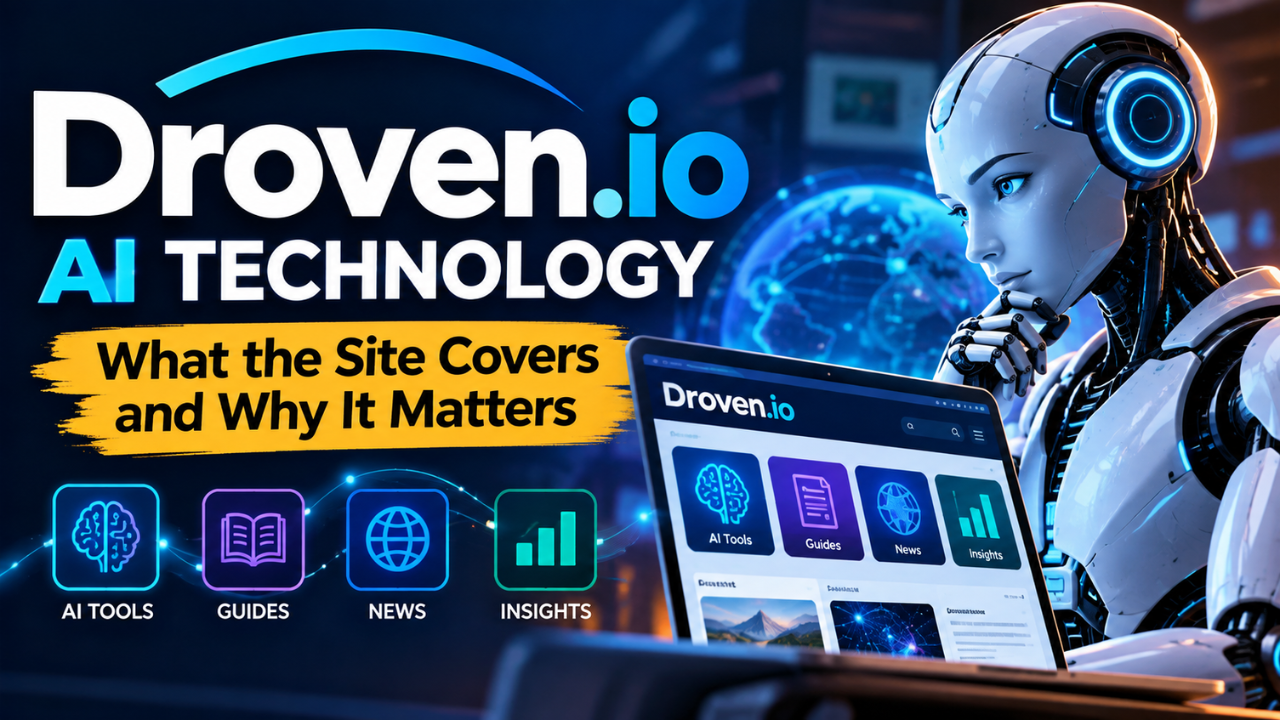
Droven.io AI Technology: What the Site Covers and Why It Matters
Search for “Droven.io AI technology” and you might expect to find a new AI product, a chatbot, or a platform to sign up for. The name can give that impression. Droven.io is better understood as a technology publication: it shares explainers, guides, reviews, and practical articles about AI and related topics.
That distinction makes the search phrase easier to understand. It points to Droven.io’s coverage of artificial intelligence and technology, rather than one single AI system built by the site. So what can readers expect to find, and how can they use that information sensibly?
Table of Contents
- What “Droven.io AI Technology” Means
- Droven.io Is a Technology Website, Not One AI Product
- The AI Topics the Site Covers
- From AI Ideas to Everyday Tasks
- Where AI Fits Into Business
- Why the Wider Technology Picture Matters
- How to Use Droven.io Effectively
- How to Judge AI Claims
- Who May Find the Site Useful
- The Practical Takeaway
What “Droven.io AI Technology” Means
A useful way to read the phrase is as a description of a subject area: AI technology as covered by Droven.io. The site organizes its content around artificial intelligence, software, cybersecurity, business technology, and digital transformation. It presents articles for people who want to understand a tool or idea without starting with technical documentation.
That can be helpful when a term pops up at work and you’re not sure what it means. Perhaps a colleague mentions generative AI, or a client asks whether your business uses automation. A straightforward explainer can help you get the basics, learn what questions to ask, and decide whether you need to dig deeper.
Droven.io Is a Technology Website, Not One AI Product
The distinction between a publication and a product matters. An AI product is something you use to complete a task: it might draft text, analyze data, or answer questions. A technology website publishes information about those systems and the ideas behind them.
Droven.io’s own description identifies it as an editorial technology site, with content that includes explainers, guides, reviews, and practical articles. Its categories include AI tools and applications, generative AI, AI in business and marketing, software development, cybersecurity, and digital transformation.
In practical terms, a visitor should expect to read about technology rather than open a Droven.io dashboard and run an AI task. An article may help you understand a type of tool or consider where it might fit into your work. You’ll still need to check the tool itself, its current features, and its terms before relying on it.
The AI Topics the Site Covers
Artificial intelligence is a broad field, and Droven.io’s coverage reflects that. Some topics focus on the technology itself, such as generative AI and machine learning. Others look at how AI appears in familiar tools and work processes.
That range matters because people rarely encounter AI as a neat, isolated subject. A small business owner may first meet it in a writing assistant. A designer may use an image generator. A customer support manager may be asked to review automated replies. Each person has a different practical question, even though the underlying topic is AI.
The site also connects AI with areas such as cybersecurity, analytics, software, and digital change. Those connections are useful. An automated system might save a team time, but it can also affect how that team stores information, checks results, or handles customer data. Thinking about the surrounding work gives readers a fuller picture than focusing on a tool’s headline feature alone.
From AI Ideas to Everyday Tasks
AI can sound abstract until you connect it to a task you already do. Think of someone returning from a meeting with a page of notes, three decisions, and a handful of deadlines. A meeting assistant could turn those notes into a draft summary or action list. The person still needs to check that names, owners, and dates are right, but they have a useful first draft to review.
Another example is sorting customer messages. A tool might group emails by topic or flag requests that appear urgent. That can help a small team get oriented more quickly. It can also misread a message or miss the reason a customer is upset, so a person should remain responsible for the final response.
These examples show the sensible role AI can play: helping with repetitive steps and organizing information. Droven.io’s AI applications coverage similarly describes tools that can assist with tasks while emphasizing the need for human judgment and review.
A good question to ask isn’t “Can AI do this?” It’s “Which part of this task could it handle reliably, and what still needs a person?”
Where AI Fits Into Business
Businesses often hear broad promises about AI and automation. But the best starting point is usually much smaller: a task that takes too long, happens over and over, or creates avoidable confusion.
Imagine an online shop where staff answer the same delivery questions throughout the day. A system might help collect order details, check tracking information, or prepare a suggested reply. That could reduce some of the repetitive work. A refund, a sensitive complaint, or an unclear case may still need a staff member to decide what happens next.
This is why practical AI coverage should talk about fit, not just features. A tool needs to work with the company’s actual process, be easy enough for employees to use, and produce results worth checking. If it takes longer to correct its work than to do the task manually, the promised time saving may not be real.
For a business reader, articles about AI tools, business processes, and digital transformation can help frame those choices. They can offer useful starting points for discussion, though a real purchase decision should also include hands-on testing and current information from the vendor.
Why the Wider Technology Picture Matters
AI doesn’t operate in a vacuum. It depends on software, data, networks, and people. A tool that handles customer information raises questions about privacy. A system connected to company accounts may need careful access controls. A model used for reporting can only be as useful as the information it receives.
That’s one reason the broader mix of technology topics matters. Cybersecurity, data privacy, analytics, and software development all have a part to play in how AI is chosen and used. A manager evaluating an AI tool may need to ask not only what it can do, but also where its information goes and who can see the output.
The same idea applies to everyday use. Before uploading a confidential contract or a customer record to an online service, check how the provider handles that information. Before trusting a generated answer, compare it with a reliable source. These aren’t complicated habits, but they can prevent avoidable mistakes.
How to Use Droven.io Effectively
Start with a question you actually need answered. If you’re curious about AI image tools, look for an article on that subject. If you’re comparing ways to automate a work task, begin with the process you want to improve. Reading with a purpose makes it easier to notice what applies to your situation.
As you read, separate background information from details that could change. Basic explanations often remain useful for a long time. Product features, prices, privacy policies, and security recommendations can change quickly. Check the publication date, then confirm current product details with the provider’s official documentation.
It also helps to treat an explainer as the beginning of your research, especially if a decision involves money, sensitive data, security, or legal requirements. A clear article can help you understand the vocabulary and identify follow-up questions. It shouldn’t replace checking primary information when the consequences matter.
How to Judge AI Claims
Every new tool seems to promise faster work or better results. Before taking a claim at face value, look for specifics. What task does the tool handle? How does it deal with missing information? Does the article or product page explain how results were tested?
Try a small, ordinary task instead of judging a tool by a polished demonstration. If you’re considering an assistant for support emails, test it on a few real examples that don’t contain private customer data. Check the accuracy, the time spent correcting the output, and whether the result sounds appropriate for your customers.
Also pay attention to the limits. AI can produce convincing answers that are incomplete or wrong. It may miss context that a person would notice immediately. The higher the stakes, the more carefully you should verify the result. That applies whether you learned about the tool from a review, a vendor page, or a general technology article.
Who May Find the Site Useful
Droven.io may suit readers who want a readable introduction to technology topics without starting with specialist material. Business owners can explore ideas before speaking with a vendor. Marketers and managers can get context about tools that affect their work. Students, early-career professionals, and curious readers can build familiarity with terms that come up in everyday conversations.
More experienced developers or IT staff may also find topics worth exploring, though they may need documentation or specialist sources for technical details. The value of a general technology site is often the first clear explanation, not the final word on a complex decision.
The Practical Takeaway
Droven.io AI technology is best understood as the site’s coverage of AI and its place in modern work, rather than a single Droven.io AI product. Readers can use its guides and explainers to build context, explore possible applications, and prepare better questions. Then they can test tools for themselves and verify important details before acting.
That’s a grounded way to keep up with a fast-moving subject: learn the basics, connect them to a real need, and keep a person responsible for the decisions that matter.





One Comment