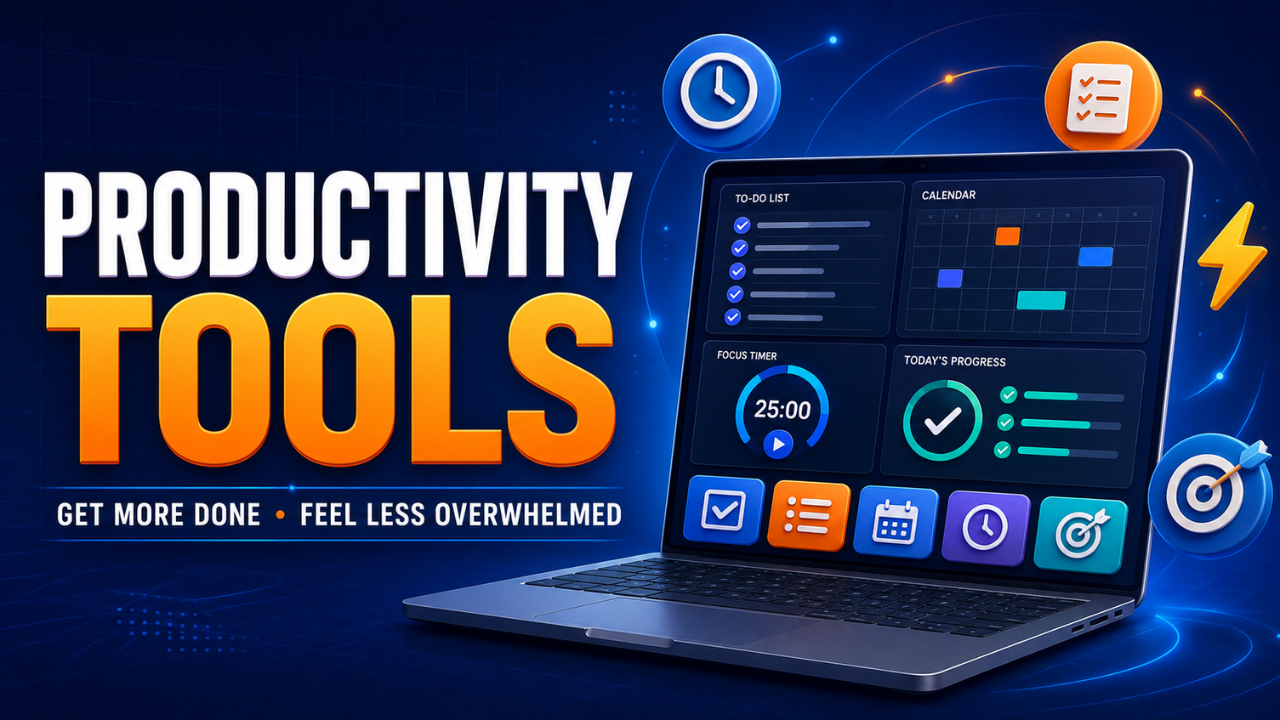
Productivity Tools That Help You Get More Done Without Feeling Overwhelmed
Productivity tools are supposed to make work easier. Yet many people spend more time organizing their task apps, adjusting dashboards, and testing new systems than actually completing anything.
The problem usually isn’t a lack of tools. It’s a lack of clarity.
A useful tool removes friction from your day. It helps you remember what matters, find information quickly, protect your attention, or work smoothly with other people. If it creates another layer of maintenance, it may be adding work rather than saving time.
The best setup is rarely the most advanced one. It’s the one you can understand at a glance and continue using when the week gets busy.
Table of Contents
- What Productivity Tools Should Actually Do
- Start With the Problem, Not the App
- Task Managers: Give Every Commitment a Home
- Calendar Tools: Make Time Visible
- Note-Taking Tools: Build a Useful Second Memory
- Focus Tools: Protect Your Attention
- Communication and Collaboration Without the Chaos
- Automation Tools: Remove Repetitive Work
- Why Too Many Productivity Tools Make You Slower
- Build a Simple System You’ll Keep Using
- Productivity Is Still a Human Skill
What Productivity Tools Should Actually Do
A good productivity tool should reduce the mental effort required to begin, continue, or finish a task.
Think about a normal Monday morning. You open your laptop and immediately face five unread emails, three messages from colleagues, a half-finished document, and a vague memory that something important is due tomorrow. Without a reliable system, your brain starts carrying all of that at once.
That’s tiring before the real work has even begun.
Productivity tools can move those open loops out of your head. A task manager remembers deadlines. A calendar shows when work will happen. A note-taking app stores useful details. A communication platform keeps conversations connected to the right project.
The tool isn’t doing your job for you. It’s creating enough order for you to do the job well.
That distinction matters. Productivity isn’t about filling every minute or completing the largest possible number of tasks. It’s about directing your time and attention toward work that actually deserves them.
Start With the Problem, Not the App
It’s easy to become impressed by features. A new platform may offer colorful boards, smart reminders, detailed reports, integrations, templates, and a dozen different views. None of that matters unless it solves a real problem in your day.
Before choosing anything, ask a simple question: where does my work currently break down?
Maybe you forget small commitments. Perhaps meetings consume the time you meant to use for focused work. Your files might be scattered across email attachments and random folders. Or your team could be discussing the same project in four different places.
Each problem needs a different response.
If you regularly miss deadlines, you probably need a task system. If you know what to do but never find time to do it, your calendar needs attention. If interruptions are the issue, a focus tool may help more than another project dashboard.
Here’s the thing: one well-chosen tool that fixes a repeated frustration is more valuable than a polished collection of apps you barely use.
Task Managers: Give Every Commitment a Home
A task manager provides one trusted place for work that needs to be completed. That could be a simple paper-style checklist, a digital to-do app, or a project platform with assignments and deadlines.
The format matters less than the habit.
When someone asks you to review a document on Thursday, record it immediately. Don’t leave the request buried in a chat thread and hope you’ll remember it later. Your brain is good at thinking, but it’s surprisingly unreliable as a reminder system.
Tasks should also be written as clear actions. “Website” doesn’t tell you what to do. “Review homepage copy” does. “Client project” feels large and slightly threatening; “Send the first design draft to Bilal” gives you a visible next step.
Try to keep categories limited. Work, personal, waiting, and someday may be enough. Creating separate lists for every tiny area of life can feel organized at first, but it often makes the system harder to check.
A task manager should answer two questions quickly: what needs my attention, and what should I do next?
Calendar Tools: Make Time Visible
A task list tells you what you want to complete. A calendar forces you to face the awkward second question: when will you complete it?
That’s where many plans collapse.
Suppose you have six hours of work on your list but only two free hours between meetings. The list can hide that conflict. Your calendar can’t. It shows the day as it really exists, not as you hope it exists.
Time blocking is useful here. Instead of writing “finish proposal” and repeatedly moving it to tomorrow, reserve a specific period for it. For example, block 10:00 to 11:30 on Wednesday morning and treat that appointment seriously.
Don’t schedule every minute, though. Real days contain delays, urgent questions, slow internet, tired afternoons, and conversations that run longer than expected. Leave breathing room.
I’ve found that a calendar works best when it protects important work rather than merely recording meetings. If other people can reserve your entire day, your priorities will always be pushed into whatever energy remains.
Note-Taking Tools: Build a Useful Second Memory
Notes become valuable when you can find and use them later. Saving information isn’t enough.
Imagine finishing a client call with several decisions, two open questions, and a promised follow-up. If those details stay on a loose page beside your keyboard, they may disappear beneath tomorrow’s work. A searchable note connected to the client or project is much safer.
Keep the structure straightforward. You might have sections for projects, meetings, reference material, and ideas. Add dates and descriptive titles so a note called “Website launch decisions — August 1” doesn’t become one of twenty files named “Meeting Notes.”
It also helps to separate reference information from action items. Notes preserve context; tasks tell you what to do. If an important action remains hidden inside a long page of notes, it’s easy to overlook.
The goal isn’t to record every thought you have. Save information that will support a decision, prevent repeated research, or help future you understand what happened.
Focus Tools: Protect Your Attention
Sometimes the system is fine. You know exactly what needs to happen and have enough time to do it. You simply keep getting distracted.
Focus tools can create a useful boundary. Website blockers can temporarily restrict social media or news sites. Timers can divide work into manageable sessions. Notification controls can stop every incoming message from demanding an immediate response.
A basic timer is often enough. Work on one defined task for 25 or 45 minutes, then take a short break. During that period, close unrelated tabs and keep your phone out of reach.
That last detail sounds almost too simple, but physical distance matters. A phone sitting face down beside your hand still carries the promise of something new. Put it across the room and the temptation becomes weaker.
Let’s be honest, though: no focus app can rescue a task that’s poorly defined. “Work on report” invites hesitation. “Write the opening 300 words of the report” gives your attention somewhere specific to land.
Communication and Collaboration Without the Chaos
Team productivity often suffers because information is everywhere. One decision appears in email, another in a group chat, and the final file lives on someone’s desktop.
Collaboration tools help when they establish a shared source of truth. Everyone should know where the latest file lives, where decisions are recorded, and who owns the next action.
Clear communication rules make the technology far more effective. A team might use chat for quick questions, project software for assignments, shared documents for active work, and email for formal external communication. The exact rules can vary, but they should be understood.
Response expectations matter too. If every message feels urgent, people spend the day monitoring conversations instead of completing work. Use status indicators, notification settings, and agreed response windows to protect uninterrupted time.
Good collaboration doesn’t mean everyone is constantly available. It means people can find what they need and understand what happens next.
Automation Tools: Remove Repetitive Work
Automation is most useful for small, predictable actions that happen again and again.
For example, a form submission might automatically create a task, add the sender’s details to a database, and notify the responsible team member. An invoice reminder could be sent after a set number of days. A standard meeting template might appear whenever a new project begins.
These aren’t dramatic changes, but repeated small savings add up.
Before automating something, understand it manually. A broken process doesn’t improve just because it runs faster. If an approval step is unclear or customer information is incomplete, automation may spread the confusion more efficiently.
Start with one repetitive task that follows consistent rules. Test the result carefully, especially when messages, payments, customer data, or public content are involved. Automation should reduce routine effort without removing necessary human judgment.
Why Too Many Productivity Tools Make You Slower
Every new tool has a cost. You have to learn it, configure it, update it, and remember to check it. If it overlaps with something you already use, you may also have to decide where each piece of information belongs.
That decision fatigue is easy to underestimate.
A person may have tasks in a to-do app, email inbox, project board, notebook, and messaging platform. None of those systems is completely wrong, but together they create uncertainty. When Friday arrives, important work can be hiding anywhere.
Try conducting a small tool audit. Write down every app you use to manage tasks, time, notes, files, and communication. Then identify duplicates. If two tools perform nearly the same job, choose one unless there’s a strong reason to keep both.
Fewer tools create clearer habits. Clearer habits build trust in the system. Once you trust it, you stop repeatedly checking everything.
Build a Simple System You’ll Keep Using
A practical setup can be surprisingly small: one task manager, one calendar, one place for notes, shared file storage, and a communication tool if you work with others.
Then create a light routine around them.
At the start of the day, check your calendar and choose a few meaningful tasks. During the day, capture new commitments instead of relying on memory. Before finishing, take five minutes to update your list and prepare for tomorrow.
A weekly review keeps the system healthy. Look at overdue work, upcoming deadlines, unanswered messages, and projects that haven’t moved. Remove tasks that no longer matter. Schedule the ones that do.
If a system constantly needs repairing, simplify it. You shouldn’t need a peaceful Sunday afternoon and perfect motivation just to keep your productivity setup alive.
Productivity Is Still a Human Skill
Productivity tools can organize work, protect time, and reduce avoidable effort. They can’t decide what deserves your attention, set reasonable boundaries, or make you begin an uncomfortable task.
That part remains human.
Choose tools based on genuine friction in your life. Keep the setup small, make each tool’s purpose clear, and review the system often enough to trust it. When the technology fades into the background and your important work becomes easier to see, you’ve probably found the right balance.