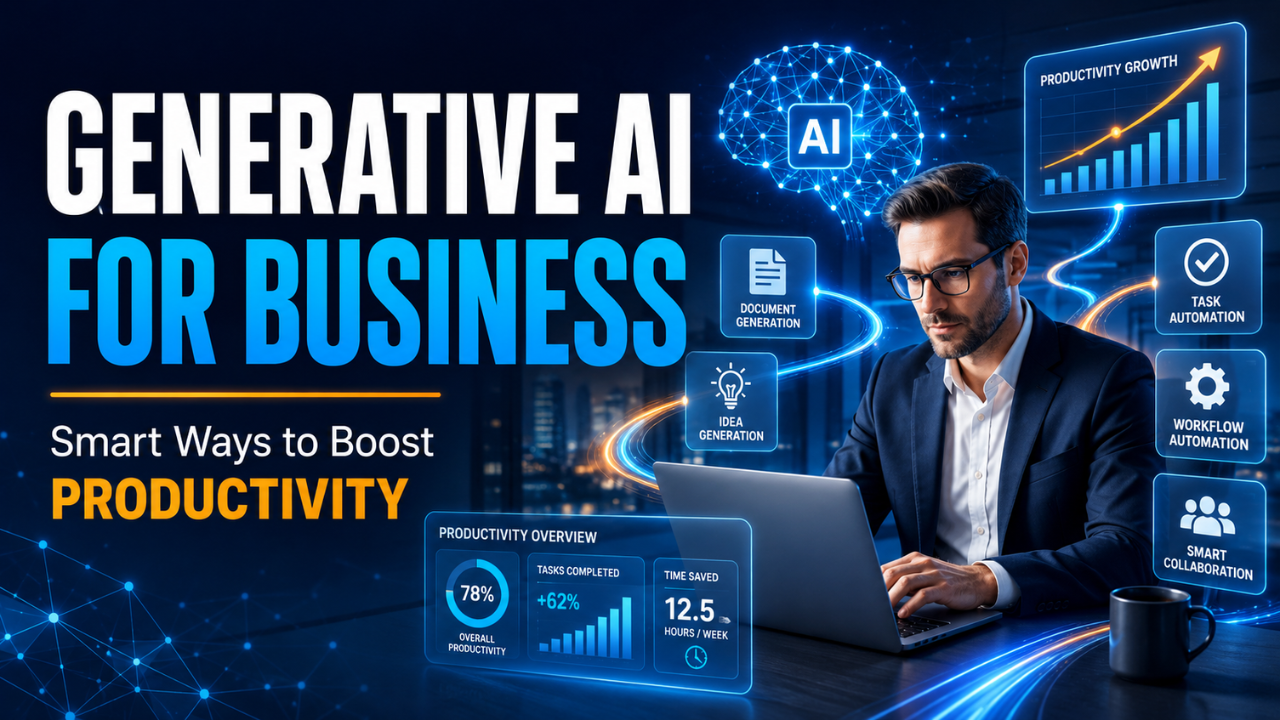
Generative AI for Business: Smart Ways to Boost Productivity
Most businesses don’t have a shortage of ideas. They have a shortage of time.
Employees spend hours rewriting similar emails, summarizing meetings, searching through documents, preparing reports, and moving information between systems. None of these tasks seems especially difficult, but together they quietly consume a large part of the working week.
Generative AI for business offers a practical way to reduce that burden. It can draft, summarize, organize, compare, and explain information in seconds. That doesn’t mean it should run the company or replace experienced people. Its real value is simpler: it helps good employees move faster and focus on work that needs judgment, creativity, and human understanding.
Table of Contents
- What Generative AI Really Changes at Work
- Where It Creates Real Business Value
- Start With a Tedious Workflow
- Keep Human Judgment in the Loop
- Protect Business and Customer Data
- Measure Results Without Fooling Yourself
- Help Employees Use It Confidently
- Common Mistakes That Limit Results
- Building an Advantage That Lasts
- Making Generative AI Useful
What Generative AI Really Changes at Work
Traditional business software usually follows fixed instructions. A payroll system calculates salaries according to established rules. An inventory platform tracks stock levels. A customer relationship management system stores contact details and sales activity.
Generative tools work differently. They deal with language, images, ideas, and unstructured information. You can give them a meeting transcript and ask for action points, provide several customer reviews and request a summary of common complaints, or turn rough notes into a readable first draft.
The important phrase here is first draft.
The technology can produce something quickly, but quick doesn’t always mean correct. It may misunderstand context, leave out an important detail, or state something inaccurate with complete confidence. Businesses get better results when they treat it as a capable assistant rather than an unquestionable expert.
That simple change in perspective can make a noticeable difference.
Where It Creates Real Business Value
The best use cases usually involve work that is repetitive, language-heavy, and easy for a person to review.
Consider a customer support team that receives hundreds of similar questions each week. Employees may repeatedly explain delivery times, refund rules, or account settings. A generative system can prepare a suggested response using approved company information. The support agent reviews it, makes any necessary changes, and sends it.
The customer still receives human attention, but the agent doesn’t have to start with a blank screen every time.
Marketing teams can use the same approach for campaign ideas, product descriptions, email variations, and content briefs. Sales representatives can summarize call notes, prepare follow-up messages, or turn scattered information into a clear account overview. Human resources teams may draft job descriptions, organize employee feedback, or explain internal policies in simpler language.
Operations departments also have plenty of opportunities. Imagine a manager receiving five weekly reports in different formats. Instead of reading every page, the manager could generate a summary that highlights delays, unusual costs, and decisions requiring attention.
The goal isn’t to remove people from the process. It’s to remove some of the friction surrounding their work.
Start With a Tedious Workflow
It’s tempting to begin with a large goal such as “use generative AI across the entire company.” That sounds ambitious, but it’s too broad to guide a useful project.
Start with one irritating workflow.
Ask employees which tasks are repetitive, slow, and mentally draining. Look for activities that happen frequently and follow a recognizable pattern. Drafting routine replies, producing meeting summaries, categorizing customer comments, and preparing standard reports are good examples.
Suppose a small recruitment agency spends 40 minutes creating a candidate summary after every interview. A sensible first project would test whether a tool can prepare the initial summary from approved notes. Recruiters would still check the details, but even saving 15 minutes per candidate could matter over hundreds of interviews.
A focused trial also makes problems easier to spot. The business can examine quality, time savings, employee feedback, and possible risks before expanding the system elsewhere.
Small wins create useful evidence. Grand announcements don’t.
Keep Human Judgment in the Loop
Generative systems are impressive because their responses often sound polished. That polish can create false confidence.
A well-written answer may still contain incorrect numbers, invented details, outdated information, or advice that doesn’t fit the situation. Any output affecting customers, employees, contracts, finances, health, or legal decisions should receive proper human review.
The reviewer also needs relevant knowledge. Asking an intern to approve a complex financial explanation doesn’t count as meaningful oversight.
Clear responsibilities help. Employees should know which outputs can be used with a quick check, which require specialist approval, and which tasks should never be delegated to an automated system.
For example, generating possible interview questions may be reasonable. Making the final hiring decision without human involvement is far more risky. One supports judgment; the other tries to replace it.
That boundary should be deliberate, not discovered after something goes wrong.
Protect Business and Customer Data
Here’s the thing: employees will experiment with convenient tools, even when the company hasn’t created a formal policy. If the rules are unclear, someone may paste a confidential contract, customer record, financial report, or private employee information into an unsuitable system.
Businesses need straightforward guidance about what information employees can enter and which tools they’re allowed to use.
Security teams should examine how a provider stores data, whether submitted information is used for training, who can access it, and how long it remains available. Access permissions also matter. A useful internal assistant shouldn’t reveal salary information, legal documents, or executive reports to everyone in the company.
Good data practices improve results as well as safety. A customer service assistant connected to current, approved policies will usually perform better than one relying on random files and outdated instructions.
Privacy and accuracy often improve together.
Measure Results Without Fooling Yourself
A flashy demonstration isn’t the same as business value.
Measurement should begin before a new tool is introduced. How long does the current task take? How often do errors occur? What does the process cost? How satisfied are employees and customers with the existing experience?
After the trial begins, compare the same measures.
Let’s say an accounts team uses a generative tool to explain unusual invoice entries. The system may reduce preparation time by 30 percent, but reviewers might then spend extra time correcting weak explanations. If the total process barely improves, the apparent time saving isn’t meaningful.
Quality matters alongside speed. Useful measures may include completion time, correction rates, customer satisfaction, employee adoption, and the number of cases requiring escalation.
Don’t force every benefit into a financial figure, though. Reducing tedious work, improving response consistency, and helping employees find information faster can have genuine value even when the exact return is difficult to calculate.
Help Employees Use It Confidently
Buying access to a tool doesn’t mean people will know how to use it well.
Employees need practical training based on their actual jobs. A generic presentation about the technology won’t help a sales representative write a better follow-up or teach a project manager how to check a generated summary.
Show people how to provide context, request a useful format, check important claims, and improve weak results. More importantly, teach them when not to use the tool.
Some employees may worry that automation is designed to remove their roles. Pretending that concern doesn’t exist will only create distrust. Leaders should explain what the company wants to improve, which responsibilities will remain human, and how roles may change.
The strongest adoption usually comes when employees help design the workflow. They understand the awkward exceptions, hidden steps, and customer expectations that senior decision-makers may never see.
Common Mistakes That Limit Results
One common mistake is adopting a tool before identifying the problem it should solve. Teams experiment enthusiastically for a few weeks, generate plenty of text, and then return to their old habits because the new system never became part of a real workflow.
Another problem is automating a broken process. If a company’s product information is scattered, outdated, and contradictory, adding a conversational interface won’t fix the underlying mess. It may simply present the confusion more confidently.
Businesses also underestimate maintenance. Policies change. Products get updated. Employees move into new roles. A system that performed well six months ago may gradually become less reliable if nobody monitors it.
Finally, chasing every new tool creates unnecessary disruption. A smaller collection of well-managed systems is usually more valuable than dozens of disconnected experiments.
Building an Advantage That Lasts
Competitors can often buy access to the same technology. The lasting advantage comes from how a business uses it.
A company with organized information, clear processes, skilled employees, and strong customer knowledge can build workflows that are difficult to copy. Its systems understand the company’s tone, rules, products, and priorities because people have carefully shaped the surrounding process.
Over time, the business can create a useful feedback cycle. Employees identify weak outputs, specialists improve the source material, managers refine the workflow, and the results become more dependable.
That work isn’t glamorous, but it’s where much of the value lives.
The winners won’t necessarily be the companies using the most tools. They’ll be the ones that connect the technology to real problems and manage it with discipline.
Making Generative AI Useful
Generative AI for business works best when expectations remain practical. Choose a specific workflow, protect sensitive information, keep qualified people involved, and measure what actually changes.
Start small enough to learn, but choose a problem important enough to matter. If the tool saves time while maintaining quality, expand carefully. If it creates more checking, confusion, or risk than value, change the process or walk away.
The technology may be new, but the business principle behind it isn’t: useful change begins with a real problem and ends with a better way of working.