
Droven.io AI in Digital Transformation: A Practical Guide
A business can buy the latest software and still lose half a day chasing a missing invoice. Customers keep waiting. Staff keep copying information between screens. The technology changes, but the frustration stays.
That’s the gap worth exploring when looking at Droven.io and AI in digital transformation. The interesting question is how artificial intelligence can help a business work better once the excitement around a new tool wears off. Getting there takes more than installing software. It takes a clear problem, reliable information, and people who understand what should happen next.
Table of Contents
- Where Droven.io Fits into the Conversation
- Start with the Job That Keeps Getting Stuck
- Where AI Can Make an Everyday Difference
- Your Data Needs Attention First
- The Connections Matter as Much as the Tool
- Give Your Team a Say in the Change
- Build Trust Before Handing Over Control
- Run a Small Test and Count the Full Cost
- Make the Improvement Worth Keeping
Where Droven.io Fits into the Conversation
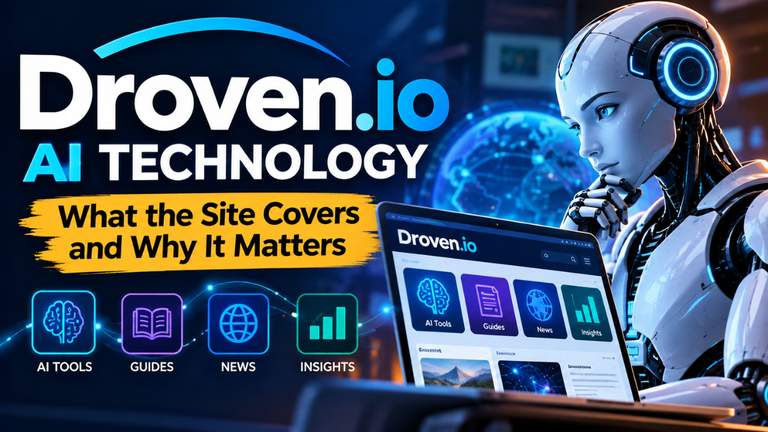
Droven.io presents itself as an editorial website covering artificial intelligence, technology, and digital transformation. Its sections include AI business processes, big data and analytics, and cybersecurity and data privacy. That makes it a place to explore ideas and practical questions around business technology.
For readers, the useful connection is between learning about a capability and deciding whether it belongs in their own business. An explanation of automated customer support might prompt a shop owner to examine unanswered messages. A piece about analytics could encourage a manager to question an unreliable sales forecast.
Reading is the starting point. Before acting on any guide, check whether its examples match your circumstances, whether the information is current, and what evidence supports its claims. Even sensible advice needs testing against the way your team actually works.
Start with the Job That Keeps Getting Stuck
Digital transformation means changing how a business operates through digital technology. IBM’s explanation of digital transformation includes processes, products, operations, and organisational change. Buying a tool is only one part of that work.
Picture a small wholesaler receiving orders by email. Someone reads each message, checks stock, enters the order, and sends confirmation. A missing product code can hold everything up.
An AI system could help identify order details and flag incomplete requests. But first, the business needs consistent product records and a clear route for handling exceptions. Otherwise, the same confusion moves through the system faster.
I’d start by asking the people doing the job where they lose time. Their answers usually produce a more useful project brief than a long feature list. “Help us catch incomplete orders before processing” gives everyone something specific to solve.
Where AI Can Make an Everyday Difference
Some useful applications are easy to overlook because they happen quietly in the background.
Take customer service. A support assistant could group incoming messages by topic, retrieve relevant policy information, and prepare a response for an employee to check. Someone asking about delivery gets a faster answer, while an unusual complaint reaches a person with enough context to help.
Sales teams might use a similar approach to summarise account notes before a call. Operations teams could examine demand patterns when planning stock. In each case, the benefit depends on whether the output helps someone take a useful next step.
Here’s the thing: a good first application doesn’t need to be ambitious. Helping an employee find the correct procedure can be more valuable than building a customer chatbot with access to every company document. The smaller task has clearer boundaries, and mistakes are easier to spot.
Choose a job that happens often enough to measure and has an obvious definition of a good result.
Your Data Needs Attention First
Imagine asking a system which customers haven’t ordered recently. One customer appears under three spellings. Several orders have no date. Old test accounts sit beside real buyers.
The answer might look polished while leaving you with the wrong people to contact.
Before a pilot, inspect the information the system will use. Check for duplicate records, missing fields, outdated documents, and inconsistent labels. Find out who can correct them and which version takes priority when two sources disagree.
You don’t have to tidy every database in the company. Start with the records needed for the chosen task. A support project, for example, might need a maintained product catalogue and current returns policy before it needs years of archived conversations.
Assign someone responsibility for keeping that information accurate after launch. A clean folder today won’t stay useful if nobody updates it when the business changes.
The Connections Matter as Much as the Tool
A demonstration can look effortless because it skips the awkward handovers.
In everyday work, an order may touch an inbox, a stock system, a payment service, and a delivery platform. Before introducing AI, trace that journey from beginning to end. Where does information enter? Who checks it? What happens if an update fails?
Suppose a system extracts the correct details from an order but fails to save them. An employee needs a visible warning and a way to recover the work. Without that, someone may assume the order is progressing while the customer waits.
For an early test, keeping a human approval step can help reveal these gaps. It also gives the team a chance to see whether the proposed workflow makes their job easier once all the handovers are included.
Give Your Team a Say in the Change
Let’s be honest: people may feel uneasy when management introduces software intended to take over parts of their work.
Explain the specific task being changed, who remains responsible, and what staff should do when the system gets something wrong. Then invite the people doing that task to test it.
A support agent may notice that a suggested reply sounds rude. A warehouse worker might know why a supposedly unusual order is perfectly normal. Those observations help shape a workable process.
Training should use examples from the actual job, including difficult cases. Give employees time to practise checking outputs and reporting problems. Their feedback needs somewhere to go, with someone responsible for acting on it.
Build Trust Before Handing Over Control
The amount of control a system receives should depend on the consequences of an error. Drafting an internal summary carries different risks from issuing a refund or changing a customer’s account.
NIST’s AI Risk Management Framework offers voluntary guidance for considering trustworthiness throughout the design, use, and evaluation of AI systems. For a small business, that can start with clear responsibilities and sensible limits.
Decide which information the system needs, who may access it, and which actions require approval. Check a tool’s data handling terms before uploading customer records or confidential documents.
Test uncomfortable situations too. What happens when the relevant policy is missing? Does the system admit uncertainty, ask for help, or produce an unsupported answer? Can an employee see where an answer came from?
Keep a straightforward way to pause the process and correct mistakes. People are more likely to trust a system when they understand its boundaries and can intervene when necessary.
Run a Small Test and Count the Full Cost
Pick one workflow and record how it performs before changing it. For customer support, that could mean handling time, errors, repeat contacts, and unresolved requests.
Now test the proposed approach on a limited set of cases. Include messy examples alongside straightforward ones, and allow enough time to encounter the exceptions your team regularly faces.
Consider a hypothetical result: an assistant saves six minutes preparing each response, but checking and correcting it takes four. The net saving is two minutes. That may still be worthwhile, provided response quality holds up.
Include the cost of setup, subscriptions, integration, training, and ongoing maintenance. Also ask what happens to the time saved. Does it help staff clear a backlog, respond sooner, or handle more work comfortably?
Agree on the criteria for continuing before the test begins. If the results disappoint, review the task, information, and workflow before expanding the project.
Make the Improvement Worth Keeping
The practical value of exploring Droven.io’s coverage of AI and digital transformation comes from turning an idea into a decision you can examine. A useful guide should leave you better prepared to ask questions about your own business.
Start with one recurring frustration. Understand the process around it, prepare the information it needs, and involve the people who deal with it every day. Then test whether the change helps, including the effort required to check and maintain it. When customers get clearer answers and employees spend less time fixing avoidable problems, you have a sound reason to keep improving.