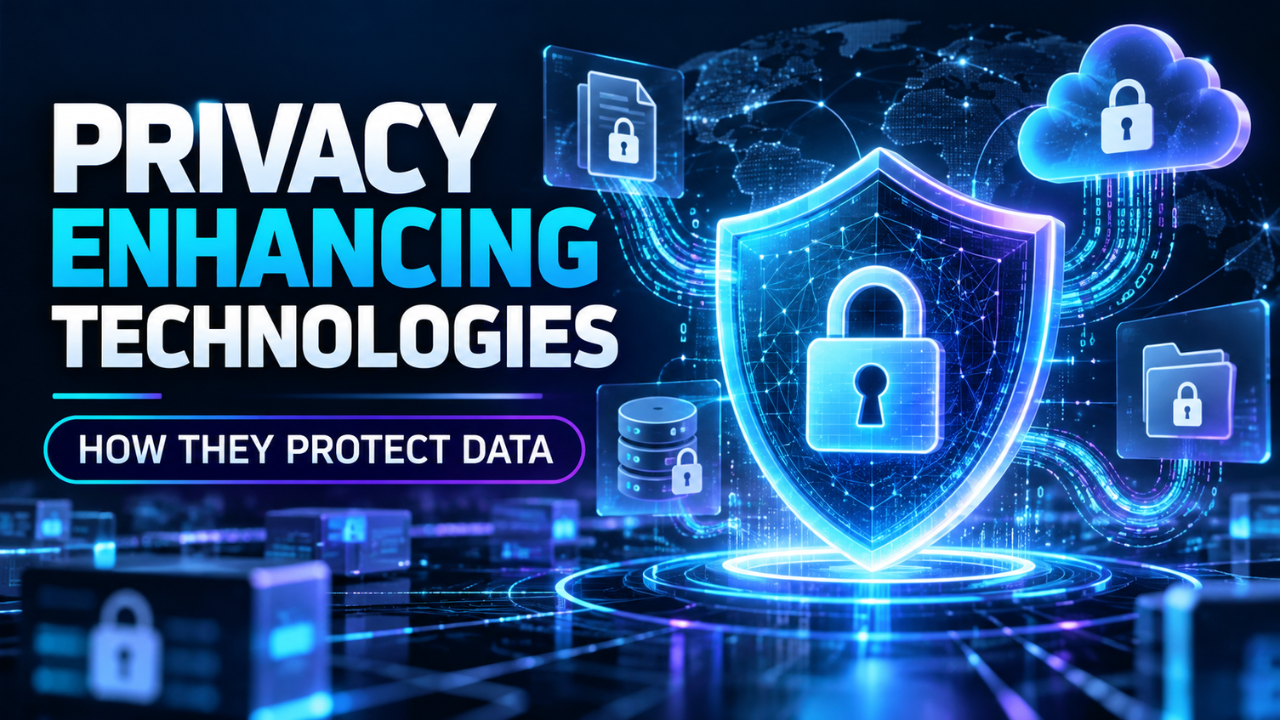
Privacy Enhancing Technologies: How They Protect Data
A hospital wants to study a rare illness. A bank wants to spot fraud across several institutions. Neither should have to hand over every person’s private records to make progress. That’s the promise behind privacy enhancing technologies (PETs): they can help people and organizations use data while reducing how much sensitive information gets exposed along the way.
PETs aren’t one magic product or a shortcut around responsible data handling. They’re a group of techniques, each designed for different kinds of data and risks. more useful question is, “How are privacy-enhancing technologies actually being used to protect sensitive data?” It’s “What information are we protecting, from whom, and at which point in the process?”
Table of Contents
- What Privacy Enhancing Technologies Actually Do
- The Main Types of PETs
- Where PETs Make a Practical Difference
- What PETs Cannot Promise
- How to Choose the Right PET
- A Better Way to Think About Data Privacy
What Privacy Enhancing Technologies Actually Do
Privacy enhancing technologies are technical methods that reduce the risks involved in collecting, analyzing, or sharing data. Some protect information while it’s being used. Others limit what a person can learn from a result, even when they can see the result itself. NIST describes PETs as technical controls that reduce privacy risks by limiting how data is handled.
Think of a group of clinics studying how common a condition is in different age groups. They may need an overall count, but researchers don’t need to read each patient’s medical file. A PET can help produce useful statistics while restricting access to the personal records behind them.
That distinction matters. Standard encryption protects data while it’s stored or being sent, but someone still needs to process it at some point. PETs can add safeguards during that processing or restrict what the final result reveals. They help make data use more controlled, though they don’t remove the need to decide whether collecting the data is appropriate in the first place.
The Main Types of PETs
Differential privacy is a way of limiting what an analysis reveals about any one person. It usually works by adding carefully calibrated noise to results. An organization might publish an approximate count of people who use a service without letting the result hinge too strongly on whether a particular person’s record was included.
The noise is intentional: a small amount of accuracy is traded for a stronger privacy guarantee. That trade-off needs careful attention. Too much noise can make a result less useful; too little may offer weak protection. Repeated queries matter as well, because answering many similar questions can reveal more than answering one. NIST’s guidance on differential privacy focuses on evaluating what a system’s guarantees actually mean in practice.
Federated learning lets a model learn from data held in different places. Instead of gathering all the raw records into one central database, participating devices or organizations train locally and share model updates. For example, several hospitals might contribute to a research model while keeping patient files within their own systems.
Here’s the catch: keeping raw data in one place doesn’t mean every part of the process is automatically private. Model updates can sometimes reveal information, so federated learning may be paired with tools such as differential privacy or secure aggregation. NIST describes these added protections as ways to address risks such as reconstruction and membership inference.
Homomorphic encryption and secure multiparty computation help people perform calculations without freely exposing the underlying information. Homomorphic encryption allows certain computations to be carried out on encrypted data, so the person doing the calculation does not first need to see the original values. Secure multiparty computation lets separate parties calculate a shared result while limiting what each party learns about the others’ inputs.
Picture several banks checking whether a customer’s details appear in more than one fraud database. They may want to identify overlaps without handing one another their full customer lists. Techniques such as private set intersection can help with that narrower task. NIST notes that cryptographic methods can also be combined with differential privacy when organizations need to protect both the inputs and the final statistics.
Zero-knowledge proofs let someone prove that a statement is true without revealing the underlying information. A service might verify that a customer meets an age requirement without receiving their full date of birth. The service gets the answer it needs; the person shares less detail.
Synthetic data is artificial data designed to resemble patterns in a real dataset. It can help teams test software or explore data without routinely handing out the original records. But synthetic data needs review: it can still carry privacy risks if it reproduces distinctive details from the source data. Calling a dataset “synthetic” doesn’t automatically make it safe.
Where PETs Make a Practical Difference
Healthcare and research are clear examples. A rare disease study may need information from several hospitals before the findings are meaningful. PETs can help the hospitals work toward a shared analysis without creating a new central store of everyone’s medical histories. That can make collaboration more feasible when organizations have good reason to work together but are cautious about sharing records.
The same idea applies to financial services. Banks may be able to compare patterns or calculate shared statistics to investigate fraud without circulating full transaction histories. In product analytics, companies can measure broad trends—such as which features people use most—while reducing the need to expose individual activity to every team involved.
PETs can also support digital identity checks. If a website only needs to know whether someone is over 18, a zero-knowledge proof could, in some systems, confirm the requirement without disclosing a birth date. The principle is simple: ask for the fact needed for the decision, rather than collecting a larger bundle of personal details.
Each example calls for a different tool. A method that suits aggregate statistics may be a poor fit for identity checks or training a machine-learning model. PETs are most useful when they’re matched to a real process and a clearly defined privacy risk.
What PETs Cannot Promise
Let’s be honest: a PET doesn’t make every use of data safe by default. If an organization collects more information than it needs, gives access to the wrong people, or keeps records longer than necessary, a clever calculation method won’t fix the whole problem. The data still has an owner, a purpose, and a lifecycle that need to be managed.
There are practical trade-offs, too. Some techniques take more computing power, time, or coordination than ordinary processing. Encrypted computations and secure multiparty systems can add overhead, while differential privacy can reduce the precision of results. NIST points to performance and scaling challenges in privacy-preserving federated learning, including the cost of cryptographic protections.
Even a sound design can fail if it’s implemented poorly. Teams may misconfigure a privacy budget, expose information in logs, or release outputs that reveal more than expected. Federated learning, for example, changes where training data sits; it doesn’t by itself guarantee that shared model updates reveal nothing.
PETs also don’t replace privacy governance. Organizations still need to decide whether data use is justified, explain it clearly, limit access, and check applicable legal and contractual obligations. The technology can reduce certain risks. It can’t make those decisions on its own.
How to Choose the Right PET
Start with the task, not the tool. Write down what the analysis needs to produce, what data it uses, who will take part, and what each participant should be allowed to learn. A hospital study that needs an overall count has a different problem from a website checking an age requirement.
Next, identify the main exposure point. Is the concern that raw records will be copied to a central location? That an analyst will see personal information? That a released statistic could reveal something about a small group? The answer will help narrow the options. Federated learning, for example, may reduce the movement of training data, while differential privacy can limit what published results disclose about individuals.
Then test whether the output is still useful. A protection that makes the result too vague for its intended purpose may not work for that use case. On the other hand, a precise result isn’t automatically worth the exposure required to produce it. Teams should decide what level of accuracy they truly need before picking a technique.
Finally, bring technical, legal, security, and operational people into the same conversation. A PET must fit the system that handles the data: its users, software, partners, and maintenance process. Pilot it with realistic data and measure both privacy protection and performance before relying on it at full scale.
A Better Way to Think About Data Privacy
Privacy enhancing technologies make it possible to ask a more useful question than “Can we access this data?” Teams can ask, “Can we get the result we need while exposing less along the way?”
That shift is practical. Sometimes the answer is differential privacy; sometimes it’s encrypted computation, a zero-knowledge proof, or a combination of methods. The strongest approach begins with the real task, reduces unnecessary data exposure, and checks whether the protection holds in the system people will actually use.