
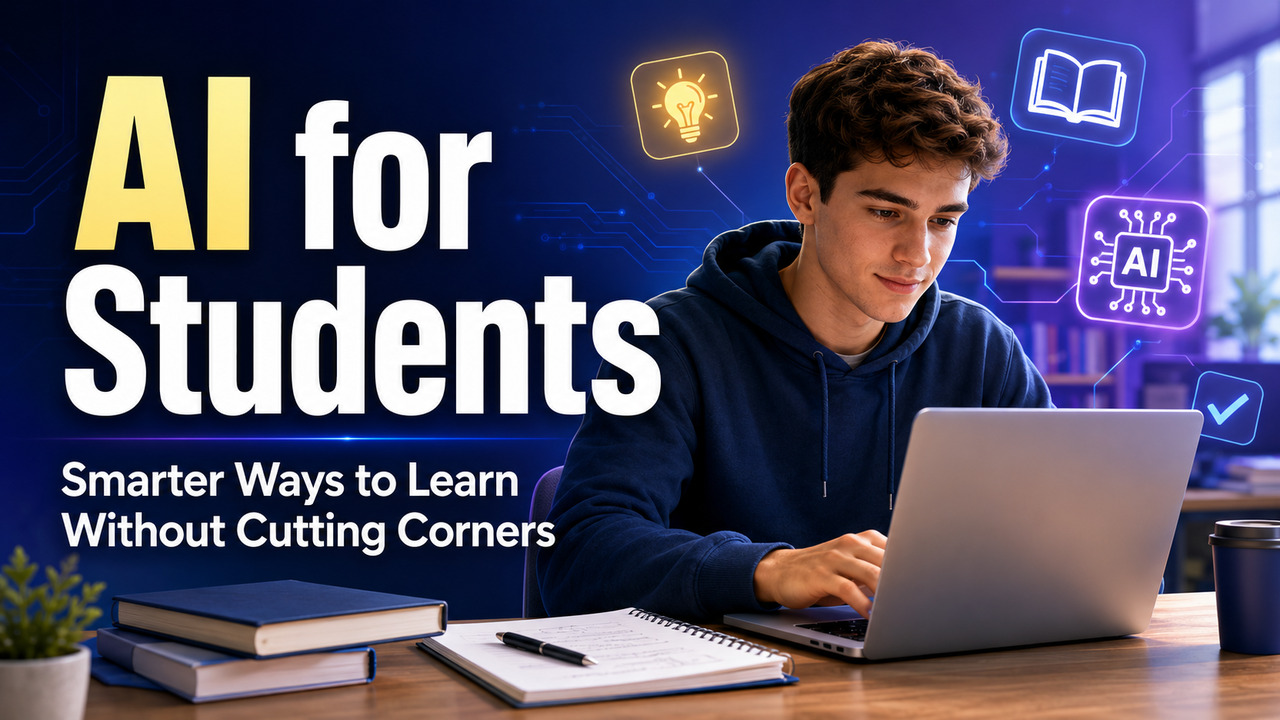
AI for Students: Smarter Ways to Learn Without Cutting Corners
A student sits at a desk with three assignments due, a difficult chapter to understand, and no idea where to begin. A few years ago, the only options were searching through textbooks, messaging a friend, or hoping a useful explanation appeared online. Today, AI can help turn that confusing workload into smaller, manageable steps.
That doesn’t mean students should hand over every task to a machine. Doing so might save time tonight, but it won’t build the knowledge needed for tomorrow’s exam, interview, or career. The real benefit comes from using technology as a study partner: something that explains, questions, organizes, and gives feedback while the student remains in control.
Used thoughtfully, AI for students can make learning more personal and less frustrating. The key is knowing where it genuinely helps—and where it can quietly make learning weaker.
Table of Contents
- Why AI Has Become Part of Student Life
- Turning Difficult Lessons Into Clear Explanations
- Studying Smarter Instead of Longer
- Getting Help With Research and Assignments
- Improving Writing Without Losing Your Own Voice
- Managing Time, Deadlines, and Daily Work
- Using AI for Creativity and Practical Skills
- Where Students Need to Be Careful
- Building Healthy AI Habits
Why AI Has Become Part of Student Life
Students don’t all learn in the same way. One person understands a lesson after reading it once, while another needs examples, diagrams, or a simpler explanation. In a busy classroom, a teacher may not have enough time to explain the same idea five different ways.
That’s where AI can be useful. It can adjust an explanation based on what the student already understands. A complicated biology paragraph can become a short summary. A difficult mathematics concept can be broken into steps. A historical event can be explained as a timeline instead of a wall of text.
There’s also the question of availability. Students often study late at night, early in the morning, or during a short break between classes. Teachers and tutors aren’t always available at those times. A digital study assistant can answer a basic question immediately, allowing the student to keep moving.
Still, convenience shouldn’t be confused with correctness. Fast answers are helpful only when they’re accurate and properly understood.
Turning Difficult Lessons Into Clear Explanations
One of the best uses of AI for students is asking for a different explanation.
Imagine a student named Hamza who has read the same paragraph about photosynthesis three times. The textbook wording still feels confusing. Instead of asking for “the answer,” he could request a simple explanation using a real-life example. He might then ask for five short questions to check whether he understood it.
That small difference matters. Hamza is still learning the topic; he’s simply receiving help in a format that works better for him.
Students can also ask for explanations at different levels. For example:
- Explain this as if I’m a beginner.
- Give me a practical example.
- Show the process step by step.
- Compare this idea with something I already know.
- Test me without showing the answers first.
These requests turn a passive reading session into an active conversation. Let’s be honest, many students lose focus when they stare at a chapter for too long. Being questioned and receiving immediate feedback can make the same material feel more manageable.
Studying Smarter Instead of Longer
Long study hours don’t always produce strong results. A student can sit with an open book for four hours and remember less than someone who studies actively for one focused hour.
AI can help create revision materials from class notes, including flashcards, practice questions, short summaries, and mock quizzes. It can also identify weak areas based on a student’s answers.
Suppose Sara has an English grammar test on Friday. She understands nouns and verbs but keeps making mistakes with tenses. Rather than revising every chapter equally, she can practise the area causing the most trouble. After each answer, she can ask why it was correct or incorrect.
That’s more useful than simply memorizing the final answer.
Students can also use AI to build a realistic revision plan. If an exam is ten days away, the material can be divided into daily sessions with time for practice and review. The plan should leave some breathing room, though. A schedule that expects three perfect hours every evening will probably fall apart after two days.
A practical plan beats an impressive-looking one.
Getting Help With Research and Assignments
Research often becomes overwhelming because students begin with a topic that’s too broad. Search results pile up, sources disagree, and suddenly the assignment feels much larger than expected.
AI can help narrow a topic, suggest research questions, explain unfamiliar terms, and organize early ideas. A student working on climate change, for instance, might reduce the topic to how rising temperatures affect farming in a specific region. That creates a clearer direction.
It can also suggest useful search terms. This is especially helpful when a student knows what they want to investigate but doesn’t know the formal vocabulary used by researchers.
However, generated information shouldn’t automatically be treated as a reliable source. AI systems can make mistakes, mix up facts, or invent references that look believable. Important claims should be checked against textbooks, academic databases, government websites, or other trustworthy publications.
Teachers usually want to see where information came from. “The tool said so” isn’t evidence.
The strongest approach is to use AI for planning and understanding, then use credible sources for facts, quotations, and citations.
Improving Writing Without Losing Your Own Voice
Writing is another area where students need balance. AI can provide feedback on clarity, grammar, structure, and tone. It can point out an unclear paragraph or show where an argument needs stronger evidence.
Consider a student who writes: “Social media is bad for young people because it causes many problems.” The sentence isn’t necessarily wrong, but it’s broad and weak. A helpful response would encourage the student to define which problems, identify the group being discussed, and support the claim with evidence.
That improves the student’s thinking, not just the sentence.
It’s also useful for brainstorming titles, creating an outline, practising vocabulary, or reviewing a completed draft. A student might ask, “Which part of my argument is least convincing?” That question produces more educational value than asking for the entire essay.
The danger appears when students submit generated work they don’t understand. The language may sound polished, but if a teacher asks a simple follow-up question, the gap becomes obvious. More importantly, the student misses the chance to develop an essential skill.
Writing gets better through practice. There’s no shortcut around that.
Managing Time, Deadlines, and Daily Work
Student life involves more than lessons. There are assignments, exams, group projects, applications, presentations, and personal responsibilities. When everything feels urgent, it’s difficult to decide what to do first.
AI can turn a messy task list into a sensible schedule. A student could provide upcoming deadlines and available study hours, then ask for a plan based on urgency and difficulty.
For example, completing a presentation due tomorrow should come before starting an essay due in two weeks. Yet the longer essay shouldn’t be ignored until the final night. Breaking it into research, outlining, drafting, and editing makes it far less stressful.
The student still needs to follow the plan, of course. No tool can create discipline on someone’s behalf. It can set reminders and organize tasks, but it can’t stop endless scrolling or make someone open the textbook.
Sometimes the most useful advice remains surprisingly simple: put the phone away and begin with ten focused minutes.
Using AI for Creativity and Practical Skills
Not every student task involves exams. Students may need to create presentation ideas, practise job interviews, write professional emails, learn basic coding, or prepare for a class discussion.
AI can act as a practice partner. It can play the role of an interviewer and ask questions one at a time. It can simulate a debate, challenge an opinion, or provide feedback on a presentation outline.
A university student preparing for an internship interview could practise answering, “Tell me about yourself.” After responding, the student could ask which parts sounded vague and what details would make the answer stronger.
Language learners can use the same approach. They can hold short conversations, request corrections, and practise situations such as ordering food or speaking to a customer. This kind of low-pressure practice helps build confidence before a real conversation.
Creative students can brainstorm story ideas, explore different viewpoints, or overcome the fear of a blank page. The final choices should still come from them. Creativity becomes more meaningful when technology opens possibilities without making every decision.
Where Students Need to Be Careful
AI can sound confident even when it’s completely wrong. That may be its biggest risk in education.
Students should verify dates, statistics, quotations, scientific claims, and references. If something seems strange, overly certain, or unsupported, check it elsewhere. This habit isn’t only useful for AI; it’s part of becoming a careful reader online.
Privacy matters too. Students shouldn’t upload passwords, identification documents, private school records, personal addresses, or confidential information about other people.
Academic rules also differ between schools and teachers. Some allow AI for brainstorming or proofreading, while others restrict it for particular assignments. Students should check the instructions before using it. Hiding its use can create a much bigger problem than asking permission.
Most importantly, students shouldn’t let convenience weaken their independence. If every question receives an instant answer, patience and problem-solving ability can slowly decline.
Struggling for a few minutes isn’t always bad. Sometimes that struggle is the learning.
Building Healthy AI Habits
A simple rule works well: try first, get help second, and check everything important.
Students should attempt the problem before asking for assistance. They can then compare their thinking with the explanation, correct mistakes, and try a similar problem without help. That final step shows whether genuine learning happened.
AI for students is most valuable when it creates better questions, clearer understanding, and more focused practice. It shouldn’t replace curiosity, effort, teachers, classmates, or trusted sources.
Used carelessly, it can become an easy way to avoid learning. Used well, it can make difficult subjects feel less intimidating and help students become more organized, confident, and independent. The difference doesn’t come from the technology itself. It comes from the habits of the person using it.



One Comment