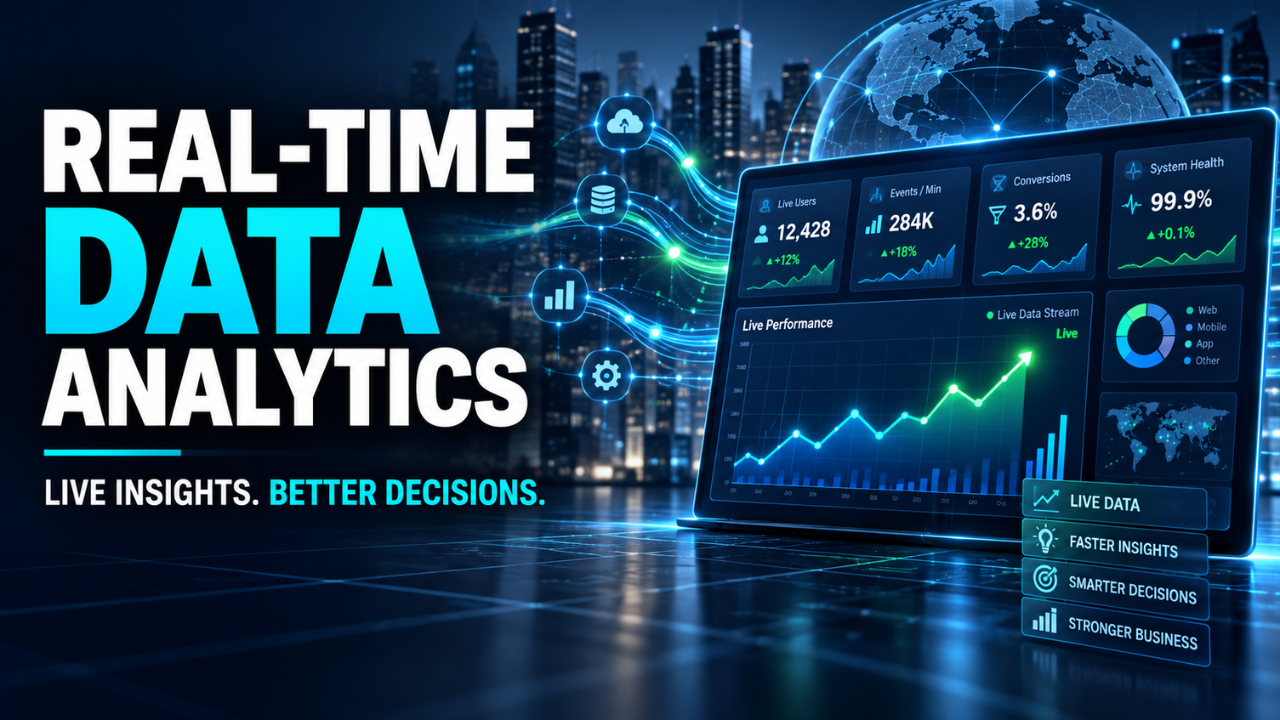
Real-Time Data Analytics: How Live Information Improves Business Decisions
Most businesses don’t struggle because they lack data. They struggle because the data arrives too late.
A sales manager may discover a product is underperforming after the promotion has ended. A delivery company may notice a route problem only after customers start complaining. A security team may find suspicious activity hours after important information has already been exposed.
Real-time data analytics changes that timing. It helps organizations collect, process, and understand information as events happen, giving people a clearer view of what’s happening right now. Instead of waiting for yesterday’s report, teams can respond while a problem is still manageable and an opportunity is still available.
The goal isn’t to watch every number on a screen. It’s to make better decisions when timing matters.
Table of Contents
- What Real-Time Data Analytics Means
- Why Businesses Need Live Information
- How Real-Time Data Analytics Works
- Real-World Uses Across Industries
- Real-Time Analytics vs. Traditional Reporting
- Common Challenges to Consider
- How to Get Started
- The Future of Real-Time Decision-Making
- Final Thoughts
What Real-Time Data Analytics Means
Real-time data analytics is the process of examining information almost immediately after it is created. The information might come from website visits, mobile apps, payment systems, machines, sensors, customer messages, or business transactions.
Traditional reporting often works on a schedule. Data is collected throughout the day, processed overnight, and reviewed the next morning. That approach still has value, especially for financial summaries, long-term planning, and historical comparisons. But it isn’t always useful when a business needs to react quickly.
Real-time analytics focuses on speed and action. If an online store suddenly receives hundreds of failed payment attempts, the system can flag the issue within minutes. If a delivery vehicle leaves its expected route, the operations team can investigate before the delay becomes a larger customer problem.
The phrase “real-time” doesn’t always mean a response within the exact same second. In some situations, a delay of a few seconds is acceptable. In others, five minutes may be too slow. The right speed depends on the decision being made.
Why Businesses Need Live Information
A delayed report tells you what already happened. Live data can help you decide what to do next.
Imagine a clothing retailer running a weekend promotion. One product begins selling far faster than expected. With traditional reporting, the team may not notice until the next day, when the popular sizes are already gone. With live analytics, the retailer can see the demand building, update stock levels, adjust advertising, or move inventory from another location.
The same principle applies to problems. Suppose a subscription company notices that customers are abandoning the payment page at an unusually high rate. Waiting for a weekly report could mean losing thousands of potential renewals. A real-time alert gives the technical team a chance to investigate the payment system while the issue is still active.
Live information also helps businesses reduce guesswork. Managers don’t have to rely entirely on assumptions or outdated spreadsheets. They can look at current activity, compare it with normal patterns, and make decisions based on what customers, employees, or systems are doing now.
That doesn’t mean every decision should be made quickly. Speed is useful when it supports good judgment. Rushing without context can create a different set of problems.
How Real-Time Data Analytics Works
The process usually begins when an event occurs. Someone places an order, a sensor records a temperature change, a customer clicks a button, or an employee scans a package. That event creates data.
The data is then sent through a collection system, often called a data stream or event pipeline. The system organizes the incoming information and sends it to an analytics platform. From there, the platform can apply rules, calculations, or comparisons.
For example, it might check whether:
- Sales are suddenly higher than normal
- A machine is operating outside its safe range
- A customer has attempted several unusual logins
- A delivery is falling behind schedule
- Website traffic has increased sharply from one location
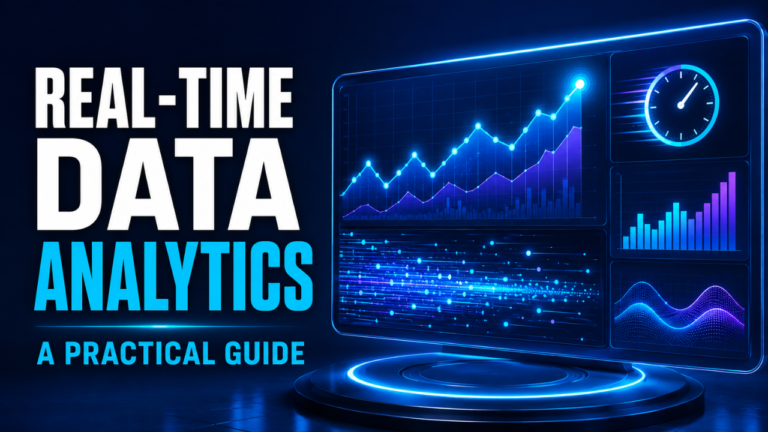
The results may appear in a live dashboard, trigger an alert, update a report, or start an automated response. A customer support manager might see the number of open chats rising. A warehouse supervisor might receive a warning that a freezer temperature is increasing. A bank might temporarily review a transaction that looks suspicious.
The technical setup can become complicated, but the basic idea is simple: capture events, process them quickly, identify meaning, and connect the result to an action.
Good systems also store historical data. Current information becomes much more useful when it can be compared with previous patterns. A sales figure of 500 orders may be excellent on an ordinary Tuesday but disappointing during a major holiday campaign.
Real-World Uses Across Industries
Real-time analytics has practical uses in almost every field.
In retail, businesses use live data to track sales, inventory, customer behavior, and website performance. A store can identify products that are selling quickly and replenish them before shelves are empty. Online retailers can also adjust recommendations based on what shoppers are viewing during a session.
In logistics, live information helps companies monitor vehicles, routes, fuel usage, and delivery progress. If traffic suddenly builds up on a major road, dispatchers can reroute drivers instead of waiting for missed delivery windows.
Manufacturing companies use sensor data to monitor equipment. A machine may continue running even though its vibration or temperature suggests a likely failure. Detecting that change early can allow a technician to schedule maintenance before the machine breaks down and stops production.
Banks and payment providers use real-time analytics to identify unusual transactions. A purchase made in an unexpected location may not automatically indicate fraud, but it can be combined with other signals to decide whether additional verification is necessary.
Healthcare organizations can use live information to monitor patient equipment, bed availability, appointment schedules, and emergency demand. The value is especially clear when staff need to make decisions under pressure.
Marketing teams also benefit. They can see which campaigns are attracting visitors, where people are leaving a website, and whether a product launch is gaining attention. However, live campaign data should be interpreted carefully. A sudden increase in clicks doesn’t always mean an increase in valuable customers.
Real-Time Analytics vs. Traditional Reporting
Real-time analytics and traditional reporting are not competing replacements. They answer different questions.
Traditional reporting is better for understanding broader trends. It can show how revenue changed over several months, which products perform best each quarter, or whether a department is meeting its annual targets. Because the data is usually cleaned and reviewed carefully, it can be useful for formal planning and financial decisions.
Real-time analytics is better for immediate awareness. It can show what is happening during a product launch, a busy shopping period, a service outage, or an unusual security event.
A practical business may use both. Executives review monthly performance reports, while operations teams monitor current activity throughout the day. The historical view explains the bigger picture. The live view helps people respond to movement inside that picture.
Problems usually appear when companies use one type of information for the wrong purpose. Making a long-term strategy based only on a live dashboard can lead to overreaction. Running a live operation using data that is several days old can lead to missed opportunities.
Common Challenges to Consider
The first challenge is data quality. Real-time systems move quickly, but speed doesn’t correct inaccurate information. If customer records are duplicated or a sensor is malfunctioning, the dashboard may simply display bad data faster.
Another issue is alert fatigue. If employees receive warnings for every small change, they may start ignoring them. Alerts should be connected to clear thresholds and meaningful actions. A notification is useful only when someone knows what it means and what to do next.
Cost can also become a concern. Processing large volumes of information continuously may require specialized infrastructure, storage, and technical support. Businesses should avoid collecting everything simply because they can. Start with data connected to a real decision.
Privacy and security require careful attention as well. Live systems may process customer locations, payment activity, employee information, or other sensitive details. Access controls, proper retention policies, and responsible data handling should be part of the design from the beginning.
Finally, people need context. A dashboard can show that sales dropped, but it may not explain why. Strong analytics combines live numbers with business knowledge and human judgment.
How to Get Started
The best starting point is a specific business problem, not an expensive technology purchase.
Ask what decision needs to happen faster. Maybe the company wants to reduce delivery delays, catch payment failures, improve stock availability, or respond more quickly to customer complaints. A clear use case makes it easier to choose the right data and define success.
Next, identify the source of the information. Is it coming from a website, point-of-sale system, customer service platform, warehouse scanner, or machine sensor? The data should be reliable enough to support the decision.
Choose a small number of useful metrics. If a manager needs to know whether orders are being fulfilled on time, the dashboard probably doesn’t need dozens of unrelated numbers. A focused view is easier to understand and more likely to be used.
It also helps to define the action connected to each result. If late deliveries increase, who receives the alert? If inventory falls below a certain level, what happens next? Real-time analytics creates value when information leads to a practical response.
Start small, test the process, and improve it based on real usage. A simple system that helps a team every day is more valuable than a sophisticated dashboard nobody trusts.
The Future of Real-Time Decision-Making
Businesses are moving toward systems that connect live data with faster recommendations and more automated workflows. Operations teams may receive early warnings before a problem becomes visible to customers. Managers may be able to compare current performance with historical patterns without waiting for a separate report.
Still, the future won’t be about replacing human decisions with endless notifications. The strongest systems will reduce noise, explain important changes, and help people focus on decisions that require experience and judgment.
Companies will also become more selective about the data they collect. As information grows, the advantage won’t necessarily belong to the organization with the most data. It will belong to the one that can identify the right signal and use it responsibly.
Final Thoughts
Real-time data analytics gives businesses a clearer view of the present. That can improve response times, reduce waste, protect systems, and create better customer experiences.
But live information is only useful when it is accurate, understandable, and connected to action. A dashboard alone won’t solve a business problem. The real value comes when the right people can see an important change, understand its meaning, and respond before the opportunity disappears.