
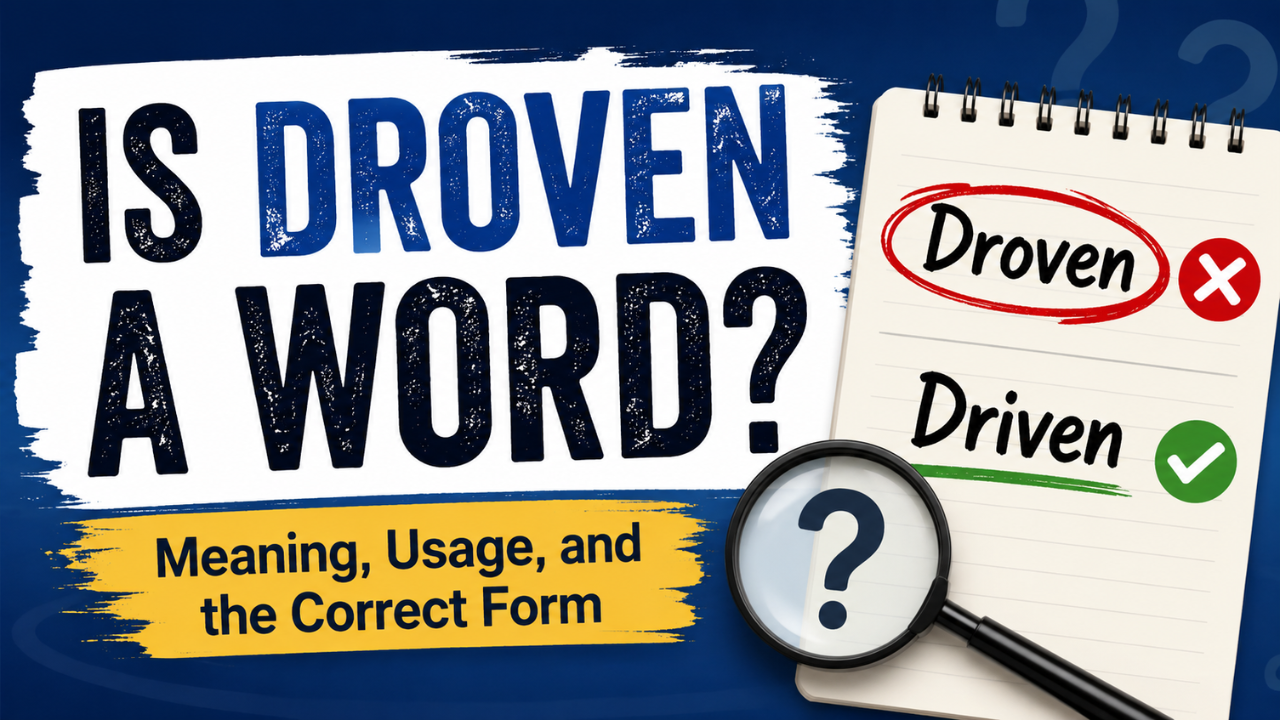
Is Droven a Word? Meaning, Usage, and the Correct Form
You’re typing quickly and a sentence comes out like, “We had droven there before.” You look at it for a second. Droven sounds strangely believable. It follows the shape of words such as driven, frozen, and broken, so why shouldn’t it work?
But is droven a word in standard English?
For normal modern English, droven is not the standard past participle of “drive.” The correct forms are drive, drove, and driven. So you would say, “We drove there yesterday” or “We had driven there before.”
There is a little more behind the confusion, though. English is full of irregular verbs, old forms, dialects, and words that look as if they should follow a pattern but don’t. That’s exactly why droven can sound right even when it isn’t the form you want in everyday writing.
Table of Contents
- Is Droven a Real Word?
- Why Does Droven Sound Correct?
- Drove vs Driven: What’s the Difference?
- Why “Had Droven” Is Incorrect
- Examples of Droven and the Correct Alternatives
- Where You Might See Droven
- A Simple Way to Remember Drove and Driven
- Common Mistakes With Drive
- Does Language Ever Make Droven Acceptable?
- Final Takeaway
Is Droven a Real Word?
If you’re asking whether droven is the normal past-tense or past-participle form of drive, the answer is no.
The standard verb forms are:
Drive → Drove → Driven
Drive is the base form.
“I drive to work every morning.”
Drove is the simple past.
“I drove to work yesterday.”
Driven is the past participle.
“I have driven to work many times.”
That means a sentence such as “I have droven that car” isn’t considered standard English. It should be:
“I have driven that car.”
Likewise:
Incorrect: She had droven home before the storm.
Correct: She had driven home before the storm.
The mistake is understandable because droven feels like it belongs somewhere between drove and driven. English simply doesn’t form this verb that way.
Why Does Droven Sound Correct?
Here’s the interesting part: droven doesn’t sound completely ridiculous.
English has many irregular verbs with vowel changes and past participles ending in -en.
Consider these:
break → broke → broken
speak → spoke → spoken
freeze → froze → frozen
Now compare them with:
drive → drove → driven
Someone learning English might naturally expect:
drive → drove → droven
It looks logical.
Unfortunately, English verbs don’t always care about the pattern we expect them to follow.
The correct participle is driven, not droven. The vowel changes again instead of keeping the o found in drove.
You can see a similar pattern with write:
write → wrote → written
We don’t say wroten.
The same thing happens with ride:
ride → rode → ridden
Not roden.
Once you compare those verbs, driven starts looking much less unusual.
Drove vs Driven: What’s the Difference?
Most people searching for “is droven a word” are really dealing with a drove vs driven problem.
The easiest distinction is that drove normally stands on its own as the simple past tense.
“I drove home.”
“Sarah drove the kids to school.”
“We drove through the mountains last summer.”
Driven, meanwhile, is the past participle. It commonly appears with helping verbs such as have, has, or had.
“I have driven that road before.”
“He has driven across the country twice.”
“They had driven for six hours before stopping.”
You wouldn’t normally say:
“I driven home yesterday.”
And you shouldn’t say:
“I had drove home.”
The correct versions are:
“I drove home yesterday.”
“I had driven home.”
That small difference becomes much easier when you stop trying to choose between words based only on how they sound.
Why “Had Droven” Is Incorrect
One of the most common places droven appears is after had.
Someone might write:
“By midnight, we had droven almost 300 miles.”
The sentence needs the past participle because had + past participle forms the past perfect tense.
The past participle of drive is driven.
So the correct sentence is:
“By midnight, we had driven almost 300 miles.”
Imagine two friends talking about a road trip.
One says, “We stopped around 10 because we’d already droven for five hours.”
You’d probably understand exactly what was meant. Still, standard English requires:
“We stopped around 10 after driving for five hours.”
That’s an important distinction. People may understand a word even if it isn’t considered correct in standard English.
Examples of Droven and the Correct Alternatives
Seeing the mistake inside complete sentences makes the rule easier to remember.
Incorrect: I have droven this truck before.
Correct: I have driven this truck before.
Incorrect: He droven to my house last night.
Correct: He drove to my house last night.
Incorrect: We had droven halfway when it started raining.
Correct: We had driven halfway when it started raining.
Incorrect: She has droven more than 500 miles today.
Correct: She has driven more than 500 miles today.
Notice something important in the second example.
“He droven to my house” becomes “He drove to my house,” not “He driven to my house.”
That’s because there’s no helping verb such as has or had. The sentence simply describes something that happened in the past.
Compare:
“He drove there.”
“He has driven there.”
“He had driven there.”
Once you recognize that pattern, choosing the correct word becomes fairly automatic.
Where You Might See Droven
Although droven isn’t the standard verb form you should use instead of drove or driven, you may still encounter it online.
People invent nonstandard forms all the time during casual conversation. Social media posts, text messages, comments, regional speech, jokes, and informal dialogue don’t always follow textbook grammar.
Someone might write:
“I’ve droven past that restaurant like ten times.”
You understand the message immediately, but standard written English would use:
“I’ve driven past that restaurant like ten times.”
There’s also an important difference between asking whether a form has ever existed somewhere in English and asking whether you should use it in modern everyday writing.
English has centuries of regional forms, obsolete spellings, specialized meanings, surnames, and dialect vocabulary. An unusual form appearing in an old text doesn’t automatically make it the right choice for an email, essay, article, application, or modern conversation.
For practical purposes, if you mean the verb drive, stick with drove and driven.
A Simple Way to Remember Drove and Driven
There’s a useful shortcut.
Think about ride.
You probably already know:
ride → rode → ridden
Now put drive beside it:
drive → drove → driven
The patterns are very similar.
You wouldn’t normally say:
“I have roden a horse.”
You’d say:
“I have ridden a horse.”
In the same way, don’t say:
“I have droven a car.”
Say:
“I have driven a car.”
Another quick trick is to look for have, has, or had.
If one of those words comes directly before the form of drive, driven is usually what you need.
“She has driven.”
“We have driven.”
“They had driven.”
Without one of those helping verbs, when you’re simply describing a completed past action, you’ll often need drove:
“She drove yesterday.”
“We drove home.”
“They drove all night.”
It’s not a rule for every possible sentence construction, but it’s a very useful everyday check.
Common Mistakes With Drive
Droven isn’t the only form that causes trouble.
Another common mistake is using drove after have, has, or had.
For example:
“I have drove there before.”
Because drove is the simple past, that sentence should be:
“I have driven there before.”
Then there’s the opposite mistake:
“I driven there yesterday.”
Without a suitable helping verb, driven doesn’t work as the simple past. You need:
“I drove there yesterday.”
Passive sentences can make things slightly more confusing because driven can also appear with forms of be.
“The car was driven by my brother.”
Here, driven is still the past participle.
The word also works as an adjective:
“She’s a highly driven person.”
In that sentence, driven doesn’t literally mean operating a vehicle. It describes someone who is strongly motivated or determined.
So driven has more than one common use, while droven isn’t the replacement for any of them.
Does Language Ever Make Droven Acceptable?
Language changes. Words that were once considered unusual sometimes become common, and informal speech constantly produces new expressions.
That doesn’t mean every understandable variation becomes standard English.
If a friend texts, “I’ve droven there before,” correcting them probably isn’t necessary unless they asked. You know what they mean.
Context matters.
But if you’re writing something where grammar matters—a school assignment, professional email, business page, published post, résumé, or formal document—use the established forms:
drive → drove → driven
This is one of those situations where descriptive and practical language use meet. Yes, people may occasionally produce droven. Yes, readers can understand it. But if your goal is clear, standard modern English, driven is the safe and correct choice for the past participle.
Final Takeaway
So, is droven a word? Not as the standard past-tense or past-participle form of drive in modern English.
Use drove when describing a completed action in the simple past:
“I drove home last night.”
Use driven as the past participle, especially with have, has, or had:
“I have driven that car before.”
The full pattern is easy to keep:
Drive → Drove → Driven
Droven sounds believable because English contains words such as broken, spoken, and frozen. But drive follows a slightly different pattern. When you’re unsure, remember ride → rode → ridden and drive → drove → driven. That small comparison usually makes the correct form stick.