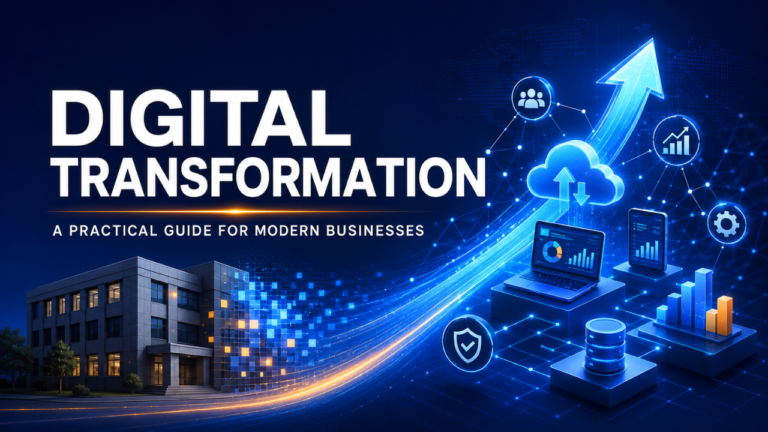
Digital Transformation Framework: A Practical Guide for Modern Business
Digital transformation sounds simple until a business actually tries to do it. Buy better software, move a few processes online, automate repetitive work, and everything should improve. At least, that’s the theory.
Real transformation is messier.
A company might invest in new systems but still have employees copying information between spreadsheets. A retailer may launch a polished online store while its inventory system remains disconnected from customer orders. Another business might collect mountains of useful data but have no clear way to turn it into decisions.
That’s where a digital transformation framework becomes useful. It gives a business a structured way to connect technology, people, processes, data, and customer needs. Instead of introducing digital tools randomly, the organization can decide what needs to change, why it matters, and how success will be measured.
The important point is that a framework isn’t simply an IT plan. Done properly, it becomes a practical roadmap for improving how the whole business works.
Table of Contents
- What Is a Digital Transformation Framework?
- Why Businesses Need More Than New Technology
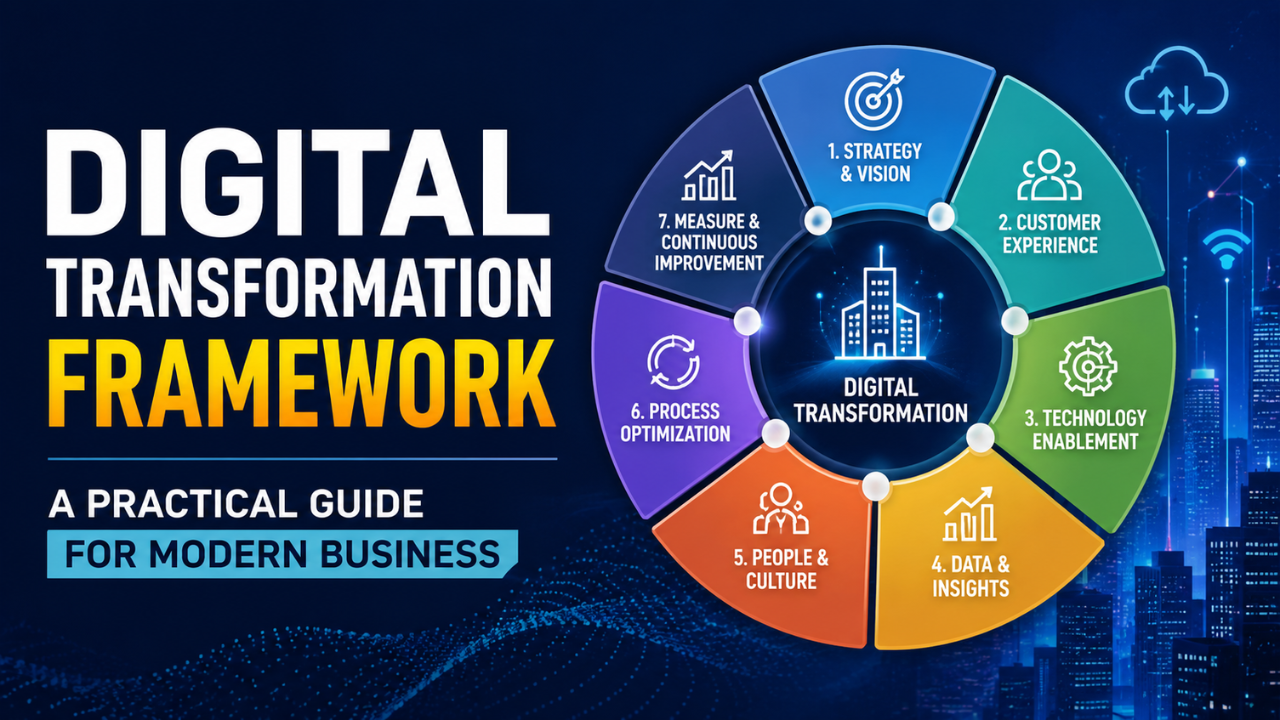
- The Core Parts of a Strong Digital Transformation Framework
- Start With Business Goals, Not Software
- Understand Your Current Digital Position
- Put the Customer at the Center
- Redesign Processes Before Automating Them
- Build the Right Technology Foundation
- Treat Data as a Business Asset
- People and Culture Can Make or Break Transformation
- Turn the Framework Into a Practical Roadmap
- Measure Progress With Outcomes That Matter
- Common Digital Transformation Framework Mistakes
- Building a Framework That Can Keep Changing
- Final Thoughts
What Is a Digital Transformation Framework?
A digital transformation framework is a structured approach businesses use to plan, manage, and measure digital change.
Think of it as the bridge between where an organization operates today and where it wants to operate tomorrow.
The framework may include customer experience, business processes, technology systems, employee capabilities, data management, cybersecurity, leadership, and overall business strategy. The exact shape will differ from one company to another because a small online retailer doesn’t have the same problems as a multinational manufacturer.
What matters is coordination.
Imagine a growing company with separate tools for sales, customer support, billing, and inventory. Each department may be doing its job reasonably well, but information gets trapped between systems. Customers repeat themselves. Employees manually update records. Managers receive reports days after something happens.
Digital transformation should solve those problems as a connected system rather than treating each one separately.
Why Businesses Need More Than New Technology
Technology purchases are easy to see. Transformation isn’t.
A business can move files to the cloud and still operate with slow approval chains. It can introduce a modern CRM while employees continue keeping their own customer spreadsheets. It can build a mobile app without improving the frustrating service sitting behind it.
That isn’t meaningful transformation. It’s mostly digitizing an existing problem.
A framework forces leaders to look beyond individual tools and ask harder questions. Which processes waste time? Where are customers struggling? What important information is not getting to the people who need it? Which capabilities will the company need three years from now?
Those questions change the conversation from “What software should we buy?” to “How should this business work?”
That difference matters.
The Core Parts of a Strong Digital Transformation Framework
There isn’t one universal framework every organization should copy. Still, effective approaches usually connect several important areas: strategy, customers, processes, technology, data, people, governance, and measurement.
These areas depend on each other.
Technology without skilled people gets underused. Data without governance becomes unreliable. Automation built around a poor process simply makes the poor process run faster. A great customer experience can’t survive for long if internal systems constantly fail employees.
A useful framework therefore looks at the organization as a whole.
The balance will change depending on the business. A bank may place heavier emphasis on security, compliance, and data governance. A retailer may focus strongly on customer experience and supply-chain visibility. A small service company might prioritize workflow automation and faster communication.
The framework should fit the business, not the other way around.
Start With Business Goals, Not Software
One of the most practical rules in digital transformation is surprisingly basic: don’t start with technology.
Start with the problem.
Suppose a company wants to reduce customer response times from 12 hours to two hours. That’s a clear business outcome. Teams can then investigate what’s causing the delay and decide whether better workflows, centralized customer information, automation, training, or new technology will help.
Compare that with saying, “We need a new customer service platform.”
The second approach begins with a solution before anyone has properly defined the problem.
Strong transformation goals might include reducing operating costs, improving customer retention, shortening delivery times, increasing employee productivity, entering new markets, or making decisions faster.
Once those outcomes are clear, technology choices become much easier to judge.
Understand Your Current Digital Position
Before planning where to go, businesses need an accurate picture of where they stand.
This is often called a digital maturity assessment, but it doesn’t need to become an enormous consulting exercise. The goal is simply to understand current strengths, weaknesses, dependencies, and bottlenecks.
Look at how employees actually work rather than how process documents claim they work.
A manager may say purchase approvals are handled through the company system. Speak with the team, and you may find that requests move through several steps—sent by email, tracked in spreadsheets, approved through chat, and only later added to the official system.
That gap is valuable information.
Assess existing technology, employee capabilities, customer channels, security practices, data quality, integration between systems, and manual processes. It creates a baseline against which future improvements can be measured.
Put the Customer at the Center
Digital transformation can become very inward-looking. Teams start discussing platforms, databases, integrations, and architecture while forgetting why many of those improvements matter.
The customer should feel the difference.
Consider something as ordinary as changing a delivery address. If customers can update it online in 30 seconds rather than calling support and waiting ten minutes, that’s digital transformation producing a visible result.
Map important customer journeys from beginning to end. Look at how people discover the business, compare options, purchase, receive support, make payments, return products, and interact after the sale.
Then find the friction.
Small improvements across those moments can have a bigger effect than one expensive headline project.
Redesign Processes Before Automating Them
Here’s the thing: automation doesn’t automatically create efficiency.
If a process contains six unnecessary approval steps, automating all six isn’t necessarily progress. Maybe four of those steps should disappear.
Before introducing automation, examine why the process exists in its current form. Some steps may have been created years ago because of an old system limitation. Others may exist because “we’ve always done it this way.”
Question them.
For example, imagine employees manually preparing the same weekly report by exporting data from three systems. Automating the exports would save time. Connecting the underlying data and creating a live dashboard could remove the weekly reporting process almost entirely.
That’s a much more meaningful change.
Build the Right Technology Foundation
Technology still matters enormously. It just needs to serve the wider strategy.
A modern digital foundation should make it easier for systems to communicate, scale, stay secure, and adapt as business needs change. Depending on the organization, that could involve cloud infrastructure, APIs, automation platforms, cybersecurity tools, mobile applications, enterprise software, or integrated customer systems.
Integration deserves particular attention.
A business with 20 modern platforms that don’t communicate may be less efficient than one with five well-connected systems.
Imagine an online order flowing automatically from the website to payment processing, inventory, fulfillment, customer notifications, and financial reporting. Employees don’t need to re-enter the same information at every stage.
That connected flow is where technology begins creating serious operational value.
Treat Data as a Business Asset
Most companies already have plenty of data. The bigger problem is making it trustworthy and usable.
Customer information may live in one platform, financial information in another, website analytics somewhere else, and operational records in spreadsheets. Different departments can end up producing different answers to the same question.
A strong digital transformation framework establishes clear rules around data ownership, quality, access, security, integration, and reporting.
The practical goal is simple: the right people should be able to access reliable information when they need it.
Picture a retail manager noticing that one product is suddenly selling faster in a particular region. With current data, stock can be moved before stores run out. With a report produced two weeks later, the opportunity may already be gone.
Speed matters, but trustworthy data matters just as much.
People and Culture Can Make or Break Transformation
A technically perfect project can fail because employees don’t understand it, don’t trust it, or don’t see how it helps them.
This is why change management belongs inside the framework rather than being treated as an afterthought.
Employees need practical training, clear communication, and opportunities to provide feedback. Managers also need to explain why a change is happening instead of simply announcing that everyone must use a new system from Monday.
Resistance can reveal genuine problems.
If experienced employees keep avoiding a new workflow, don’t immediately assume they’re being difficult. Perhaps it takes twice as long as the previous method. Maybe important features are missing. Maybe training was poor.
Listen before pushing harder.
Successful digital organizations create a culture where people can test better ways of working without treating every unsuccessful experiment as a disaster.
Turn the Framework Into a Practical Roadmap
A framework explains what matters. A digital transformation roadmap turns those ideas into action.
Not everything should happen at once.
Projects can be prioritized based on business impact, urgency, cost, complexity, risk, and dependencies. Quick wins are useful because they build confidence, but they shouldn’t distract from larger structural improvements.
A company might begin by connecting customer and sales information, then redesign support workflows, modernize reporting, and gradually replace older infrastructure.
Each stage should have clear ownership.
Someone needs responsibility for the outcome, not merely for installing the technology. That distinction prevents transformation projects from becoming endless implementation programs with unclear business value.
Measure Progress With Outcomes That Matter
Transformation needs measurable results.
Useful metrics depend on the original goals. A company focused on customer service might track response time, resolution time, customer satisfaction, and repeat contacts. An operations project could measure processing time, error rates, manual hours, or cost per transaction.
Avoid becoming obsessed with activity metrics.
Training 500 employees sounds impressive, but did employees actually adopt the new system? Launching seven digital tools sounds productive, but did productivity improve?
Measure what changed in the business.
It’s also worth establishing baseline numbers before major work begins. Without knowing that an old process took four days, it’s difficult to demonstrate the value of reducing it to six hours.
Common Digital Transformation Framework Mistakes
The biggest mistake is treating transformation as a technology project owned entirely by the IT department.
Another is trying to transform everything simultaneously.
Organizations also run into trouble when they copy another company’s framework too closely, ignore employee feedback, underestimate legacy systems, collect data without improving its quality, or fail to assign clear ownership.
Then there’s the finish-line problem.
A business creates a three-year transformation program and assumes that once the final project is completed, transformation is finished. But markets change. Customer expectations shift. New competitors appear. Technology evolves.
A framework needs room for continuous adjustment.
Building a Framework That Can Keep Changing
The strongest digital transformation framework isn’t a rigid diagram hanging in a meeting room. It’s a working system for making better decisions about change.
Review priorities regularly. Retire technology that no longer provides value. Revisit customer journeys. Watch operational metrics. Keep developing employee skills. Strengthen security as systems become more connected.
Most importantly, keep linking digital investments back to real business outcomes.
Digital transformation works best when it stops feeling like a special project and becomes part of how the organization operates. Teams notice friction, test improvements, measure results, and keep moving.
That’s the real takeaway. A framework won’t transform a business by itself. What it can do is give people a shared direction, prevent disconnected technology decisions, and turn ambitious ideas into manageable changes. Start with the business problem, connect people and processes with the right technology, measure what genuinely improves, and keep adapting.