
Generative AI: What It Is and Why It Matters
Generative AI has moved from a tech-world buzzword to something people use every day. You may have seen it help write an email, create an image, summarize a long report, or turn a rough idea into a working piece of code.
That sounds impressive, and it is. But the real value isn’t that it can produce things quickly. It’s that it can help people get past the blank-page moment, explore ideas faster, and spend more time on judgment instead of repetitive first drafts.
A small business owner can use it to create social media captions quickly. A student may use it to simplify difficult notes. A designer might test several visual directions before choosing one. The tool is different in each case, but the pattern is the same: it gives you a starting point.
Table of Contents
- What Generative AI Actually Does
- How Generative AI Works in Simple Terms
- Where People Use Generative AI Today
- The Best Part: Faster First Drafts
- Where It Can Go Wrong
- Using Generative AI While Keeping Your Own Voice
- Generative AI and the Future of Work
- Final Thoughts
What Generative AI Actually Does
Generative AI is technology that creates new content from instructions, examples, or patterns it has learned. That content can be text, images, music, video, code, voice, designs, and more.
The word “generative” matters here. Traditional software usually follows fixed rules. You enter numbers into a calculator, and it gives you an exact answer. You click a button in a spreadsheet, and it sorts your data.
Generative AI works differently. You give it a request, such as “write a friendly reply to this customer” or “create a modern logo idea for a coffee shop,” and it produces something new based on your direction.
Think of it like working with a very fast assistant who always needs clear instructions. If your instruction is simply “make something nice,” you’ll probably get a vague result. If you say, “write a warm 80-word welcome email for first-time customers, using simple language,” the output becomes much more useful.
That’s why people often get mixed results. The tool matters, but the request matters just as much.
How Generative AI Works in Simple Terms
At a basic level, generative AI learns patterns from huge amounts of existing information. It studies how words usually fit together, what makes an image look like a beach, how code is structured, or how different styles are formed.
Then it uses those patterns to create a fresh response.
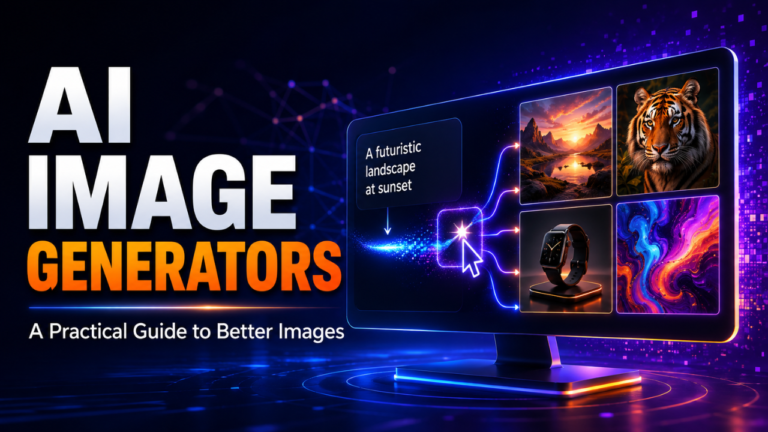
For text, it predicts what should come next based on your prompt and the context. For images, it turns written descriptions into visual details. For code, it recognizes common programming patterns and suggests possible solutions.
It doesn’t “think” like a person sitting at a desk with a coffee and a deadline. It doesn’t have life experience, personal beliefs, or real-world common sense in the human way. Still, it can be remarkably good at finding patterns and turning a rough request into a usable draft.
Here’s a simple example. Imagine you run a local bakery and need a post for a weekend offer. You could write:
“Create a short Instagram caption for a bakery’s fresh chocolate cake offer this Saturday. Keep it warm and casual.”
Within seconds, you have a starting point. Maybe it’s not perfect. Maybe you change a few words to match your style. But you’re no longer staring at an empty screen.
That’s where the time-saving begins.
Where People Use Generative AI Today
Generative AI is showing up in places that don’t always look “technical.” It’s becoming part of normal work, creative projects, and daily problem-solving.
Writers use it to organize ideas, improve rough wording, or create outlines. Marketers use it to brainstorm campaign angles. Developers use it to explain code or spot bugs. Customer support teams use it to draft replies faster.
It also helps outside work.
A parent might ask for easy lunch ideas using ingredients already in the kitchen. Someone planning a trip might use it to build a loose itinerary. A job seeker may use it to improve the clarity of a resume. These are ordinary tasks, but they can take a surprising amount of energy.
Visual tools are especially interesting. A person with a product idea can describe packaging, colors, and a mood, then quickly see possible concepts. That doesn’t replace a skilled designer. Good designers bring taste, strategy, and an understanding of people. But it can make early brainstorming much quicker.
A useful tool, not a magic button
Let’s be honest: generative AI can produce a lot of average content very quickly. If everyone accepts the first result without thinking, the internet becomes repetitive and bland.
The strongest results happen when a real person stays involved. Use the output as raw material. Add your experience. Fix weak details. Remove anything that doesn’t sound like you.
The final quality still comes from human judgment.
The Best Part: Faster First Drafts
The first draft is often the hardest part of any task. Not because people lack ideas, but because starting feels heavy.
You know you need to write the proposal, reply to the client, plan the presentation, or create the product description. Yet you keep delaying it because the first sentence feels too important.
Generative AI can make that first step easier.
Instead of asking it to “do everything,” use it to break the task into smaller moves. Ask for ten headline ideas. Ask for a rough structure. Ask it to turn messy notes into a cleaner format. Ask for three different tones: friendly, direct, and professional.
Now you’re choosing, editing, and improving instead of struggling to begin.
For example, if you manage a website and need an article brief, you can provide the main topic, target reader, and key points. The tool can help you shape a clear outline. Then you can add the details that come from your own research and experience.
This approach is practical because it keeps you in control. You’re not handing over your thinking. You’re removing some of the friction around getting started.
Where It Can Go Wrong
Generative AI can sound confident even when it is wrong. That is one of the biggest things to remember.
It may give an outdated fact, misunderstand a question, make up a source, or present a weak idea in polished language. A clean sentence is not automatically a correct sentence.
This matters even more in areas like health, legal advice, money, safety, or business decisions. If the information could affect someone’s well-being or finances, check it from reliable sources before acting on it.
There’s also the issue of privacy. Don’t paste sensitive customer information, private documents, passwords, financial records, or confidential business details into tools unless you know exactly how that information is handled.
Another risk is losing your own voice. If you use the same type of prompt every day and publish the output without editing, your content can start to feel flat. It may be grammatically fine, yet somehow lifeless.
Readers notice that.
They respond to specific examples, real opinions, honest lessons, and small details that only a person involved in the work would know.
Using Generative AI While Keeping Your Own Voice
The easiest rule is this: give it your raw material first.
Don’t start with a blank request when you can share your notes, rough thoughts, customer questions, product details, or personal viewpoint. The better your input, the more useful the output becomes.
Say you’re writing about guest posting. Rather than requesting a general post, explain what you’ve seen in real work. Mention that clients care about traffic, relevance, turnaround time, and whether a site is genuinely maintained. Those details give the writing a more grounded direction.
It also helps to ask for options instead of one final answer. Ask for five opening lines. Ask for three ways to explain a difficult idea. Compare them, combine the best parts, and rewrite them in your own voice.
Keep your final edit simple:
- Check facts and numbers.
- Remove overused phrases.
- Add a real example or opinion.
- Make sure the tone sounds like you.
- Read it aloud once.
Reading aloud is underrated. If a sentence feels strange when spoken, it will probably feel strange to the reader too.
Generative AI and the Future of Work
Generative AI will change jobs, but it won’t affect every role in the same way. Some repetitive tasks will become faster. Some entry-level work may change shape. New skills will become more valuable.
The people who benefit most will usually be those who learn how to guide the tools well.
That doesn’t mean everyone needs to become a programmer. It means learning how to ask better questions, check results, make decisions, and add the context that a machine cannot naturally understand.
For many professionals, the future may look less like replacement and more like leverage. A small team can handle more work. A freelancer can produce better first drafts faster. A business owner can test ideas without waiting days for every small task.
Still, speed alone isn’t enough. Trust, taste, relationships, and responsibility remain important. A client doesn’t just pay for words on a page. They pay for someone who understands the goal, notices problems, and makes smart choices.
That part is still deeply human.
Final Thoughts
Generative AI is most useful when you treat it like a practical partner for early ideas, repetitive tasks, and rough drafts. It can save time, unlock momentum, and help turn vague thoughts into something concrete.
But it works best with your direction, your standards, and your final judgment. Use it to move faster, not to stop thinking. That balance is where generative AI becomes genuinely valuable.