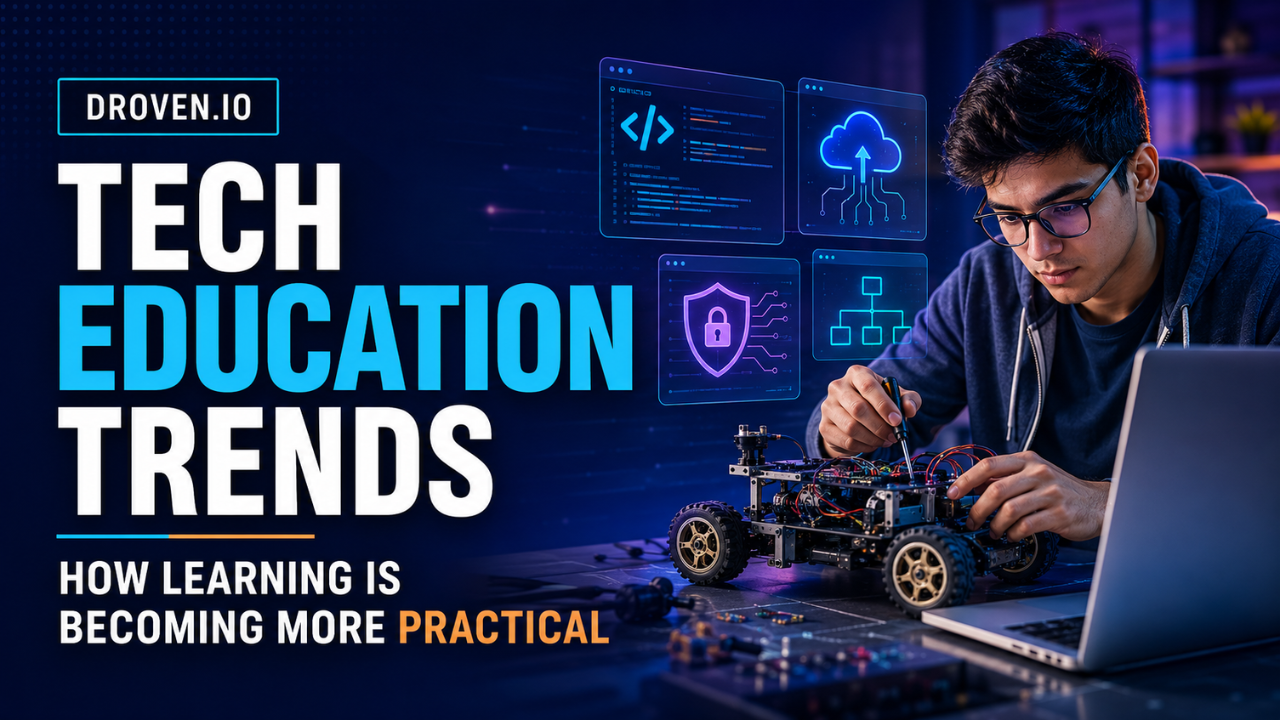
Droven.io Tech Education Trends: How Learning Is Becoming More Practical
Technology changes quickly, but the way people learn it has often moved at a much slower pace. A student might spend months studying theory, complete a course, and still feel lost when facing a real project.
That gap is finally starting to close.
The latest Droven.io tech education trends point toward learning that is shorter, more practical, and closely connected to real work. Students aren’t simply collecting information anymore. They want to build useful skills, prove what they can do, and adapt as technology changes around them.
Table of Contents
- Learning Is Being Rebuilt Around Useful Skills
- Short Courses Are Becoming More Valuable
- Projects Are Replacing Passive Learning
- Hybrid Learning Is Becoming More Intentional
- Teachers Are Moving From Lecturers to Guides
- Human Skills Matter in Technical Careers
- Access, Privacy, and Digital Wellbeing Need Attention
- What These Trends Mean for Learners
Learning Is Being Rebuilt Around Useful Skills
Traditional education usually starts with subjects. Modern tech education increasingly starts with a question: what should the learner be able to do?
That small shift changes everything.
Instead of spending weeks memorizing cloud computing terms, for example, a learner might be asked to deploy a simple application, configure storage, and solve a basic access problem. The theory still matters, but it appears when the student actually needs it.
This practical approach reflects what’s happening in the workplace. The World Economic Forum’s Future of Jobs Report 2025 found that technological change is reshaping the skills employers need. It also reported that nearly 40% of the skills required at work are expected to change by 2030.
A four-year qualification can provide a strong foundation, but it can’t teach every tool someone may use throughout a career. Learning programs must therefore focus on durable abilities: solving problems, understanding systems, checking information, and learning unfamiliar tools without constant supervision.
Picture a junior developer facing an error they’ve never seen before. Remembering a textbook definition won’t be enough. They need to read the message, inspect the code, test possible causes, and explain the solution. That’s the kind of ability practical education should develop.
Short Courses Are Becoming More Valuable
Not every learner needs another long degree. Sometimes, they need one specific skill by next month.
That’s why short courses, focused certificates, and modular learning programs are becoming more useful. A marketing professional might study data visualization for six weeks. A network technician may complete a cybersecurity module. Later, those smaller achievements can become part of a broader qualification.
The attraction is easy to understand. Learners can fit shorter courses around jobs, families, and other responsibilities. They can also update their knowledge without starting their education again from the beginning.
Still, shorter doesn’t automatically mean better.
A useful course should have a clear outcome, guided practice, feedback, and some form of honest assessment. Watching five hours of recorded lessons may feel productive, but recognition isn’t the same as mastery. If the learner can’t perform the task without copying the instructor, the course hasn’t done enough.
The strongest short programs tend to be narrow and specific. “Learn everything about cybersecurity” is too broad. “Identify common phishing attempts and secure a small business email account” gives the learner something real to achieve.
Projects Are Replacing Passive Learning
Let’s be honest: it’s easy to watch a tutorial and believe you understand the topic. The truth appears when the video ends and you try to do the work alone.
Project-based learning exposes that difference early.
A student studying web development might build a responsive website for a local café. Someone learning data analysis could clean a messy sales file and turn it into a simple dashboard. A cloud learner might create a small test environment and document how it works.
These projects teach more than technical steps. Students learn how to handle unclear instructions, manage time, notice mistakes, and make decisions. Those lessons are difficult to gain from multiple-choice questions alone.
Projects also give learners evidence of their skills. A certificate tells an employer that a course was completed. A working application, technical report, or public portfolio shows what the person can actually produce.
Not every project needs to be large or complex. In fact, smaller finished projects are often more useful than ambitious ideas that remain half-complete. A clean, functioning tool with a clear explanation can reveal far more than an unfinished “next big platform.”
Good tech education is beginning to treat the portfolio as part of the learning process, not something students hurriedly assemble after graduation.
Hybrid Learning Is Becoming More Intentional
Online learning proved that education doesn’t always require a physical classroom. It also revealed something important: putting lessons on a screen isn’t enough.
Effective hybrid learning gives each environment a purpose.
Students might watch a short explanation at home, complete a guided exercise online, and use classroom time for discussion, troubleshooting, or group work. Recorded material provides flexibility, while live sessions create space for feedback and human connection.
Consider a student learning spreadsheet automation. They can watch the basic demonstration whenever their schedule allows. During a live session, however, they can bring in a formula that keeps failing and work through the problem with an instructor. Both parts support each other.
The World Bank’s work on digital technologies in education emphasizes infrastructure, digital content, learning platforms, and teacher skills. That combination matters because buying devices alone doesn’t improve learning. Schools also need relevant material, trained educators, technical support, and a sensible plan for using the technology.
The future of hybrid education won’t be defined by how much content moves online. It will be judged by whether online and in-person activities make learning clearer, more flexible, and more effective.
Teachers Are Moving From Lecturers to Guides
When information was difficult to access, the teacher’s main job was often to deliver it. Now, learners can find thousands of explanations within seconds. The harder task is deciding which explanation is accurate, useful, and appropriate.
That makes teachers more important, not less.
Their role is shifting toward guidance. A strong instructor helps students ask better questions, choose suitable resources, recognize weak information, and connect separate ideas. They also notice when someone appears busy but isn’t actually learning.
For example, a student may complete a coding task by following copied steps. The output works, yet the learner can’t explain why. A thoughtful teacher will pause, change part of the problem, and ask the student to solve it again. That moment turns imitation into understanding.
Teachers also create structure. Online information is abundant, but it’s scattered. Beginners rarely know what to learn first or which details can wait. A good educator builds a path through that confusion and provides feedback at the points where learners usually struggle.
Technology can speed up routine tasks, organize resources, and offer extra practice. Judgment, encouragement, and meaningful feedback still require a strong human presence.
Human Skills Matter in Technical Careers
Technical knowledge may help someone get an interview, but human skills often decide how well they perform after being hired.
Developers need to explain delays. Cybersecurity professionals must communicate risks without creating panic. Data analysts have to turn complicated findings into recommendations that other people can understand. Even highly independent technical roles involve teamwork, judgment, and responsibility.
The Future of Jobs report identifies creative thinking, resilience, flexibility, curiosity, and lifelong learning as increasingly important alongside technical knowledge. That pairing makes sense. Tools will change, but people will still need to make decisions about how and when to use them.
Tech courses are responding by adding group projects, presentations, peer reviews, and written explanations. These activities may feel less exciting than learning a new platform, yet they mirror real work.
Imagine two candidates with similar technical ability. One sends vague updates and becomes defensive when questioned. The other explains decisions clearly, listens to feedback, and admits when something needs checking. Most teams will choose the second person.
Communication isn’t an extra skill sitting beside technical knowledge. It’s how technical knowledge becomes useful to other people.
Access, Privacy, and Digital Wellbeing Need Attention
The growth of digital education can create new opportunities, but it can also deepen old inequalities.
A fast laptop, reliable internet connection, quiet workspace, and paid software may seem normal to one learner. For another, they’re serious barriers. UNESCO reports that internet access has expanded worldwide, yet many schools still lack reliable connectivity, particularly at the primary and lower-secondary levels. Its digital education overview shows why access remains a central issue rather than a solved problem.
Smart programs plan for low-bandwidth connections, mobile devices, downloadable lessons, captions, and flexible deadlines. These details can decide who gets to participate.
Privacy deserves equal care. Education platforms may collect names, progress records, assessment results, device information, and patterns of activity. Schools and learners should understand what data is collected, why it’s needed, and how long it will be stored.
Digital wellbeing matters too. More screen time isn’t always better learning. A well-designed course leaves room for reading, conversation, handwritten planning, physical practice, and rest. Technology should remove unnecessary friction, not turn every minute of education into another notification.
What These Trends Mean for Learners
The clearest lesson from current tech education trends is that learning has become an ongoing process. Finishing one course is useful, but knowing how to keep learning is far more valuable.
Choose programs that include real practice, useful feedback, and work you can show. Build small projects instead of endlessly collecting tutorials. Strengthen communication alongside technical ability, and don’t confuse familiarity with competence.
Most importantly, stay curious without chasing every new tool. You don’t need to learn everything. You need a solid foundation, a practical direction, and the confidence to adapt when the next change arrives. That’s what modern tech education should provide.