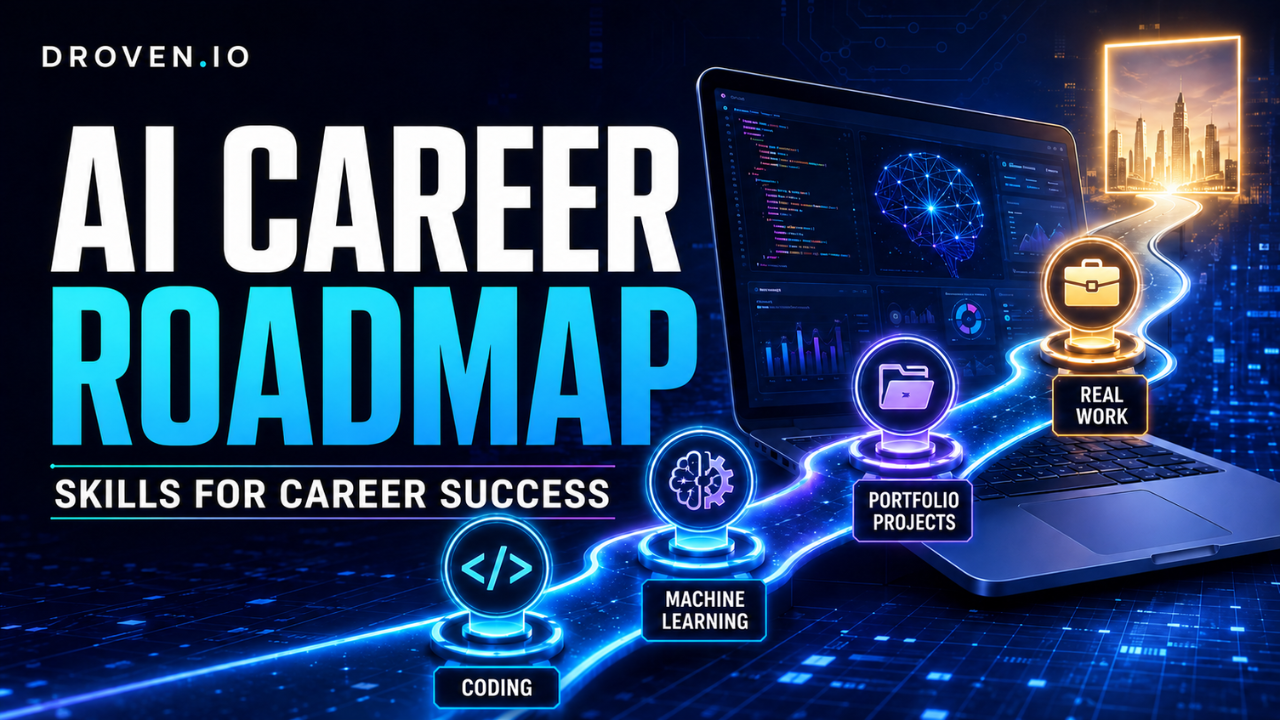
Droven.io AI Career Roadmap: Skills for Career Success
Artificial intelligence can look like a career gold rush from the outside. New tools appear every week, job titles keep changing, and online advice often makes it seem as though you must learn everything before you can apply for anything. That’s a fast route to confusion.
The Droven.io AI career roadmap offers a more useful way to think about the journey: choose a direction, learn the foundations that support it, build evidence of your ability, and improve through real feedback. You don’t need to become a mathematician, software engineer, product manager, and researcher at the same time. You need a sensible path that matches the work you actually want to do.
Table of Contents
- Why a Clear Roadmap Matters
- Start With a Role, Not a Course
- Learn the Foundations Without Getting Stuck
- Choose a Career Track That Fits You
- Build Projects That Solve Real Problems
- Get Comfortable With Modern Workflows
- Turn Your Portfolio Into Proof
- Prepare for the Job Market
- A Practical 90-Day Plan
- Mistakes That Slow Career Progress
- Build Momentum One Useful Skill at a Time
Why a Clear Roadmap Matters
Without a roadmap, learning becomes a collection of random tutorials. You finish a Python course, watch a few machine learning videos, test a chatbot, and still don’t know what kind of role you can handle. The individual activities may be useful, but they don’t add up to a clear professional story.
A roadmap connects your learning to an outcome. If your goal is to become a data analyst who uses intelligent tools, you can focus on spreadsheets, SQL, data cleaning, visualization, and basic automation. You probably don’t need to train a large language model from scratch.
That focus saves time and makes progress easier to measure. Ask, “Can I complete the main tasks expected in this role?” rather than, “Do I know enough yet?”
Start With a Role, Not a Course
Course platforms are good at selling beginnings. Careers are built around destinations. Before choosing what to study, examine a few roles and note the work they involve every day.
An AI engineer may build and deploy models. A data scientist studies data, tests ideas, and communicates findings. A product manager connects user needs with technical possibilities. An automation specialist improves repetitive business processes. A content or marketing professional may use language and image tools without writing complex code.
Imagine Sara, who works in customer support. She wants to move into a more technical position, but she doesn’t enjoy advanced mathematics. Jumping directly into deep learning theory would likely frustrate her. A better route could be conversational design, support automation, knowledge-base management, or no-code workflow development. Her existing customer experience becomes an advantage rather than something she leaves behind.
Read real job descriptions before committing. Repeated responsibilities reveal what employers actually value.
Learn the Foundations Without Getting Stuck
Every track needs a base, but the depth changes with the role. Most people benefit from understanding data, basic statistics, model limitations, privacy, bias, and how automated systems make or support decisions. Technical tracks will also require programming, usually Python, plus SQL, APIs, version control, and cloud basics.
Learn concepts through use. If you study classification, build a small system that sorts customer messages by topic. If you’re learning SQL, analyze a simple sales database and answer practical questions. Theory becomes memorable when it helps you finish something.
Math deserves a balanced approach. Understand probability, averages, distributions, vectors, and model evaluation, but don’t delay every project until you’ve mastered advanced calculus. With coding, start by reading, changing, and debugging small programs. The first goal is simply to test an idea.
Choose a Career Track That Fits You
There isn’t one correct route into the field. Your experience, interests, and tolerance for technical work should shape the choice.
If you enjoy building systems, an engineering track may suit you. If you prefer finding patterns and explaining them, consider data analysis or data science.
Strong business or communication skills can lead to product, consulting, operations, design, or responsible technology roles. Existing industry knowledge remains valuable in every track.
Let’s be honest: a fashionable title isn’t enough. Choose work you can imagine doing on an ordinary Tuesday, not just a role that sounds exciting on social media. You can change direction later, but an initial focus helps every new skill reinforce the last one.
Build Projects That Solve Real Problems
Certificates show that you completed lessons. Projects show what you can do when the steps aren’t provided. Employers usually find the second signal more convincing.
A strong beginner project doesn’t need millions of records or an expensive cloud setup. It needs a clear problem, a reasonable solution, and an honest explanation of the result. You might create a tool that summarizes support tickets, predicts basic inventory needs, searches a set of company documents, or flags duplicate product listings.
Suppose you build a résumé-matching tool. Don’t stop at a working screen. Explain how the text is processed, what the scoring means, where the system can fail, and how you would protect applicants from unfair decisions. That turns a basic demo into evidence of professional judgment.
Aim for two or three polished projects rather than twelve unfinished experiments. Let each one demonstrate a different ability.
Get Comfortable With Modern Workflows
Real work rarely happens inside a single notebook. Learn Git well enough to save changes, create branches, and explain decisions. Practice calling an API and handling failed responses. Store secrets safely, add simple tests, and track cost and response quality when using hosted models.
Also learn to evaluate output instead of trusting a polished answer. Check accuracy, consistency, speed, privacy, and usefulness. A system that works beautifully in a five-minute demo may perform poorly with messy customer data. Professional value comes from noticing that gap early.
Turn Your Portfolio Into Proof
A portfolio should make your thinking easy to inspect. For each project, state the problem, your role, the tools used, the main decisions, the outcome, and what you would improve next. Include screenshots or a short demo where helpful, but don’t hide weak explanations behind attractive visuals.
Numbers help when they’re genuine. “Reduced manual tagging time by 40% on 500 test messages” says more than “built an innovative solution.” A clear README, sensible file names, setup instructions, and a short limitations section also signal care.
Prepare for the Job Market
Once you have useful skills and two solid projects, start applying. Waiting until you feel completely ready usually becomes an excuse. Job descriptions often describe an ideal candidate, not the minimum acceptable person.
Tailor your résumé around outcomes. Replace long lists of tools with examples of what you built, improved, measured, or automated. Use the language of the role where it accurately matches your experience.
For interviews, practice explaining one project from beginning to end. Be ready to discuss trade-offs, failed attempts, data quality, security, evaluation, and the next improvement. A calm explanation of what went wrong can be more impressive than pretending everything worked immediately.
A Practical 90-Day Plan
During the first 30 days, choose one target role and study 20 job descriptions. List the five most repeated skills, learn their basics, and complete small exercises. Keep the scope narrow enough for consistent study.
From days 31 to 60, build your first complete project around an industry you understand. Create a basic version quickly, test realistic examples, and improve the weakest part. Ask someone to use it without your help; their confusion will reveal what’s missing.
Between days 61 and 90, polish that project and build a smaller second one that fills a skill gap. Update your résumé, prepare a concise explanation of both projects, and begin applying consistently.
The plan won’t make you an expert in three months. It will move you from vague interest to visible evidence. After 90 days, review the responses and add frequently requested skills to your next learning cycle.
Mistakes That Slow Career Progress
The biggest mistake is trying to learn the entire field. It’s too broad, and it changes too quickly. Learn what supports your target role, then expand when a real need appears.
Tutorial dependence is another trap. Real learning begins when the instructions stop. Change the data, add a feature, break the code, and repair it. That’s where confidence grows.
Don’t ignore communication or present generated output as automatically correct. Employers value people who explain choices clearly, recognize uncertainty, and manage risk.
Build Momentum One Useful Skill at a Time
The Droven.io AI career roadmap works best as a cycle: choose a role, learn the necessary foundations, build something useful, show your reasoning, collect feedback, and improve. Your first job title doesn’t need to define the rest of your career. It only needs to move you closer to meaningful work.
Start smaller than your ambition, but make the work real. One completed project, clearly explained, is worth far more than a folder full of saved courses. Pick a direction, give yourself 90 focused days, and let consistent proof—not hype—shape your next opportunity.