
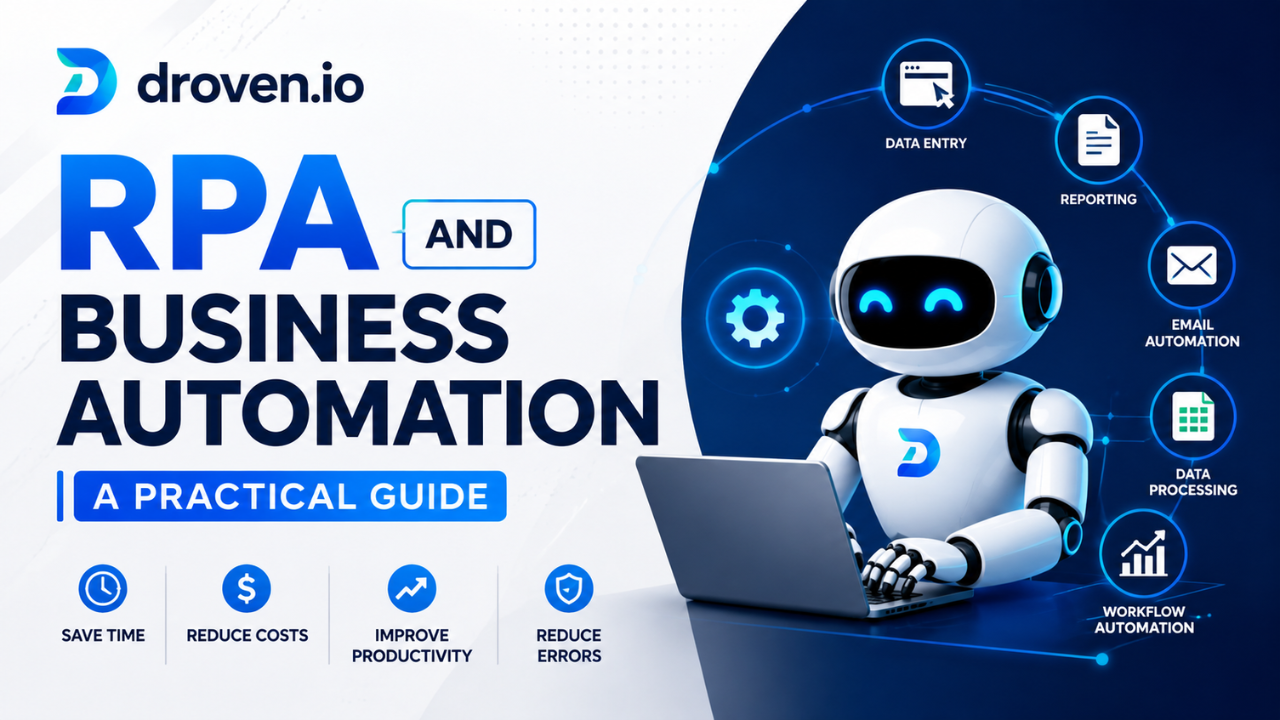
Droven.io RPA and Business Automation: How It Simplifies Business Work
Business automation sounds complicated until you notice how much repetitive work happens inside an ordinary company every day. Someone copies customer details from an email into a spreadsheet. Another employee downloads invoices, renames files, and uploads them to an accounting system. A manager spends Friday afternoon combining numbers from several reports.
None of these jobs is especially difficult. They’re simply repetitive.
That’s where Droven.io RPA and business automation becomes useful as a topic for companies looking to simplify operations, reduce manual work, and make everyday processes more reliable. Robotic Process Automation, usually shortened to RPA, allows software robots to handle predictable digital tasks that people would otherwise perform manually.
Think about an employee processing 300 identical order confirmations every morning. If the steps barely change, having someone click through the same screens hundreds of times isn’t a great use of their time. Automation can take care of that routine while the employee handles exceptions, customers, and decisions that actually require judgment.
Table of Contents
- What RPA and Business Automation Actually Mean
- Why Businesses Are Automating Repetitive Work
- Where RPA Makes the Biggest Difference
- A Simple Real-World Automation Example
- RPA and Traditional Business Automation Are Different
- Choosing the Right Processes to Automate
- What Can Go Wrong With Business Automation
- Measuring Whether Automation Is Actually Working
- Why People Still Matter in Automated Businesses
- Where Business Automation Is Heading
- Final Thoughts on Droven.io RPA and Business Automation
What RPA and Business Automation Actually Mean
RPA is software designed to imitate actions a person performs on a computer.
An automation bot might open a website, log into an account, copy information, paste it into another application, generate a report, rename a document, or send a notification when something changes.
The important part is that the task follows recognizable rules.
Suppose an online retailer receives supplier invoices through email. An employee might normally download every attachment, find the invoice number, enter the total into accounting software, place the file into the correct folder, and mark the email as processed.
That workflow might take only three minutes.
But three minutes multiplied by 150 invoices becomes seven and a half hours.
Automating repetitive steps changes the calculation completely.
Business automation is the broader idea. It covers RPA but can also include automated workflows, software integrations, approval systems, scheduled reporting, customer notifications, inventory updates, and other processes that move work forward without constant manual involvement.
RPA is therefore one piece of a much bigger automation strategy.
Why Businesses Are Automating Repetitive Work
Cost matters, of course, but saving money isn’t always the biggest benefit.
Consistency can be even more valuable.
People get interrupted. They misread numbers. They forget to update fields. Someone receives a phone call halfway through processing an order and accidentally skips a step.
A correctly configured automation follows the same instructions every time.
Consider a property management company receiving dozens of rental applications. Staff might need to create applicant records, organize documents, send confirmation emails, and notify the correct manager.
None of those steps requires much creativity.
Automating them means applications move through the system faster, while staff spend more time speaking with applicants and handling unusual situations.
Speed improves too.
A task that takes a person several minutes might take software only seconds. When thousands of transactions are involved, those small savings become significant.
There’s another advantage that often gets overlooked: employees usually don’t enjoy repetitive copying and clicking.
Removing tedious work can make a role more interesting without eliminating the person doing it.
Where RPA Makes the Biggest Difference
RPA works best where rules are clear and repetition is high.
Finance teams are a common example. They deal with invoices, transaction records, payment confirmations, reconciliations, and regular reports. Many processes follow predictable patterns.
Human resources teams also handle repetitive administration.
A new employee joins the company. Accounts need to be created. Documents need to be stored. Payroll information must be entered. Managers need notifications. Welcome emails must be sent.
One new hire isn’t much work.
One hundred new hires are.
Customer service operations can benefit as well. Automation can categorize requests, update customer records, collect information from different systems, and route cases to the right person before an agent even opens the ticket.
Sales departments have similar opportunities.
Imagine a sales representative receiving leads through a website form. Instead of manually copying every lead into a CRM, automation can create the contact, assign the correct sales rep, record the source, and schedule a follow-up task.
The salesperson starts with a ready-to-work lead rather than five minutes of administration.
A Simple Real-World Automation Example
Picture a small logistics company.
Every morning, one employee receives shipping reports from several partners. The employee downloads spreadsheets, checks tracking numbers, updates an internal dashboard, identifies delayed shipments, and emails account managers about problems.
It works.
But it takes two hours every morning.
A basic automation could download the reports, extract the relevant fields, compare delivery statuses, update the dashboard, and create a list of shipments requiring attention.
The employee arrives and sees 14 exceptions instead of reviewing 600 normal shipments.
That difference explains the real purpose of automation.
Automation shouldn’t simply replace activity. Droven.io RPA and Business Automation: How It Simplifies Business Work
RPA and Traditional Business Automation Are Different
These terms are often treated as interchangeable, but there’s an important difference.
Traditional automation usually depends on systems being directly connected. Software developers might use APIs or built-in integrations so one application can exchange information with another.
RPA can often work through the same interface a human uses.
If a company relies on old software with limited integration options, an RPA bot may still be able to open the application, enter information, click buttons, and retrieve results.
That flexibility is one reason RPA became attractive to organizations running a mixture of modern and legacy systems.
Still, RPA shouldn’t automatically be the first choice for everything.
If two applications already offer a reliable direct integration, connecting them properly may be cleaner than having software imitate mouse clicks.
Good automation starts with the process, not the tool.
Choosing the Right Processes to Automate
Here’s the thing: not every repetitive job deserves automation.
Sometimes businesses get excited and try to automate complicated processes before fixing obvious problems inside them.
That usually creates a faster version of a bad workflow.
A better starting point is asking a few simple questions.
Does the task happen frequently? Are the rules consistent? Does the work involve structured information? Are mistakes expensive or annoying? Does the process consume enough staff time to justify changing it?
Tasks meeting several of those conditions are usually stronger automation candidates.
Invoice processing might make sense.
Deciding whether an angry customer deserves a refund probably requires more judgment.
Companies should also examine exceptions.
Suppose 95% of incoming orders follow the same pattern while 5% require special handling. Automating the predictable 95% and sending the remaining cases to staff can work beautifully.
Trying to design automation for every imaginable situation may create more complexity than value.
What Can Go Wrong With Business Automation
Automation isn’t magic.
Poorly designed automation can create mistakes faster than people ever could.
Imagine a bot that copies pricing data from one system into another. If the original format suddenly changes and nobody notices, hundreds of incorrect records could be created.
Monitoring matters.
Processes also change over time. Websites update layouts. Software interfaces move buttons. Companies change approval rules. Forms gain new fields.
An automation that worked perfectly six months ago might eventually require adjustment.
Security deserves attention too.
Automation systems may access customer information, financial systems, employee records, or internal business tools. Access should be limited to what the automated process actually needs.
There’s also a surprisingly common problem: automating something nobody needs anymore.
A company might spend weeks improving a report only to discover that half the managers receiving it never open it.
Before automating a process, ask whether the process should exist at all.
Measuring Whether Automation Is Actually Working
A successful automation project should produce measurable improvements.
Time saved is the obvious metric.
If a process previously required 40 staff hours each month and now requires five hours of exception handling, the benefit is easy to understand.
Error rates are equally useful.
Perhaps employees previously made 12 data-entry corrections each week. After automation, that drops to one.
Processing speed can also reveal value.
A customer onboarding process that once took two days might finish routine setup within minutes.
But numbers don’t tell the whole story.
Ask employees whether their workload improved. Ask customers whether responses became faster. Check whether managers now have better visibility into operations.
Sometimes the biggest benefit isn’t reducing cost.
It’s removing a bottleneck that used to slow everything else down.
Why People Still Matter in Automated Businesses
There’s a tendency to imagine automation as humans on one side and software on the other.
Real businesses don’t work that neatly.
Automation is strongest when each side handles what it does well.
Software is good at repetition, consistency, structured rules, and working through large volumes of data without getting bored.
People are better at negotiation, unusual situations, creative decisions, empathy, relationship building, and understanding context.
Take customer support.
Automatically collecting order details before an agent joins the conversation makes sense.
Automatically treating every frustrated customer according to the same rigid rule probably doesn’t.
The smartest approach is often a partnership: machines handle predictable steps while people handle meaning.
Where Business Automation Is Heading
Businesses are gradually moving from isolated automation toward connected workflows.
Instead of automating one task, companies are looking at entire processes.
A customer places an order. Inventory changes. Shipping documents are created. Finance records the transaction. The customer receives updates. Managers see the sale inside their reporting dashboard.
When those steps communicate properly, employees don’t need to push information manually from one department to another.
That’s the bigger opportunity behind business automation.
Small companies can benefit just as much as large ones.
A business doesn’t need thousands of employees before automation makes sense. Sometimes automating five annoying hours of administrative work each week is enough to justify the effort.
Start small.
Find one repetitive process that everyone complains about. Understand how it works. Remove unnecessary steps. Automate the predictable parts. Measure what changed.
Then move to the next opportunity.
Final Thoughts on Droven.io RPA and Business Automation
The practical value behind Droven.io RPA and business automation comes down to something simple: businesses shouldn’t spend valuable human time repeatedly moving information between screens when software can handle the predictable work.
The biggest wins usually don’t come from automating everything at once. They come from finding boring, high-volume tasks that follow clear rules and quietly consume hours every week.
Automate those first.
Keep people responsible for judgment, relationships, and unusual situations. Review automated workflows regularly, measure whether they’re actually helping, and don’t automate a broken process just because the technology exists.
Used thoughtfully, RPA and broader business automation can make everyday operations faster, cleaner, and considerably easier to manage.






One Comment