Data Lakehouse Architecture: A Practical Guide to Modern Data Management
Modern companies rarely have a shortage of data. The harder problem is figuring out where to put it, how to manage it, and how to make it useful without building a messy collection of disconnected systems.
For years, teams often had to choose between a data warehouse and a data lake. Warehouses offered structure and reliable analytics. Lakes offered flexibility and affordable storage for huge amounts of raw information. Both solved important problems, but neither was perfect.
That’s where data lakehouse architecture comes in.
A lakehouse tries to bring the strongest parts of those two approaches together. You get the flexibility of a data lake while adding many of the management, reliability, and performance features people expect from a warehouse.
It sounds simple on paper. What makes it interesting is how it actually works in practice.
Table of Contents
- What Is Data Lakehouse Architecture?
- Why Companies Started Looking Beyond Data Lakes and Warehouses
- How Data Lakehouse Architecture Works
- The Main Layers of a Data Lakehouse
- Why the Lakehouse Model Is Useful
- Data Lakehouse vs Data Warehouse
- Data Lakehouse vs Data Lake
- Where Data Lakehouses Work Well
- Challenges You Should Expect
- How to Approach a Lakehouse Project
- The Bigger Picture
What Is Data Lakehouse Architecture?
Data lakehouse architecture is a data management approach that combines characteristics of traditional data lakes and data warehouses within one broader platform.
A data lake can hold enormous amounts of structured, semi-structured, and unstructured data. That might include customer records, application logs, images, sensor information, JSON files, and transaction histories.
The problem is that a lake can become difficult to manage when everything gets dumped into it without enough structure.
A data warehouse sits at the other end of the spectrum. Data is normally cleaned, transformed, organized, and prepared before analysts use it.
A lakehouse attempts to keep the open and flexible storage model of a lake while introducing stronger controls for things such as transactions, schema management, governance, metadata, and analytics.
Think of a company collecting information from its website, mobile application, stores, and customer support system.
Instead of maintaining one storage environment for raw data and another completely separate environment for business reporting, the company can build a lakehouse where different workloads use the same underlying data more efficiently.
That reduced duplication is one of the biggest attractions.
Why Companies Started Looking Beyond Data Lakes and Warehouses
The traditional approach often creates more movement than people expect.
Imagine an online retailer collecting millions of events every day. Its data lake receives page views, searches, purchases, returns, product information, and application logs.
The analytics team wants a clean dashboard showing daily revenue.
Raw data from the lake may therefore need to be copied into a warehouse, cleaned, transformed, and organized before the dashboard can use it.
Now the data exists in multiple places.
Different copies can fall out of sync. Storage costs increase. Data pipelines become more complicated. Engineers spend time maintaining movement between systems rather than improving the data itself.
A warehouse-only strategy has its own limitations.
Warehouses are excellent for structured analytical workloads, but companies increasingly deal with information that doesn’t arrive as neat rows and columns. Forcing every type of data into a traditional warehouse structure can become expensive or unnecessarily restrictive.
The lakehouse idea grew from a fairly practical question:
Why maintain completely separate worlds if some of their capabilities can exist together?
How Data Lakehouse Architecture Works
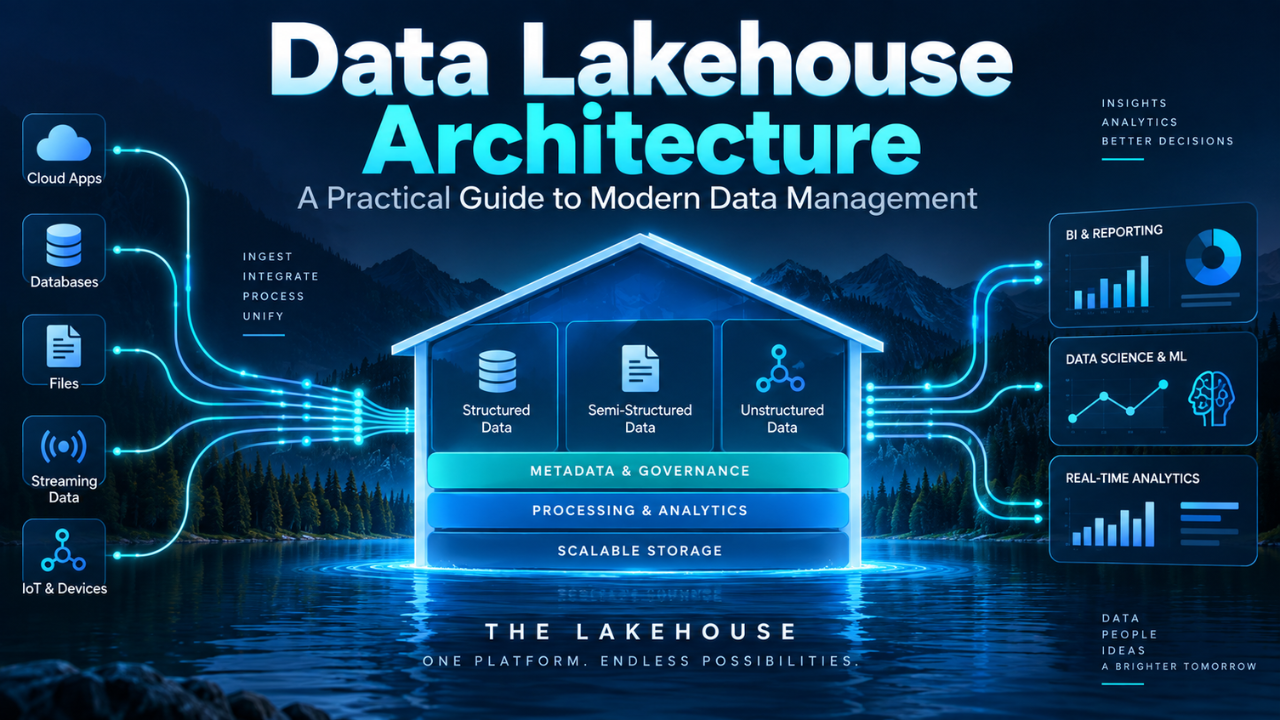
A lakehouse usually keeps data in scalable object storage or another distributed storage environment.
Instead of treating those files as an uncontrolled collection, the platform adds a management layer around them.
That layer can keep track of tables, schemas, file versions, transactions, and metadata. Query engines and processing systems can then work with the stored information through a more reliable structure.
Suppose a payment record gets updated while another process is reading the same table.
In a poorly controlled environment, concurrent changes can potentially produce inconsistent results. Modern lakehouse technologies commonly introduce transactional controls designed to make these operations safer.
The same stored data can then support several types of work.
A finance analyst may run SQL queries against sales tables. A data engineer may process large event datasets. Another team may use historical information for forecasting.
They don’t necessarily need separate copies of every dataset for each job.
The Main Layers of a Data Lakehouse
Implementations differ, but most lakehouse environments contain a few recognizable pieces.
Storage and Data Management
At the bottom sits the storage layer.
This is where raw and processed information actually lives. Cloud object storage is popular because it can scale to enormous volumes while separating storage from compute resources.
On top of storage sits a table or data-management layer.
This is particularly important.
It provides structure around files and can support features such as schema enforcement, transaction management, table history, metadata tracking, and controlled updates.
Without this layer, you may simply have a data lake rather than a true lakehouse-style environment.
Processing, Governance, and Access
Compute engines sit above the stored data and perform jobs such as transformation, querying, streaming, and analytics.
Because compute and storage can be separated, organizations may scale processing power without automatically expanding storage at the same rate.
Governance also matters.
Companies need to know who can see a particular dataset, where information came from, how it changed, and whether sensitive fields should be restricted.
Finally, users need ways to access everything.
That could mean business intelligence dashboards, SQL tools, notebooks, reporting applications, APIs, or operational systems.
The goal isn’t to create one giant tool that does absolutely everything. It’s to create an architecture where those tools can work against a more consistent foundation.
Why the Lakehouse Model Is Useful
One practical advantage is reducing unnecessary data copies.
If analytics and other processing workloads can use the same reliable underlying tables, teams don’t have to move information between systems every time a new requirement appears.
That can simplify architecture considerably.
Flexibility is another reason companies explore lakehouses. Businesses rarely collect only relational data anymore. Web logs, documents, event streams, application telemetry, images, and traditional tables can all be part of the same data environment.
Then there’s scalability.
Separating storage and computing allows organizations to adjust resources according to the workload. A reporting team running heavy end-of-month analysis might temporarily need far more compute power than it uses on an ordinary Tuesday.
Open data formats can also reduce dependence on a single processing engine.
That matters more than it initially sounds.
Data often survives longer than the software used to analyze it. Keeping information in broadly accessible formats gives organizations more room to change tools later.
Data Lakehouse vs Data Warehouse
A data warehouse remains a strong option when the main requirement is highly structured business analytics.
If a company primarily needs dependable dashboards based on well-defined financial, sales, and operational tables, a traditional warehouse may be perfectly suitable.
There’s no prize for making an architecture more complicated than necessary.
A lakehouse becomes more interesting when the organization has diverse data, large volumes, multiple processing workloads, or frequent movement between lakes and warehouses.
The difference isn’t simply “old technology versus new technology.”
It’s about workload.
Warehouses usually emphasize structured analytical data and tightly controlled schemas. Lakehouses generally provide more flexibility around the types of information being stored while still trying to deliver warehouse-like reliability.
Data Lakehouse vs Data Lake
A data lake focuses heavily on flexible, scalable storage.
You can place almost anything inside it.
That freedom is useful, but it can become dangerous when governance and organization are weak. A poorly managed lake may eventually contain thousands of files that nobody fully understands.
Someone finds a folder called customer_final_v2_new.
Is that the current customer dataset?
Maybe.
Or perhaps another engineer created customer_final_v3_REAL six months later.
It sounds silly until you’ve worked around enough shared data folders.
A lakehouse adds stronger table management, metadata, governance, and transactional features to prevent that kind of environment from becoming unmanageable.
The storage remains flexible, but the information sitting on top of it becomes easier to trust and use.
Where Data Lakehouses Work Well
Large digital businesses are an obvious fit because they often generate many different forms of information.
An e-commerce platform, for instance, could store website events, customer transactions, product information, inventory updates, marketing activity, and delivery records within the same broader environment.
Financial companies may combine transactional information with historical records and application events.
Manufacturing businesses can bring together equipment sensor readings, maintenance records, production statistics, and supply chain information.
Media companies might manage viewing activity alongside content metadata and subscriber records.
Even smaller organizations can benefit, although scale matters.
If your entire reporting environment consists of a handful of relational tables and three dashboards, building a sophisticated lakehouse might solve problems you don’t actually have.
Challenges You Should Expect
Lakehouse architecture isn’t a magic cleanup button.
The technology can provide better tools for governance, but somebody still has to establish governance rules.
Data quality remains a human and organizational responsibility.
If five departments define an “active customer” differently, moving their information into the same storage platform won’t suddenly make those definitions agree.
Skills can also become a challenge.
Teams may need to understand distributed processing, object storage, table formats, access control, query optimization, orchestration, and monitoring.
Costs require attention too.
Flexible cloud infrastructure makes scaling easy. Sometimes a little too easy. Poorly optimized queries or constantly running compute resources can quietly create large bills.
Architecture has to be operated well, not merely designed well.
How to Approach a Lakehouse Project
Starting with technology is tempting.
A team sees a new platform, creates an enormous migration plan, and starts moving everything before deciding exactly what problem the migration should solve.
A better starting point is the workload.
Look at where data currently lives. Identify which datasets are repeatedly copied between systems. Find pipelines that are difficult to maintain. Check whether different teams are using conflicting versions of the same information.
Those problems tell you where a lakehouse could provide genuine value.
Then start with a focused use case.
Perhaps your company keeps web activity in a lake but copies it into another system every night for reporting. That pipeline could be a useful candidate for testing a more unified architecture.
Measure the result.
Did the new approach reduce pipeline complexity? Are queries fast enough? Can analysts actually use the tables? Is governance easier? What happened to infrastructure costs?
Real answers from one production workload are worth far more than an impressive architecture diagram.
The Bigger Picture
Data lakehouse architecture reflects a wider change in how companies think about data platforms.
Organizations increasingly want fewer isolated systems, less unnecessary data movement, and more freedom to run different workloads against trusted information.
A lakehouse can help create that foundation by combining flexible storage with stronger data management and analytical capabilities.
Still, the architecture should serve the business rather than become the business.
If your current warehouse handles everything comfortably, there may be little reason to replace it. If your data lake has become difficult to govern while teams constantly copy information into separate analytical platforms, the lakehouse approach becomes much more compelling.
The useful question isn’t whether every company needs a data lakehouse.
It’s whether bringing storage, management, and analytics closer together can remove real complexity from your data environment. When the answer is yes, a lakehouse can be a very practical next step.