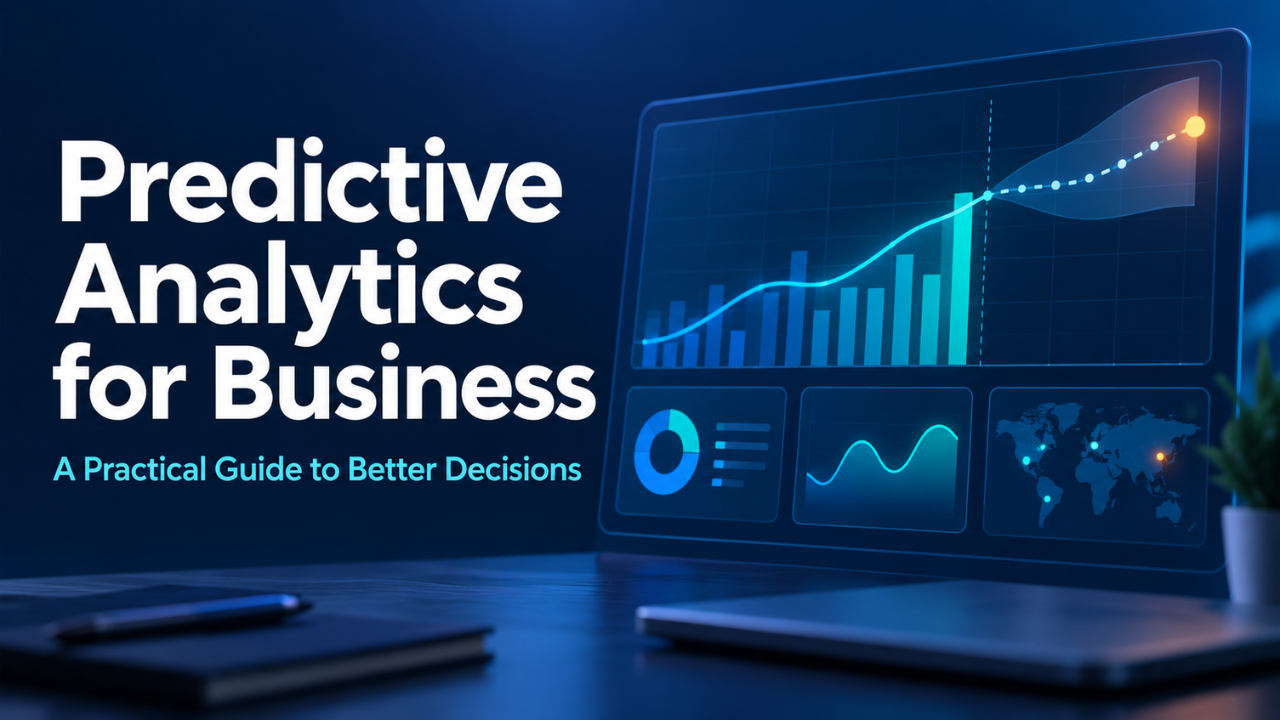
Predictive Analytics for Business: A Practical Guide to Better Decisions
A busy shop can still lose money. The shelves are full, customers are buying, and the team is working hard. Yet popular products keep selling out while slow sellers gather dust.
The problem isn’t always effort. Sometimes, it’s knowing what’s likely to happen next.
Predictive analytics for business helps companies use their existing data to make better forecasts. That might mean estimating next month’s sales, spotting customers who could leave, or preparing for a rise in demand before it arrives.
You don’t need a perfect view of the future to make this useful. You need enough warning to make a better decision while there’s still time to act.
Table of Contents
- What Predictive Analytics Actually Tells You
- Start With a Decision Worth Improving
- Where Predictions Help in Everyday Business
- Good Forecasts Start With Reliable Data
- How a Prediction Becomes Something You Can Use
- Check Whether the Forecast Deserves Your Trust
- Put Predictions Into the Working Day
- Start Small and Keep Learning
What Predictive Analytics Actually Tells You
Predictive analytics uses historical and current data to estimate future outcomes. It looks for patterns that may help explain what’s likely to happen next. IBM describes this approach as combining historical data with statistical modeling and other analytical techniques. Source: IBM
That difference matters because it changes the conversation. Instead of asking only, “What went wrong?” a manager can ask, “What should we prepare for?”
The output might be a sales estimate, a likely delivery date, or a probability that a customer will cancel.
None of these is a promise.
A customer with a high cancellation score may renew. A product expected to sell well may disappoint. Predictions describe uncertainty using evidence; they don’t remove it.
That’s why a useful forecast should support judgment rather than become something everyone follows without question.
Start With a Decision Worth Improving
It’s tempting to begin with software. There are dashboards to explore, features to compare, and impressive demonstrations to watch.
I’d start somewhere less exciting: a recurring decision that costs money when you get it wrong.
For a bakery, that could be how much bread to make each morning. For a service business, it might be how many people to schedule next week. An online store might want to know which products need reordering before a supplier’s deadline.
Make the question specific.
“How can we understand our customers?” is too broad to guide a useful first project. “Which customers are most likely to stop placing orders over the next 60 days?” gives the work a clear target.
Then ask what you’d do with the answer.
If nobody can act on a prediction, even an accurate one has limited value. A forecast becomes useful when it changes a purchase, a schedule, a conversation, or another real decision.
Where Predictions Help in Everyday Business
Inventory is an easy place to see the value. Imagine a small clothing retailer preparing for cooler weather. Last year’s sales offer a starting point, but recent demand, planned promotions, and supplier lead times also matter.
A demand forecast can help the buyer adjust quantities before placing an order. The aim is to balance product availability against the cost of holding stock.
Customer retention offers another practical use. Suppose a subscription business notices that some customers are logging in less often and leaving support issues unresolved. Those patterns may help identify accounts worth checking on.
The right response isn’t automatically a discount. A customer struggling with setup may need help, while someone who no longer needs the service may have little reason to stay.
Staff planning works similarly. A café could use past orders, weekday patterns, and known local events to estimate busy periods. That gives the manager a better starting point for shifts.
Across these examples, the benefit is preparation. The prediction creates time to respond before a small issue becomes an expensive one.
Good Forecasts Start With Reliable Data
Here’s the thing: a polished dashboard can hide messy records.
If the same customer appears under three names, their purchase history may look incomplete. If refunds aren’t recorded properly, sales may look stronger than they were.
Before building a forecast, check what your data actually represents.
Dates should follow a consistent format. Product codes should refer to the same items across systems. Missing values need attention, especially when “not recorded” could be mistaken for zero.
Context matters too. Picture a store that sold only five umbrellas during a rainy week because it ran out on Monday. A model using sales alone could mistake limited stock for weak demand.
There’s no universal minimum amount of data that makes every prediction reliable. The amount you need depends on the question, how often events occur, and how much conditions vary. Seasonal forecasting needs enough history to reveal the relevant seasonal patterns.
Collect what helps answer the business question, and limit access to customer information to people who need it.
How a Prediction Becomes Something You Can Use
A predictive model is a method for connecting available information with an outcome you want to estimate.
For sales forecasting, it might examine how orders change over time. For customer cancellation, it might compare earlier customer behavior with whether those customers eventually left.
Different questions need different approaches. Estimating next week’s order volume is different from estimating whether a particular account will renew.
The basic workflow is straightforward: define the outcome, prepare relevant records, build the model, and test its predictions against outcomes it hasn’t already seen.
One detail deserves special attention. The model should use only information that would have been available when the prediction was made.
For example, a cancellation forecast mustn’t rely on a cancellation confirmation recorded afterward. That would make its test performance look impressive without helping anyone predict the future.
The final result should also be easy to interpret. “Expected demand is around 200 units, with a plausible range of 170 to 235” offers more planning context than an unexplained number.
Check Whether the Forecast Deserves Your Trust
A complicated model should earn its place.
Compare it with a simple starting point, such as last week’s sales or the same month last year. If the new approach doesn’t improve on that baseline, investigate before investing more.
For forecasts over time, test on later periods using earlier information. This better reflects the situation the business will face when making real predictions.
Now, accuracy alone isn’t enough. Different mistakes have different costs.
Underestimating demand for fresh sandwiches might mean missed sales. Overestimating it might mean food waste. The best ordering decision depends on both consequences.
Customer risk scores need similar care. Suppose only five out of every hundred customers cancel. A system that predicts nobody will cancel is technically correct 95% of the time, but it identifies none of the customers you wanted to help.
Ask whether the forecast finds useful cases, how often it raises false alarms, and whether acting on it improves results. A strong headline percentage doesn’t answer those questions.
Put Predictions Into the Working Day
Even good forecasts can sit unopened in a report.
Someone needs to own the next step. If demand is expected to rise, who reviews the stock order? If an account looks likely to leave, who checks its history and contacts the customer?
The prediction should arrive before the decision deadline, in a place the responsible person already uses.
A weekly staffing forecast belongs in the scheduling process. A product demand estimate should be available when purchasing decisions happen. Timing is part of usefulness.
Give people room to add context. A sales manager may know that a large customer has delayed a project, even though the change hasn’t reached the reporting system.
Record those adjustments and their reasons. Over time, you can see when human input improved the forecast and when it didn’t.
Also, separate predicting an outcome from proving that an action works. Identifying customers likely to leave doesn’t prove that a discount will keep them. Test the response itself where practical.
Start Small and Keep Learning
A sensible first project has a narrow question, usable data, and someone ready to act.
Choose one product category, one location, or one customer group. Define success before starting. That could mean fewer stockouts, less waste, or better staffing coverage, depending on the problem.
Track the business result alongside prediction quality. Include the cost of maintaining the system and the time employees spend responding to it.
Keep reviewing performance after launch. Customer habits change. Prices move. Suppliers become less reliable. A forecast that worked well six months ago may need adjustment today.
Predictive analytics for business is most useful when it becomes a habit of making informed decisions, checking the outcome, and learning from the gap. Start with one question that matters. Build a forecast you can test. Then use what you learn to make the next decision a little better.