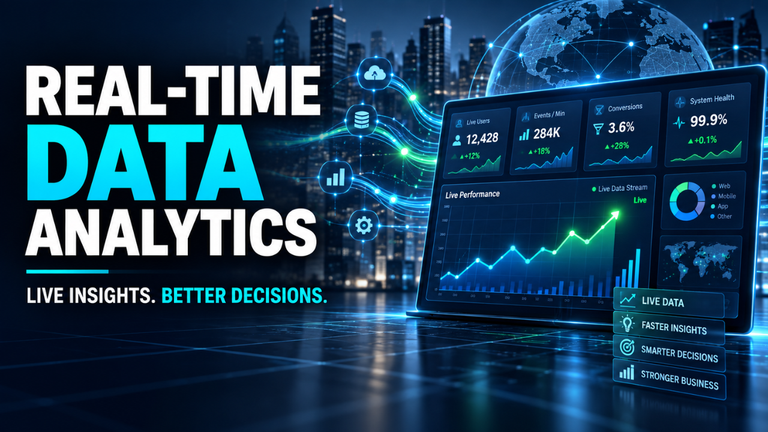
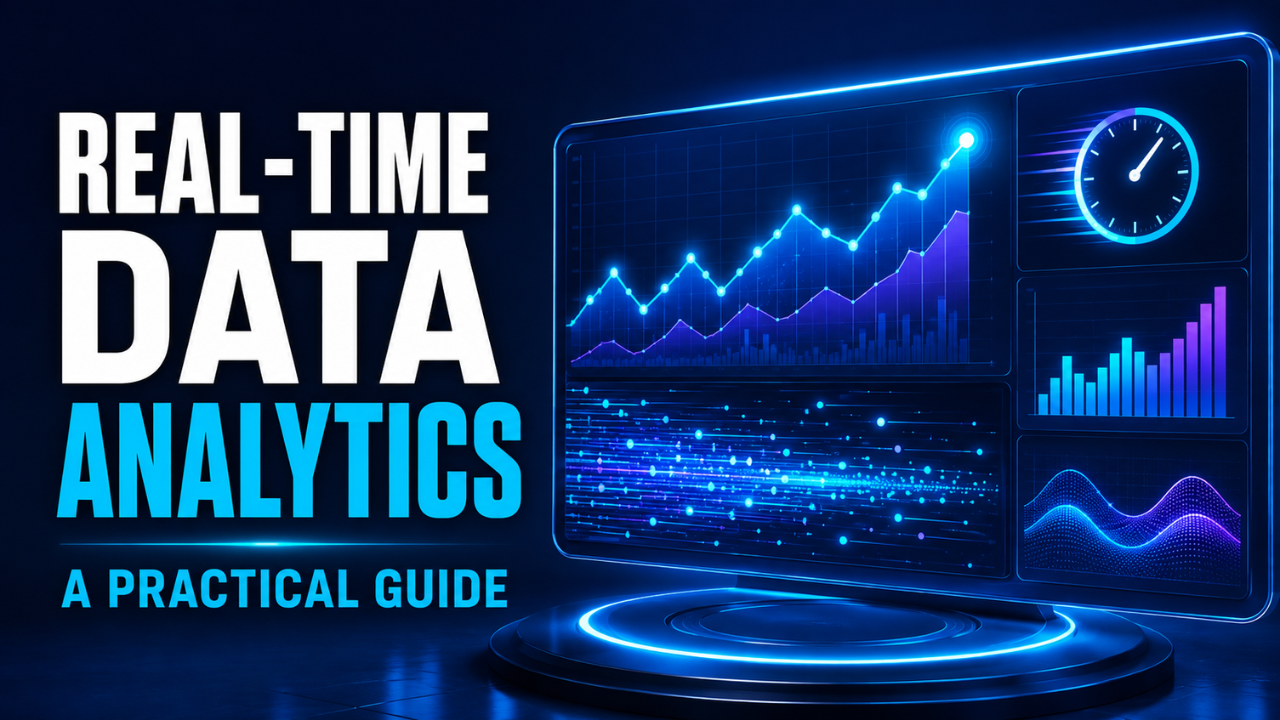
Real-Time Data Analytics: A Practical Guide
Most businesses don’t have a shortage of data. They have a timing problem.
A sales report may show that a product sold out yesterday, but that information can’t help the customers trying to buy it right now. A delivery company may discover a delayed route at the end of the day, long after drivers and customers have been affected. Traditional reports explain what happened. Real-time data analytics helps people respond while it’s still happening.
That speed changes how decisions are made. Instead of waiting for a weekly dashboard, teams can see important activity almost immediately and take action before a small issue grows into an expensive one.
Table of Contents
- What Real-Time Data Analytics Actually Means
- How Real-Time Analytics Works
- Real-Time Analytics vs. Traditional Analytics
- Where Real-Time Data Creates Real Value
- The Business Benefits That Matter Most
- Common Challenges and Hidden Costs
- How to Start Without Overcomplicating It
- Measuring Whether the System Is Working
- The Right Balance Between Speed and Judgment
- Final Takeaway
What Real-Time Data Analytics Actually Means
Real-time data analytics is the process of collecting, processing, and examining data as soon as it becomes available. The delay might be a few milliseconds, several seconds, or even a couple of minutes, depending on what the business needs.
The word “real-time” can be slightly misleading. It doesn’t always mean instant.
For a payment fraud system, a two-minute delay would be far too long. The transaction may already be complete by then. For a warehouse manager monitoring daily inventory movement, a delay of thirty seconds may be perfectly acceptable.
What matters is whether the information arrives quickly enough to support the decision.
Imagine a supermarket tracking freezer temperatures. A traditional report might reveal on Monday morning that a freezer became too warm during the weekend. By then, the food may need to be thrown away. A real-time monitoring system can detect the temperature change immediately and alert an employee before the stock is damaged.
That’s the practical difference. The data becomes useful while there’s still time to act.
How Real-Time Analytics Works
A real-time analytics system usually begins with a continuous source of information. That source could be a website, mobile application, payment platform, factory sensor, delivery vehicle, or customer support system.
Each action creates an event. A customer places an order. A machine begins to overheat. A driver changes direction. A card payment is attempted from an unusual location.
Those events move through a data stream rather than waiting to be gathered into one large batch. The system processes them, checks for meaningful patterns, and sends the results to a dashboard, notification service, or automated workflow.
Consider an online retailer during a major sale. Thousands of visitors are browsing, adding products to their carts, and completing purchases. A real-time system can track inventory as orders arrive. When stock becomes low, the website can update availability, the warehouse can receive a warning, and advertising for that item can be paused.
Several actions happen from the same flow of live data.
The technical setup can be complex behind the scenes, but the business idea is simple: capture events, understand them quickly, and deliver the result to the person or system that can do something useful with it.
Real-Time Analytics vs. Traditional Analytics
Traditional analytics usually works with historical data collected over a fixed period. A company may combine yesterday’s transactions overnight and display the results the next morning.
This approach is often called batch processing. It’s still valuable.
Monthly revenue analysis, annual planning, customer research, and long-term performance reviews rarely need second-by-second updates. In fact, a slower and more carefully prepared dataset may be more accurate for those purposes.
Real-time analytics serves a different need. It focuses on situations where the value of information drops quickly as it gets older.
A restaurant chain can use historical reports to decide which menu items should be removed next season. At the same time, it might use live order data to notice that one location is suddenly receiving far more delivery requests than its kitchen can handle.
Neither method replaces the other. Strong businesses normally use both. Historical analytics provides perspective, while real-time analytics supports immediate decisions.
Let’s be honest: making every report live would create unnecessary expense and noise. Speed matters only when someone can use it.
Where Real-Time Data Creates Real Value
Fraud detection is one of the clearest examples. Banks and payment platforms can examine transaction amount, location, device information, and recent account activity before approving a purchase. When something looks unusual, the system can request extra verification or temporarily block the payment.
Retail businesses use live analytics to follow inventory, website traffic, customer activity, and changing demand. If a product suddenly becomes popular, the retailer can adjust stock allocation before one warehouse runs empty while another holds unused units.
Healthcare teams may monitor patient readings from connected medical devices. A sudden change in heart rate, oxygen level, or blood pressure can trigger an alert. The goal isn’t simply to collect more medical data. It’s to help trained staff notice urgent changes sooner.
Manufacturers watch equipment performance in much the same way. Small changes in vibration or temperature may appear before a machine fails. Maintenance teams can inspect the equipment during a planned pause instead of dealing with an unexpected shutdown in the middle of production.
Logistics companies also rely on current information. Traffic conditions, weather, vehicle location, and delivery progress can all affect the best route. A route that looked efficient at 8 a.m. may become a terrible choice twenty minutes later.
In each case, timing creates the value.
The Business Benefits That Matter Most
Faster decisions are the obvious benefit, but speed alone isn’t enough. A rushed bad decision is still a bad decision. The real advantage comes from having relevant information at the moment a choice must be made.
Live visibility can also improve customer experience. Think about waiting for a food delivery. A vague message saying “your order is on the way” isn’t very helpful. Seeing the driver’s current location and estimated arrival time reduces uncertainty and makes delays easier to understand.
Operational problems can be caught earlier as well. A sudden drop in website checkouts might point to a broken payment page. Without real-time monitoring, the company could continue losing sales for hours before someone notices the problem in a report.
There’s also less dependence on guesswork. A call centre manager can see demand rising and move available staff before waiting times become unreasonable. A hotel can monitor booking patterns and adjust room availability while customer interest is still high.
The best results often come from small decisions made sooner, not dramatic decisions made faster.
Common Challenges and Hidden Costs
Real-time systems can become expensive because they must process information continuously. More events, more calculations, and more users usually require greater computing capacity.
Data quality presents another problem. If information arrives quickly but contains missing fields, duplicate records, or incorrect values, the system may produce misleading results at impressive speed.
False alerts are particularly frustrating. Suppose a factory sends a warning every time a machine’s temperature moves slightly above normal. Employees may respond carefully at first. After dozens of harmless alerts, they’ll start ignoring them. Eventually, a serious warning may receive the same treatment.
Privacy and security need attention too. Live systems may handle payment details, customer locations, medical readings, or account activity. Access should be limited, sensitive information should be protected, and retention rules should be clearly defined.
Then there’s the human side. A beautiful live dashboard achieves very little if nobody knows who should respond. Every important alert needs an owner, an expected action, and a sensible escalation process.
How to Start Without Overcomplicating It
Start with a decision, not a pile of data.
Ask what needs to happen faster. Maybe the business needs to detect failed payments, prevent inventory shortages, reduce delivery delays, or identify website problems. A specific operational question makes it easier to decide which data matters and how quickly it must arrive.
Next, define an acceptable delay. Does the result need to appear within one second, thirty seconds, or five minutes? Shorter delays usually require more complex and costly systems. There’s no prize for building millisecond performance when the team checks the dashboard every hour.
Choose one focused use case for the first project. A retailer might begin with low-stock alerts for its most valuable products rather than rebuilding the entire reporting system. That creates a manageable test and gives the team a clear result to measure.
It’s also worth planning the response before launching the alert. If stock falls below a set level, who receives the warning? Can that person transfer inventory, contact a supplier, or pause a campaign? Information without action is just another notification.
Once the first use case works reliably, the system can expand.
Measuring Whether the System Is Working
Technical speed matters, but business impact matters more.
A team should track how long data takes to move from the original event to the final result. It should also monitor missing events, processing errors, system availability, and the number of false alerts.
Those measurements show whether the technology is dependable. They don’t prove that it’s useful.
For that, look at the business outcome. Did fraud losses fall? Were outages detected sooner? Did fewer customers order unavailable products? Has equipment downtime decreased? Are deliveries arriving more consistently?
Imagine that a company cuts its alert time from five minutes to ten seconds, but employees still take two hours to respond. The faster system hasn’t fixed the real bottleneck.
Measurement should cover the entire path from event to action, not just the dashboard.
The Right Balance Between Speed and Judgment
Real-time analytics can reveal what’s happening, but it doesn’t automatically explain why it’s happening.
A sudden rise in product returns might signal a quality problem. It could also come from a temporary shipping issue, confusing product information, or a change in customer behaviour. Live data points people toward the issue. Good judgment and deeper analysis are still needed to understand it.
That balance matters. Use real-time information for urgent awareness and immediate operational decisions. Use historical analysis for context, trends, and careful planning.
Real-Time Data Analytics works best when speed has a purpose. The goal isn’t to watch every number move. It’s to notice the few changes that require attention, deliver them to the right people, and make action easier. Start with one decision that currently arrives too late. Fixing that delay can be far more valuable than building the most impressive live dashboard in the room.