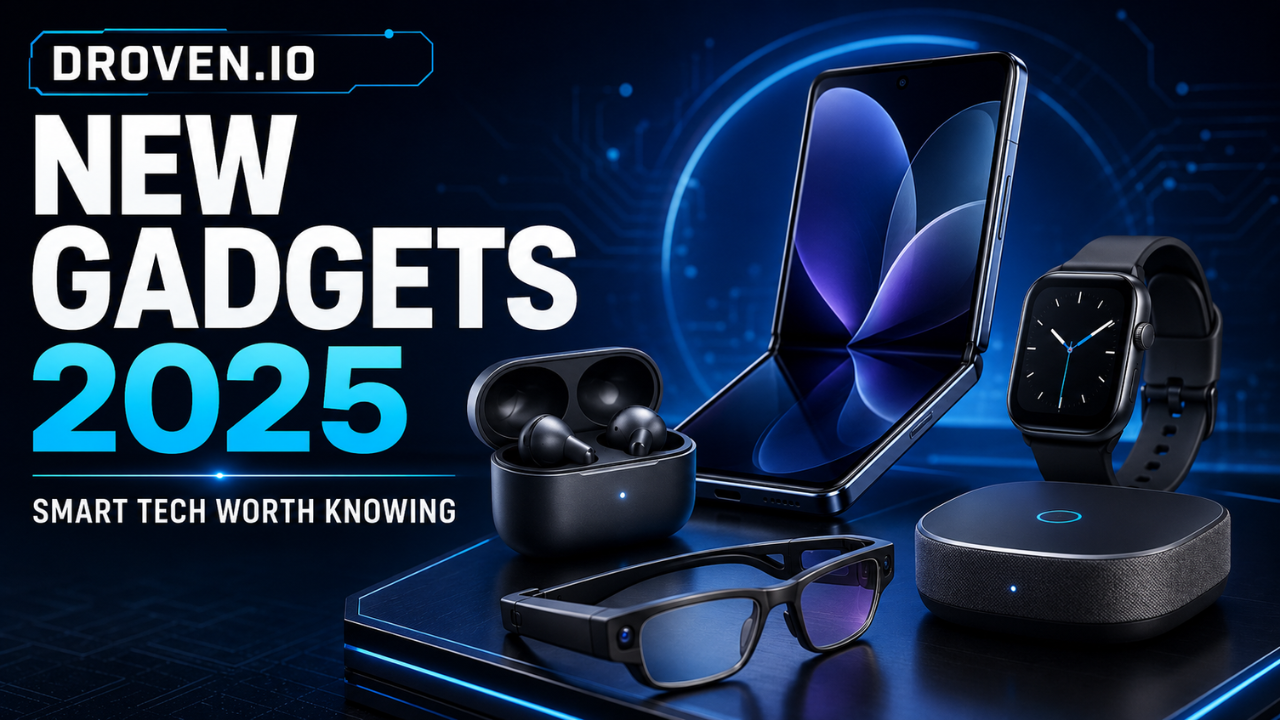
Droven.io New Gadgets 2025: Smart Tech Worth Knowing
New gadgets arrive every year with big promises. They’ll save time, improve health, protect the home, or make work feel effortless. Yet after the excitement fades, many of them end up sitting unused in a drawer.
The more interesting story behind droven.io new gadgets 2025 isn’t simply that devices became faster. It’s that technology started fitting more naturally into everyday life. Wearables became less distracting, smart-home products handled more tasks automatically, and portable devices offered abilities that once required a full desktop setup.
That doesn’t mean every new release deserves your money. Some gadgets solve real problems. Others add another screen, subscription, or charging cable to your routine. Knowing the difference matters.
Table of Contents
- Why 2025 Gadgets Felt More Practical
- Wearables Moved Beyond Basic Fitness Tracking
- Smart Homes Became More Independent
- Foldable Devices Found a Clearer Purpose
- Portable Entertainment Became More Flexible
- Smart Kitchen Gadgets Focused on Useful Automation
- Personal Security Technology Improved
- Sustainability Became Part of Gadget Design
- Privacy and Compatibility Still Matter
- How to Choose a Gadget You’ll Actually Use
- What the 2025 Gadget Wave Tells Us
Why 2025 Gadgets Felt More Practical
Earlier generations of smart products often felt like experiments. A connected appliance might perform one clever trick, but setting it up could take longer than doing the task yourself. Some devices also depended heavily on apps that were slow, confusing, or quickly abandoned.
Many gadgets released or improved during 2025 took a more practical direction. Manufacturers focused on longer battery life, easier controls, stronger connections, and better cooperation between devices. These changes sound less exciting than a futuristic product launch, but they make a much bigger difference in daily use.
Imagine arriving home with grocery bags in both hands. Your lights turn on, the door locks behind you, and the thermostat has already adjusted the temperature. You haven’t issued three separate voice commands. The system responds to a routine you created earlier.
That kind of quiet automation became a defining idea in 2025. Good technology started asking for less attention rather than demanding more of it.
Wearables Moved Beyond Basic Fitness Tracking
Counting steps is useful, but it’s no longer enough to make a wearable stand out. Newer watches, smart rings, and health trackers paid greater attention to sleep, recovery, stress, heart rate patterns, and general wellness.
Smart rings became particularly interesting because they offered health tracking in a smaller, less distracting form. A ring doesn’t light up every few minutes with emails and social notifications. For someone who wants sleep or activity data without carrying another small screen, that simplicity has real appeal.
Consider a person who exercises four times a week but always feels tired on Friday. A wearable may reveal that the problem isn’t the workout plan. Their sleep has been shorter and less consistent on Wednesday and Thursday nights. That information can help them adjust their habits instead of simply training harder.
Still, health gadgets need to be treated sensibly. Consumer wearables can highlight patterns, but they don’t automatically provide a medical diagnosis. Accuracy can vary depending on the device, how it’s worn, and the type of measurement being taken.
The useful question isn’t whether a tracker collects a huge amount of data. It’s whether that data helps you make a better decision.
Smart Homes Became More Independent
Smart-home technology continued moving away from isolated devices and toward connected systems. Lights, cameras, speakers, locks, thermostats, sensors, and appliances increasingly worked as parts of a larger setup.
Better automation was one of the most noticeable improvements. Motion sensors could do more than switch on a light. A system might detect movement after dark, brighten a hallway, adjust nearby cameras, and send an alert if the activity happens while everyone is away.
Energy management also became more important. Smart plugs and thermostats helped users identify devices that consumed power unnecessarily. Automated blinds, lighting schedules, and room-based temperature controls offered additional ways to reduce waste.
Here’s the thing: a smart home should still work when the internet has a bad day. Basic controls such as switches, locks, and alarms shouldn’t become useless because a cloud service is temporarily unavailable.
Before buying any connected home product, it’s worth checking whether it supports local controls, established smart-home standards, and the platform you already use. Compatibility is far more valuable than one flashy feature.
Foldable Devices Found a Clearer Purpose
Foldable phones originally attracted attention because they looked unusual. By 2025, their purpose had become easier to understand.
Book-style foldables offered additional room for reading, multitasking, gaming, and document editing. A user could keep a video call open on one side of the display while viewing notes on the other. Flip-style models took the opposite approach by making a regular smartphone easier to carry.
Flexible screens also appeared in laptops and hybrid devices. These designs allowed one piece of hardware to act as a tablet, portable monitor, reading device, or compact workstation.
Of course, foldables still involve compromises. They can cost more than conventional devices, and repairs may be expensive. Hinges, screen protectors, dust resistance, and long-term durability deserve close attention.
Buying one only because it folds probably isn’t a great decision. Buying one because the larger screen replaces a second device can make much more sense.
Portable Entertainment Became More Flexible
Entertainment gadgets grew more portable without giving up as much performance. Handheld gaming systems, compact projectors, wireless displays, and improved earbuds allowed people to create a surprisingly capable entertainment setup almost anywhere.
A small projector, for example, can turn a plain bedroom wall into a movie screen. It may also work for business presentations or family photo nights. That makes it more versatile than a television that stays permanently attached to one wall.
Handheld gaming devices followed a similar pattern. They appealed to people who wanted access to larger game libraries without remaining at a desk. Someone could play for 20 minutes during a commute, pause the game, and continue later from another location.
Battery life remains the key limitation. Powerful processors and bright screens consume energy quickly. Performance numbers may look impressive on a product page, but real battery tests usually tell you more about how enjoyable the device will be.
Smart Kitchen Gadgets Focused on Useful Automation
Connected kitchen appliances are easy to dismiss as unnecessary. Let’s be honest, nobody needs an internet connection just to make toast. But some smart kitchen tools became genuinely useful by improving timing, temperature control, and consistency.
Modern countertop cookers could adjust heat during different stages of a recipe. Smart ovens offered guided settings for common foods, while connected thermometers allowed users to monitor cooking temperatures from another room.
Picture preparing dinner while answering a work call. Instead of repeatedly checking the oven, you receive an alert when the food reaches the selected temperature. That’s a small convenience, but it solves a real problem.
The best kitchen gadgets support basic cooking skills rather than trying to replace them. They should also remain easy to clean and operate manually. If a product needs a complicated account setup before it can heat food, convenience has already been lost.
Personal Security Technology Improved
Safety-focused gadgets became smaller and more accessible during 2025. Smart doorbells, portable alarms, tracking tags, vehicle cameras, connected locks, and home sensors offered additional ways to monitor property and personal belongings.
Tracking devices proved useful for keys, luggage, backpacks, and other items that are frequently misplaced. During travel, a tracker can also help confirm whether checked luggage reached the correct airport.
Home cameras improved their ability to separate meaningful activity from harmless movement. A good system should distinguish between a person approaching the door and a tree moving in the wind. Fewer false alerts make users more likely to pay attention when something important happens.
Security products also create privacy responsibilities. Camera placement should respect neighbors and visitors. Recordings need proper protection, and users should understand whether video is stored locally or uploaded to a remote server.
More surveillance doesn’t automatically mean more safety. Thoughtful placement and secure settings matter just as much as the camera itself.
Sustainability Became Part of Gadget Design
Battery life and energy efficiency aren’t only environmental concerns. They also affect convenience and ownership costs.
Some 2025 gadgets used recycled materials, lower-power components, replaceable parts, or packaging with less plastic. Software support became another part of the sustainability conversation. A perfectly functional device shouldn’t become obsolete simply because its manufacturer stops providing security updates.
Repairability deserves attention too. Before spending heavily, check whether the battery can be replaced and whether repair services are available. A slightly more expensive product may offer better value if it lasts several additional years.
Marketing terms such as “green” or “eco-friendly” don’t provide enough information on their own. Specific details about materials, power use, repair programs, and expected software support are far more meaningful.
Privacy and Compatibility Still Matter
The droven.io new gadgets 2025 trend reflects a world filled with devices that can listen, watch, measure, and learn routines. That creates convenience, but it also produces personal data.
Before connecting a new gadget, check what information it collects and whether those permissions are necessary. A smart bulb shouldn’t need access to your contact list. A fitness tracker may require health data, but you should still know how that information is stored and shared.
Compatibility can create another headache. A device may work beautifully inside one ecosystem but poorly with products from another brand. Buyers should look beyond the phrase “smart compatible” and confirm exactly which platforms, phones, hubs, and wireless standards are supported.
Subscriptions also deserve investigation. Some gadgets hide useful functions behind monthly plans. Calculate the total cost over two or three years rather than looking only at the purchase price.
How to Choose a Gadget You’ll Actually Use
Start with the problem, not the product. What task do you want to make easier? If you can’t answer that clearly, the gadget may be interesting without being useful.
Think about how the device fits your existing routine. A wearable that requires daily charging won’t suit someone who regularly forgets to charge devices. An advanced smart-home hub may frustrate a person who only wants to control two lights.
Real-world reviews are more helpful than specification sheets. Pay attention to comments about setup, battery performance, app reliability, repairs, and customer support. Those details reveal what ownership feels like after the launch-day excitement disappears.
It’s also wise to wait. Early buyers often pay the highest price and discover the first software problems. A few weeks of patience can bring better reviews, important updates, and sometimes a worthwhile discount.
What the 2025 Gadget Wave Tells Us
The most valuable lesson from droven.io new gadgets 2025 is simple: useful innovation doesn’t always look dramatic. Sometimes it’s a battery that lasts longer, a device that works with products you already own, or an automation that quietly saves ten minutes every day.
Wearables, foldables, smart-home systems, portable entertainment devices, and connected kitchen tools all became more capable. Yet the smartest purchase is still the one that solves a genuine problem without creating three new ones.
New technology should fit into your life, protect your data, and remain useful after the novelty fades. If a gadget can do that, it deserves attention. If it can’t, leaving it on the shelf may be the most intelligent choice of all.